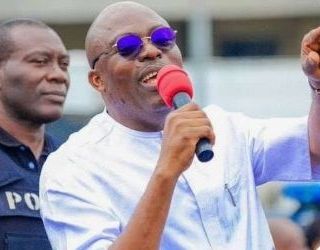
Political stakeholders across Rivers State have continued to react to reports that some elders of the African Democratic Congress (ADC) have purchased nomination and expression of interest forms for Governor Siminalayi Fubara, signaling early moves toward his re-election bid in the 2027 governorship election.
The development is already stirring conversations within the state’s political space, especially against the backdrop of the lingering political crisis that has shaped governance and party alignments in recent times.
A public affairs analyst, Opunabo Nko-Tariah, has expressed strong confidence in the governor’s chances, arguing that Fubara’s growing grassroots appeal and resilience in the face of political challenges position him favorably ahead of the next election cycle.
According to him, rather than weakening the governor, the prolonged political tension particularly his widely reported rift with the Minister of the Federal Capital Territory has significantly boosted his popularity among ordinary citizens.
“He is going to win because of the organic support he has built over time and the level of goodwill he enjoys among the people. Despite the hiccups occasioned by the political friction, he has remained focused and has delivered in key areas,” Nko-Tariah said.
He pointed to visible infrastructural projects, job creation efforts, and improvements in the welfare of civil servants as indicators of what he described as “creditable performance” within a relatively short period in office.
“If you look at the construction work going on across the state, the attention given to workers’ welfare, and other developmental strides, you will see that the administration is making progress. Of course, he may not have achieved everything expected, but considering the challenges he faced, especially in his early months in office, it is unrealistic to expect a perfect performance within four years.”
The analyst also dismissed arguments suggesting that political heavyweights from more populous local government areas such as Obio/Akpor and Port Harcourt City could pose a serious threat to the governor’s re-election.
“Even if you bring a candidate from Port Harcourt or Obio/Akpor, the governor still has the political strength and support base to win in those areas,” he added.
However, not all analysts share this optimism.A political scientist and lecturer at the University of Port Harcourt, Dr. Obinna Nwodim, offered a more measured perspective, emphasizing that electoral outcomes are ultimately determined by performance and voter perception rather than popularity alone.
He noted that while early political moves are expected in a democratic setting, the governor’s re-election bid will depend heavily on how convincingly he presents his achievements to the electorate.
“His chances are dependent on the electorate. At the end of the day, the people will assess his performance. There are other contenders already showing interest, including Tonye Cole, which means the race could be competitive,” Wodim stated.
He further explained that if Governor Fubara secures his party’s ticket, the burden will be on him to justify his first term with tangible results.
“If he emerges as the governorship candidate, he will present his scorecard to the people. The decision to re-elect him will be based on whether the electorate believes he has performed well enough to deserve another mandate. That is how democracy works.”
Dr. Nwodim also acknowledged that the governor has the constitutional right to seek re-election, describing the purchase of nomination forms by supporters as a normal political development at this stage of the electoral cycle.
Beyond performance and popularity, the political scientist raised concerns about the complex structure of political loyalties within the state, particularly at the local government level. He pointed out that a significant number of local government chairmen are aligned with the opposition All Progressives Congress (APC) and are believed to be loyal to the FCT Minister, a factor that could complicate campaign dynamics.
“There is no doubt that the governor has attracted sympathy and has built a support structure, including loyal political foot soldiers. However, the situation is quite complex. We have about 20 local government chairmen who are APC members and are aligned with the former governor. These individuals will be active during the campaign period,” he explained.
According to him, the divided political structure could create uncertainties in mobilization, coordination, and overall campaign effectiveness.
“Ideally, such structures should work in alignment with the sitting governor, but the current reality presents a different scenario. This makes the political environment unpredictable and could influence how the election eventually plays out.”
Political observers note that Rivers State remains one of the most politically strategic states in Nigeria, with its elections often shaped by strong personalities, party structures, and grassroots mobilization.
As early alignments and endorsements begin to emerge, analysts believe the coming months will be critical in determining the strength of alliances, the role of opposition figures, and the overall direction of the 2027 governorship race.
For now, the reported purchase of nomination forms by ADC elders has added a new dimension to the unfolding political narrative, signaling that the battle for Rivers State’s top seat may already be quietly taking shape.
By Nzeuzor Jane and Maduadugwo Jane. Port Harcourt.