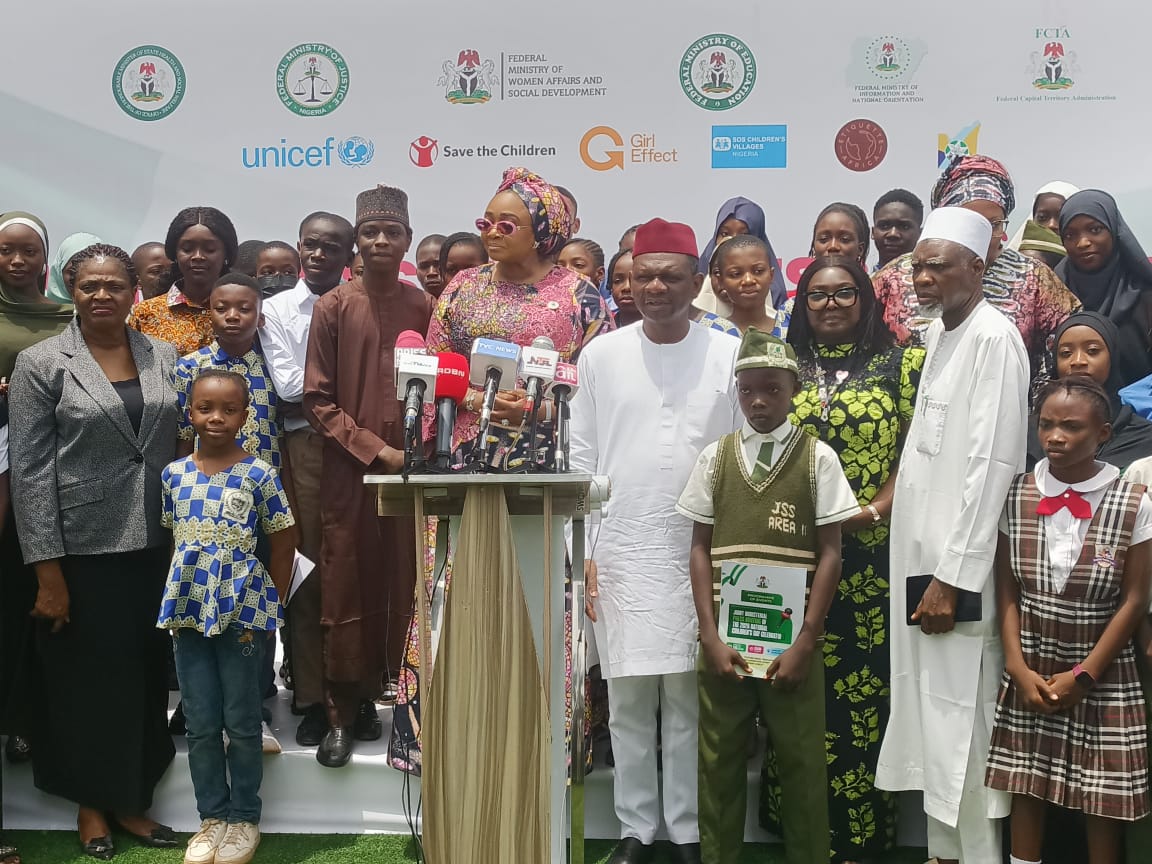
Federal Government (FG), in collaboration with United Nations International Children’s Emergency Fund (UNICEF) and other development partners, has officially flagged off activities for the 2026 National Children’s Day celebration, with a strong call for inclusion, child protection, and the promotion of family values as pillars for national development.
Speaking during a press briefing and intergenerational dialogue held in Abuja yesterday (Friday), the Minister of Women Affairs and Social Development, Iman Suleiman-Ibrahim, said this year’s theme, “Future Now: Promoting Inclusion for Every Nigerian Child,” reflects the commitment of the Tinubu administration to ensuring that no Nigerian child is left behind.
She stressed that government policies and programmes are being tailored towards guaranteeing equal opportunities for children irrespective of gender, disability, ethnicity, religion, or economic background.
According to the Minister, children remain central to Nigeria’s future, noting that they account for more than 40 per cent of the nation’s population.
She explained that the Federal Government is strengthening efforts in child protection, education, healthcare, nutrition, and social welfare in line with both local and international legal frameworks, including the Child Rights Act, the Violence Against Persons Prohibition Act, the United Nations Convention on the Rights of the Child, and the African Charter on the Rights and Welfare of the Child.
Suleiman-Ibrahim also announced the designation of 2026 as the Year of Families and Social Development, describing the family as the foundation of every child’s emotional, moral, and social development.
“The family is the child’s first school, first point of identity, and first source of emotional support,” she said, adding that stronger family systems are critical to raising responsible citizens and building a stable society.
UNICEF Acting Chief of Child Protection, Mona Aika, called for sustained investment in child welfare, education, healthcare, nutrition, and protection services across the country.
She urged stakeholders to create more opportunities for children, particularly girls, to participate in conversations and decisions affecting their future.
Also speaking, the Director of Programme Operations at Save the Children, Joshua Anar, stressed the need for closer collaboration among government institutions, civil society organisations, and communities to address abuse, neglect, violence, and harmful practices affecting vulnerable children.
Representatives of the Federal Ministry of Health highlighted ongoing interventions in maternal and child healthcare, immunisation, and nutrition, while Girl Effect Nigeria reaffirmed its commitment to supporting adolescent girls through empowerment and leadership initiatives.
As part of activities marking the 2026 Children’s Day celebration, the Ministry launched the FUTURE NOW Podcast, a youth-driven digital platform aimed at amplifying the voices of children and adolescents on issues affecting their wellbeing and aspirations.
During the interactive session, children raised concerns over the impact of economic hardship on families and access to quality education. Responding, the Minister acknowledged the challenges and called for shared responsibility among government, parents, communities, and development partners in addressing issues affecting children.
She further commended the Nigerian National Children’s Parliament for promoting civic engagement and leadership among young Nigerians.
Activities for the 2026 Children’s Day celebration are expected to continue nationwide until May 27, with programmes including advocacy campaigns, mentorship sessions, school engagements, youth forums, sporting activities, and a novelty football match designed to promote teamwork, inclusion, and social cohesion.