Abia State is a vital component of Igbo land. The Igbo people are widely renowned for their hard work, resourcefulness, strong sense of social justice, quest for excellence, and deeply rooted republican values. Historically, the region has produced distinguished leaders across diverse fields of human endeavor—leaders whose commitment to excellence and sound values has contributed immensely to the advancement of modern science, technology, medicine, economics, law, and the arts. Through these accomplishments, they brought pride not only to themselves and their families, but also to their region and the nation at large. However, this pride was, over time, punctuated by the poor leadership outcomes of those entrusted with the governance of the state.
Truth be told, Abia State—created in August 1991 from the old Imo State—began its journey under military administration, which did little to advance its development. Indeed, military rule in Nigeria, which lasted for nearly three decades, has little record of meaningful progress to its credit. In comparative terms, Abia’s experience under military rule from 1991 to 1999 fell below the national average.
The civilian administration of Dr. Ogbonnaya Onu, elected in 1992, offered a glimpse of hope. However, this hope was short-lived, as his government was abruptly terminated by the Abacha coup of November 1993.
In fairness to the military administrations in the state, it must be acknowledged that they maintained a degree of stability in governance. Basic administrative systems—such as salary payments, recruitment processes, discipline, and promotions within the civil service—were upheld with a reasonable level of consistency. This ensured operational efficiency, even though there was little or no progress in infrastructural development.
With Nigeria’s return to democratic rule in 1999, expectations were high. The people anticipated not only the continuation of administrative efficiency established under military rule but also a significant leap in infrastructural development and the fulfilment of their collective aspirations.
Unfortunately, these expectations were not met.
Particularly high hopes were placed on the youthful and charismatic governor, Chief Orji Uzor Kalu, who won the 1999 gubernatorial election. His early performance in infrastructure initially raised optimism. However, these hopes were gradually and systematically eroded as his administration devolved into a transactional system characterized by greed, graft, disregard for established rules, and elements of family dominance.
Perhaps the most damaging outcome of this era was the erosion of discipline within the civil service. Favoritism became widespread, with loyalists promoted over more qualified senior officers. Recruitment processes were compromised, and fiscal discipline weakened. These developments laid the foundation for the stagnation and eventual decay the state would experience in subsequent years.
Matters worsened as political tensions escalated. Chief Kalu’s confrontational stance toward federal authorities triggered internal crises within the ruling Peoples Democratic Party (PDP). Much of his later years in office were consumed by political battles with influential party members at the federal level, including ministers, legislators, and other stakeholders.
Between 2002 and 2007, Abia State was engulfed in political turmoil, frequently making national headlines.
By 2007, as Chief Kalu exited office, his political structure succeeded in installing his Chief of Staff, Chief T. A. Orji, as governor—despite the latter being under detention at the Kirikiri Maximum Security Prison over allegations of financial misconduct.
Chief T. A. Orji, who contested under the Peoples Progressive Alliance (PPA), was unable to rise above the entrenched culture of mediocrity and inefficiency established by his predecessor. Instead, his administration sustained and deepened the politics of exclusion and the transactional sharing of state resources among a small ruling elite and their associates.
Fiscal indiscipline worsened, budgetary processes were routinely ignored, and transparency in public procurement remained elusive. Even the limited infrastructural efforts initiated during the previous administration were either neglected or abandoned.
By the time he left office, Abia State had entered a phase of widespread deterioration across virtually all sectors.
Amid this decline, a counter-movement began to emerge. A professional reform-oriented group, led by the highly accomplished Dr. Alex Chioma Otti—who resigned his position as Managing Director of Diamond Bank—stepped forward to challenge the entrenched status quo.
His entry into the political arena significantly altered the dynamics of the struggle to reclaim the state from the grip of a long-standing political cabal that had dominated governance since 1999.
In the 2015 elections, Dr. Okezie Ikpeazu of the PDP was declared winner after a highly contested process. However, his administration performed even worse than that of his predecessor. His tenure became widely associated with systemic looting, fiscal recklessness, administrative inefficiency, and severe infrastructural decay.
By the time he left office in 2023, Abia State had acquired the unfortunate reputation of being one of the least developed states in Southern Nigeria.
During the twilight of his administration, both urban and rural infrastructure had collapsed. Roads were in deplorable condition, healthcare systems were largely non-functional, and medical personnel were frequently on strike or leaving the service.
The education sector fared no better. Many tertiary institutions lost accreditation for key programs, while both staff and students suffered from poor infrastructure and inadequate accommodation. Workers, both teaching and non-teaching, were owed salaries spanning several months, and in some cases, years.
Security also deteriorated, as criminal gangs took control of parts of several local government areas.
Urban environments became overwhelmed by filth, with refuse clogging major roads and public spaces.
The worst affected were civil servants and pensioners, who endured irregular salary payments and accumulated arrears. Morale within the public service reached an all-time low.
During this “locust years” period, Aba—the famed Enyimba City and pride of the Igbo people—suffered the most severe decline, degenerating into a severely dilapidated urban center with some of the worst road networks in the country.
Perhaps most troubling was the conduct of the ruling political class during this period. Detached from the suffering of the people, they operated like mercenaries within their own land—exhibiting arrogance, insensitivity, and disregard for public welfare, while the masses yearned desperately for change.
Consequently, Abia State’s human development indicators declined sharply, reinforcing its negative reputation.
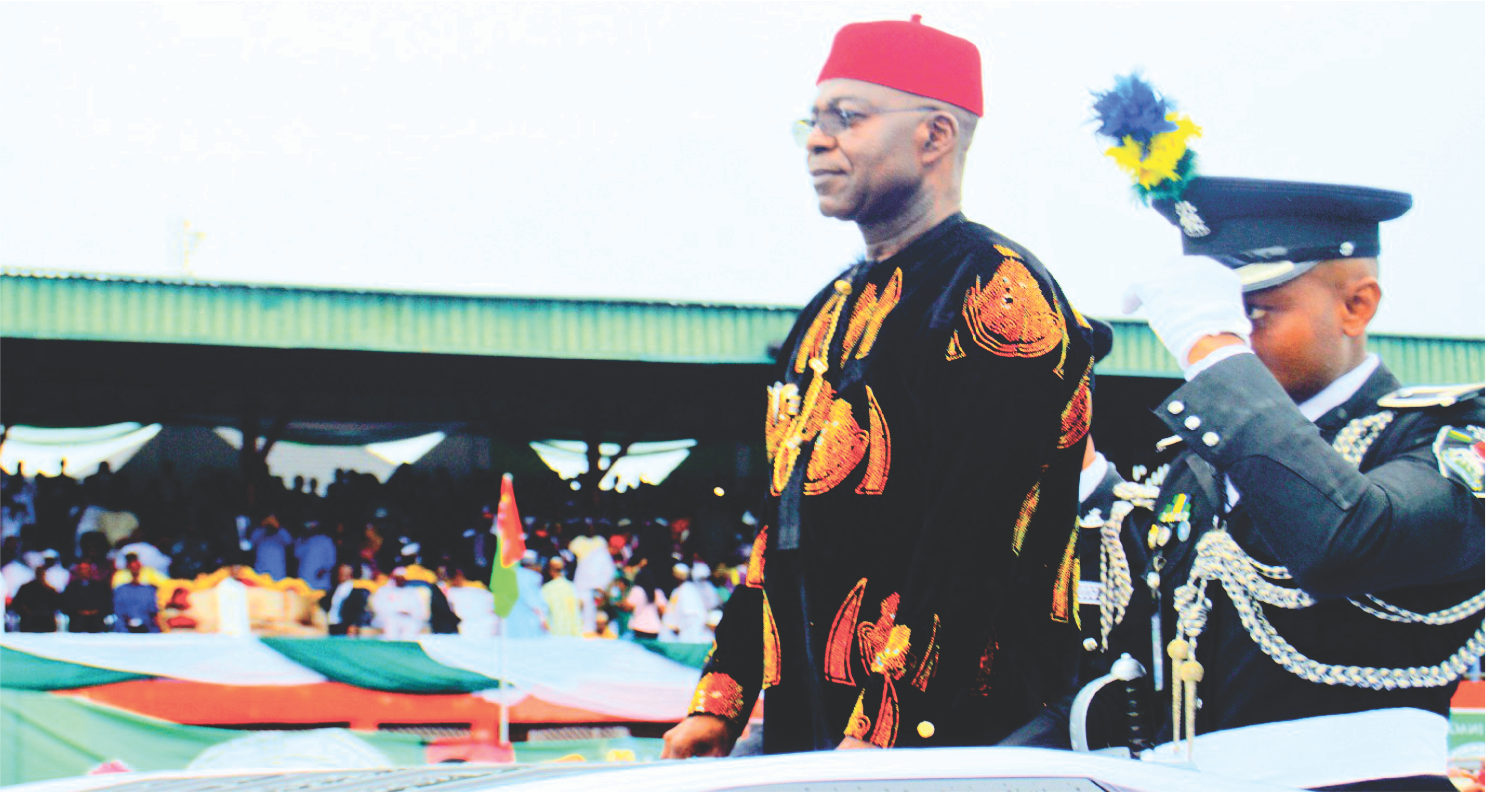
The turning point came with the election of Dr. Alex Chioma Otti on March 18, 2023. He was sworn into office on May 29, 2023 amidst an ongoing industrial action by organized labor, which had to be persuaded to suspend its strike to enable the new administration to commence operations.
Dr. Otti’s victory symbolized the collective resolve of the Abia people to break free from decades of misrule. It marked the culmination of a long and courageous struggle that began as far back as 2015—one in which citizens resisted intimidation and manipulation to usher in a government committed to transparency, efficiency, and accountability.
Three years into his administration, Dr. Otti—who campaigned on a clear vision to restore Abia’s lost glory and reposition it as a leading state significant progress toward realizing that vision.
The evidence supporting this transformation forms the subject of the subsequent sections.
By Jones Ike General Manager/Editor-In-Chief Abia Newspapers