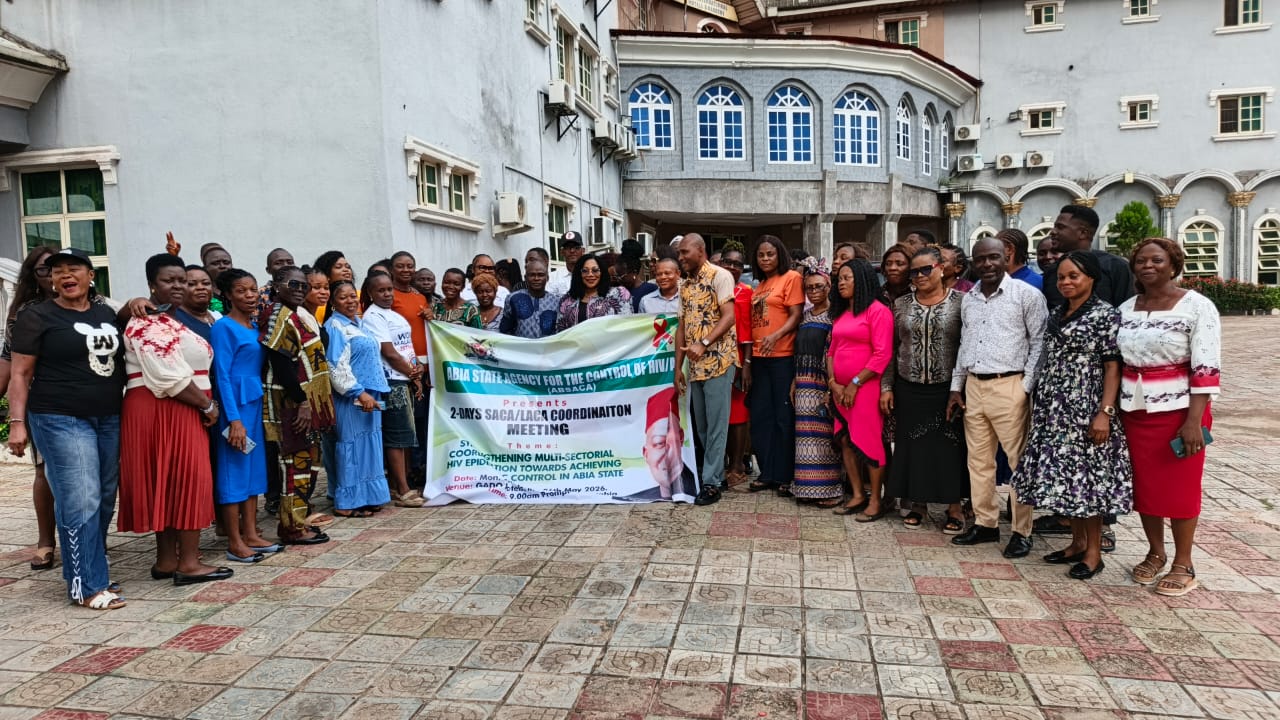
The Abia State Agency for the Control of HIV/AIDS (ABSACA) has successfully concluded a two-day SACA/LACA Coordination Meeting aimed at strengthening collaboration and enhancing strategies toward achieving HIV epidemic control across the state.
The meeting, themed “Strengthening Multi-Sectoral Coordination Towards Achieving HIV Epidemic Control in Abia State”, was held at Gado Hotels, Umuahia and brought together stakeholders, State AIDS Control Agency (SACA) officials, and Local AIDS Control Agency (LACA) representatives from the 17 Local Government Areas of Abia State to strengthen state and local government ownership of HIV programmes.
The training focused on improving service delivery, data management, collaboration, and community-level response mechanisms in the fight against HIV/AIDS.
Speaking during the opening session, the Director General of ABSACA, Dr. Uloaku Emma Ukaegbu, commended the Governor of Abia State, Dr. Alex Chioma Otti, OFR, for his commitment to quality healthcare delivery and improved access to health services across the state.
Representatives of one of the Local Government Areas receiving materials during the coordination meeting.
She charged participants to approach the training with seriousness and dedication, emphasizing the need for effective implementation of lessons learned within their various Local Government Areas.
According to her, “Effective coordination, commitment, and proper understanding of HIV response mechanisms remain critical to controlling the epidemic and improving healthcare outcomes in Abia State”.
The Director General, ABSACA, Dr. Uloaku Emma Ukaegbu, addressing participants during the SACA/LACA Coordination Meeting in Umuahia.
The two-day programme featured presentations and practical sessions facilitated by experts in HIV prevention, testing, management, monitoring and evaluation, and programme coordination. Facilitators included Dr. Uloaku Emma Ukaegbu, Director General, ABSACA; Princess Okorie, Technical Officer, M&E CCFN; Charles Chijioke, M&E SASCP; Ndubuisi Kanu, M&E SACA; Chinedu Iro, M&E SACA; and Mark Onoja, MEA
Day One focused on Pre-Test and Basic HIV Testing Services (HTS), Consent and Counseling, Roles and Responsibilities of LACAs in HIV Response, and Team Building in the context of LACA functionality.
Facilitators highlighted the importance of proper counseling, ethical consent procedures, accurate testing protocols, and strong inter-agency teamwork in ensuring efficient HIV response systems.
Participants were reminded that community-based awareness, confidentiality, trust, and quality service delivery are essential in encouraging people to access HIV services without fear or stigma.
Day Two sessions centered on Key Population Programmes, Harm Reduction and Service Delivery Challenges, Index and Social Network Modalities, Introduction of New Tools, Review of the NDARS Reporting Platform, Next-Step Initiatives, and the Development of Action Point Resolutions.
Facilitators extensively discussed practical approaches to addressing challenges encountered in service delivery and emphasized the importance of proper reporting systems and innovative strategies in strengthening HIV intervention programmes.
Participants also had the opportunity to highlight challenges experienced at the local government level, share practical field experiences, and propose workable solutions aimed at improving programme implementation in their respective areas.
They, however, identified reluctance among some individuals to disclose information about their sexual partners or encourage them to undergo HIV testing as a major challenge affecting HIV response efforts. Despite ongoing sensitization and awareness campaigns, participants noted that fear, privacy concerns, and hesitation still make partner disclosure and testing difficult in some communities, limiting effective follow-up and intervention efforts.
Cross-section of participants during Day Two of the two-day SACA/LACA Coordination Meeting, recently held in Umuahia.
Some participants further noted that the lack of data subscription support poses a challenge to timely HIV Testing Services (HTS) reporting, as it often delays the submission of programme data and other required reports, thereby affecting prompt documentation and reporting processes.
Delivering the vote of thanks on behalf of participants, Mr. Kelechi Oji commended the Governor of Abia State, Dr. Alex Chioma Otti, for prioritizing healthcare development and supporting initiatives geared towards strengthening the healthcare system in the state.
HIV early detective test kits and other materials for distribution to the 17 Local Government Areas of Abia State.
He also praised the Director General of ABSACA for her resilience and commitment, noting that continuous seminars and training remain vital for professional growth and improved performance.
According to him, “Capacity-building programmes such as this equip participants with updated knowledge and practical skills needed to strengthen HIV response efforts at the grassroots”.
The event concluded with the presentation of HIV test kits and other essential materials, reaffirming ABSACA’s commitment to achieving HIV epidemic control in Abia State.
Among the materials introduced were the latest 4th generation rapid HIV test kits, designed to support earlier detection of HIV infection, with the capacity to detect possible HIV infection from as early as the second week after exposure. The kits were distributed to various LGAs to strengthen targeted and index testing efforts, enhance early case identification, and improve HIV response at the grassroots level.