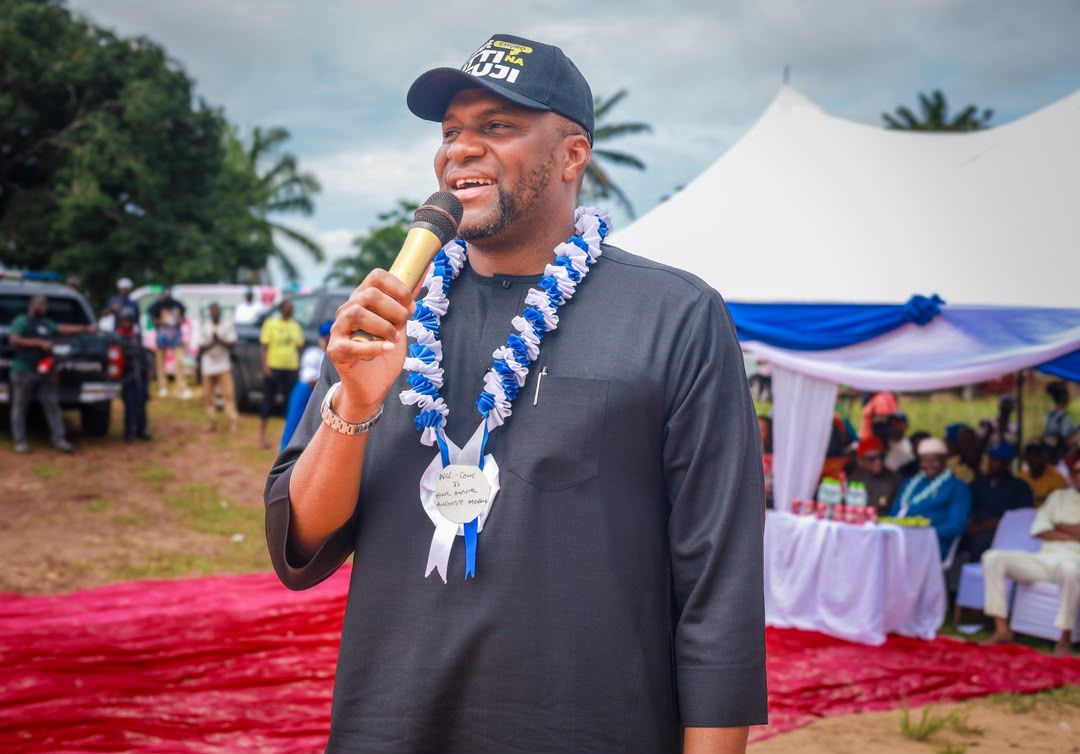
Every election presents an opportunity for the people to examine not only the individuals seeking public office but also the kind of leadership and representation they want for the future. In Bende Federal Constituency, the conversation around the 2027 election should therefore go beyond political parties, personalities, endorsements and campaign rhetoric. It should be a conversation about competence, character, capacity, service and measurable impact. The central question should be simple: what kind of representative does Bende need come 2027 and at this stage of its development? It is within this context that the record and political aspiration of Dr. Chimaobi Desmond Anyaso, popularly known as OFUJI of the Labour Party deserve serious public examination.
One of the strongest ways to assess a person seeking public responsibility is to look at what he has done before seeking political power. In the case of Dr. Anyaso, his engagement with communities did not begin with his current political ambition. Over the years, he has been associated with interventions in education, healthcare, youth development, women empowerment, entrepreneurship and community support through philanthropic initiatives connected with him. That history is important because it provides the public with something more concrete than promises. Politics is largely about what a person says he intends to do, but a person’s record can provide some indication of the values and priorities that may guide him when given greater responsibility.
There has been considerable discussion about Dr. Anyaso’s personal generosity and his reputation for welcoming and supporting people. When I said on Radio on Monday that if you visit his home you are unlikely to leave hungry, that is my own illustration of a personal culture of hospitality and generosity by OFUJI. But the conversation about food security must go much further than individual generosity. Bende requires an economic system that allows families to produce, earn and afford food sustainably.
This means moving the agricultural conversation from subsistence to productivity. Bende has farmers, fertile land and significant agricultural potential, but the challenge is how to connect production to financing, modern inputs, storage, transportation, processing and reliable markets. Young people must also be encouraged to participate in the agricultural value chain, not merely as farmers but as processors, distributors, aggregators, entrepreneurs and technology-driven agricultural businesses. A representative who understands this reality should be thinking about how federal programmes, agencies and legislative opportunities can be deployed to strengthen agriculture and create sustainable economic opportunities for the people, this is what Dr Chima Anyaso is coming up with .
Giving a person money or food can provide immediate relief, but creating opportunities through which that person can earn a sustainable income is a more enduring form of empowerment and Dr Chima Anyaso has shown before now that he is fully prepared.
Education is another area where Dr. Anyaso’s philanthropic record deserves attention. The Ahuoma Anyaso Education Foundation has established a tuition-free nursery and primary school in Igbere, Bende Local Government Area since the last 19years, the institution serves hundreds of children and provides support for staff, uniforms and learning materials. Other publicly reported figures from the foundation have also highlighted the number of children who have benefited from its educational interventions, infact one of the callers on radio acknowledged that his Children attends that school free of charge.
The importance of such an intervention goes beyond the immediate beneficiaries. Education is one of the most effective ways of breaking the cycle of poverty. When a child from a less privileged family receives quality education, the potential impact extends to that child’s family and, eventually, the wider community. For Bende, where the future of a large youthful population is at stake, investment in education should remain central to any serious development conversation.
The question, therefore, is how the experience gained through private philanthropy can be translated into broader public advocacy. A federal representative should be able to identify opportunities within federal education programmes, scholarship schemes, vocational institutions, skills-acquisition initiatives and other interventions and ensure that Bende is not left behind which is why we are calling on all sons and daughters of Bende to Vote for the Labour Party.
The same principle applies to healthcare. Dr. Anyaso and his foundation have been involved in free medical interventions in communities, including medical outreaches designed to take healthcare services to people who may otherwise struggle to afford or access them. The foundation has also carried out interventions involving eye care, medications, consultations and referrals.
Philanthropic medical outreach cannot replace a functional public healthcare system, but it demonstrates an understanding of a problem that many rural communities face. For residents who live far from specialist facilities in Umuahia or cannot easily afford medical services, even basic medical intervention can make a significant difference.
The next level of the conversation should therefore be about how Bende can attract stronger healthcare infrastructure, federal medical programmes, specialist services, improved primary healthcare and interventions targeted at vulnerable populations. A representative should not only distribute assistance; he should use the opportunities available through the federal government to help build systems that reduce the need for emergency assistance in the first place.
Women are central to the economic life of Bende, particularly through petty trading, agriculture, food processing and small-scale businesses. Any development agenda that ignores women cannot adequately address the economic realities of the constituency.
In 2026, 100 women traders in Bende received financial support of ₦200,000 each through an empowerment intervention of the Chima Anyaso Foundation to support their rural businesses which many of them are already doing so well and making much more profits.
The same applies to young people. Youth empowerment should not be reduced to occasional gifts or political appointments. Bende needs a system that equips young people with skills, connects them to opportunities and enables them to become employers rather than perpetual dependants on political structures.
This is one area where Dr. Anyaso’s philanthropic experience could potentially become relevant to public policy. Someone who has already participated in empowerment initiatives has a practical understanding of some of the challenges facing small businesses and vulnerable groups. The responsibility of political representation would be to take that understanding to a broader level through legislation, advocacy and federal programmes.
Infrastructure is another area where the people of Bende must insist on quality. Dr Chima Anyaso has made references to major engineering companies such as Julius Berger, but the fundamental principle should not be controversial: Bende deserves infrastructure that meets the highest practicable standards, the companies currently handling road projects in Bende has failed the people because those roads breaks down barely two months after completion.
Mentioning a company such as Julius Berger should not be interpreted to mean that every project must be awarded to that company or that indigenous contractors should be excluded. Quite the contrary, OFUJI will support, encourage competent indigenous contractors, Local companies will be given the opportunity to build the financial, technical and managerial capacity required to compete for major projects.
However, local participation must never become an excuse for poor ‘workmanship’. The real question should always be whether a contractor has the capacity to deliver a particular project according to the required specifications. If a major project requires a large engineering firm because of its technical complexity, Bende should not be denied quality infrastructure in the name of political correctness.
At the same time, whenever a major contractor comes into Bende, the benefits should not end when the construction equipment leaves. The representative should be asking how many Bende youths are employed, how many local businesses provide services, how many artisans acquire skills, how many local suppliers participate and what economic opportunities remain within the constituency after the project is completed. That is the difference between merely attracting a project and using a project as an instrument of economic development.
Dr. Anyaso’s philanthropic activities have also attracted recognition from different organisations over the years. Some of those recognitions includes but not limited to the African Achievers Award, the Democracy Youth Icon of the Year Award and other community and humanitarian honours. More recently, he was honoured by the Presbyterian Church of Nigeria with a “Beacon of Hope and Love” Award in recognition of humanitarian and community-development efforts.
Awards alone should never be used as proof that somebody will make a good politician. An award cannot replace competence, accountability or performance. However, when recognitions are connected to a sustained record of humanitarian and community interventions, they become part of the body of information that the public can examine when assessing a person’s history of service.
The more important issue is therefore not the number of awards Dr. Anyaso has received. The more important issue is what did he do to receive them? That is where public scrutiny should be directed and evidence shows that he has down so well and come 2027, he will even do better as a Representative.
The biggest question before Dr. Anyaso, like every other person seeking to represent Bende, is how his experience outside government can translate into effective legislative representation. A philanthropist can respond directly to people’s needs, while a federal legislator operates through laws, oversight, advocacy, constituency projects and engagement with federal institutions.
But philanthropy can provide useful experience. It can expose a person to the realities of poverty, healthcare challenges, educational disadvantage, unemployment and the struggles of small businesses. The challenge is converting that experience into policies and programmes that can benefit a much larger population.
That is why Bende needs a representative who understands that the office of a member of the House of Representatives is not simply a platform for distributing personal wealth, acquiring private lands and building Solar Panels for himself and his cronies . It is an institution through which the interests of the constituency can be presented, defended and advanced at the federal level.
The representative must be able to engage federal ministries, departments and agencies. He must understand legislation and oversight. He must know how to pursue constituency interventions. He must understand the importance of committees and federal programmes. Above all, he must remain connected to the people whose mandate he carries and this is where we are bringing the OFUJI argument for consideration.
Bende is not short of talented people. It has farmers, professionals, entrepreneurs, traders, artisans, students, civil servants and young people with enormous potential. What the constituency requires is an environment where that potential can be converted into opportunity.
The debate should therefore not be reduced to who has the largest political structure or who can make the loudest promises. The people deserve to examine the history, competence, ideas and capacity of everyone seeking their support.
In Dr. Chima Anyaso, there is a record of philanthropy that predates the current political contest. There is a record that includes education, healthcare, women empowerment, youth development and community interventions.
The ultimate test should be whether his experience, resources, networks and understanding can be transformed into effective representation for Bende and we say capital YES to such because we are marketing a sellable candidate.
Bende deserves a representative who understands that a mandate is not an inheritance; it is a responsibility. It deserves someone who understands that political office should not become a permanent means of livelihood, but an opportunity to serve, create opportunities and leave the constituency stronger than it was found.
The people of Bende is demanding for more, we are demanding quality infrastructure, better educational opportunities, stronger healthcare, agricultural development, youth empowerment, support for women and small businesses, greater access to federal programmes and transparent representation.
And that is why the record, experience and proposed vision of Dr. Chima Anyaso (OFUJI) of the Labour Party will be accepted by Ndi Bende Voters accross the 13 Wards of Bende Local Government Area of Abia State.
In summary, it is the Turn of Umunna Bloc, it is the time of Dr Chima Anyaso and come 2027, Labour Party Will win the Bende Federal Constituency Seat.
Promise Uzoma Okoro, is the Director of Media and Publicity of the Chima Anyaso Campaign Organization.