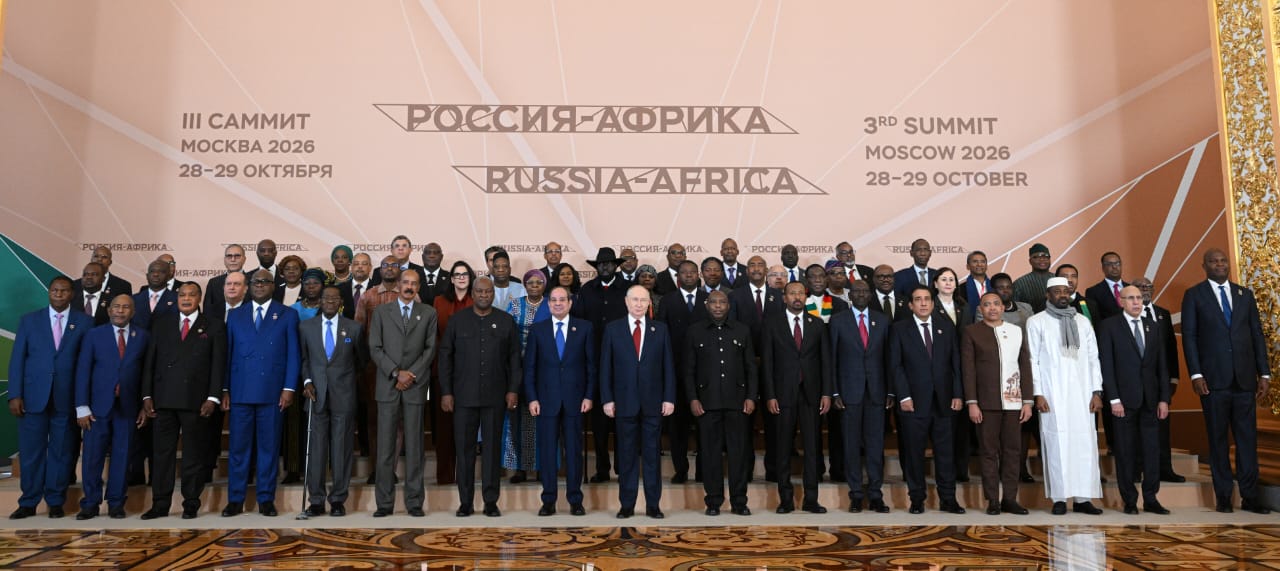
Nigeria has called on African countries and Russia to translate their longstanding diplomatic relations into tangible economic benefits, urging both sides to prioritise trade, investment and development projects over political declarations.
The Minister of State for Foreign Affairs, Ambassador Sola Enikanolaiye, made the appeal while delivering Nigeria’s national statement at the Third Russia-Africa Summit held at the Grand Kremlin Palace in Moscow.
Enikanolaiye, who led Nigeria’s delegation, conveyed the goodwill of President Bola Ahmed Tinubu to Russian President Vladimir Putin and the Chairman of the African Union (AU), President Évariste Ndayishimiye of Burundi.
He stressed that the success of the Africa-Russia partnership should be determined by its capacity to deliver measurable improvements in economic growth, infrastructure and the living conditions of citizens.
The minister identified difficulties in banking services, cross-border transactions and financial infrastructure as major obstacles to trade and investment, calling for practical arrangements to facilitate business activities between the two regions.
He also urged both governments to create an enabling environment for greater private-sector participation, noting that businesses must play a central role in driving sustainable economic development.
On infrastructure, Enikanolaiye called on Russian investors to explore opportunities in Africa’s railway systems, seaports, transportation, energy, telecommunications and logistics sectors.
He said investments in these areas should promote regional connectivity and advance the objectives of the African Continental Free Trade Area (AfCFTA).
The minister further identified digital technology, artificial intelligence, cybersecurity, software development and scientific research as promising areas for cooperation, warning that Africa must avoid becoming merely a consumer of technologies developed elsewhere.
He emphasised the need for technology transfer, technical training and local capacity development to enable African countries to build indigenous technological capabilities.
On agriculture and food security, Enikanolaiye advocated stronger collaboration in fertiliser production, mechanisation, irrigation, agricultural research, food storage and processing.
He particularly encouraged Russian investment in agricultural technology and agro-industrial development, stressing that Africa must strengthen local production and retain more economic value from its agricultural resources.
Addressing security challenges, the Nigerian delegation leader reaffirmed the country’s commitment to African-led solutions, identifying terrorism, violent extremism, arms trafficking, piracy, cybercrime and organised criminal networks as major threats to regional stability.
He called for increased international cooperation while maintaining that external partnerships should strengthen, rather than undermine, the African Union, ECOWAS and other regional institutions.
On global governance, the minister reiterated Nigeria’s support for sovereign equality, territorial integrity, non-interference and peaceful resolution of disputes.
He also advocated reforms of the United Nations Security Council and international financial institutions to ensure that Africa receives adequate representation in global decision-making.
Enikanolaiye said Nigeria supported the development of an Africa-Russia Action Plan for 2027–2029, with clearly defined objectives, financing arrangements and monitoring mechanisms to ensure that agreements reached at the summit translate into concrete results.
He used the occasion to invite Russian businesses and investors to take advantage of Nigeria’s investment opportunities, describing the country as Africa’s largest market and a strategic gateway to West Africa and the AfCFTA.
He identified energy, renewable and nuclear technology, solid minerals, agriculture, manufacturing, pharmaceuticals, defence and digital services as sectors with considerable investment potential.
The minister also expressed Nigeria’s interest in expanding mutually agreed local-currency settlement arrangements with Russia to facilitate cross-border trade and reduce payment difficulties.
He reaffirmed Nigeria’s support for a fair multipolar international order, opposing unilateral sanctions and the use of international trade rules for political purposes.
Tracing the historical relationship between both countries to the Soviet era, Enikanolaiye recalled Russia’s support for Nigeria’s unity, sovereignty and territorial integrity, describing the country as a longstanding partner.
In his remarks, Russian President Vladimir Putin described Russia and Africa as natural allies in the quest for a more balanced multipolar global order.
Putin reaffirmed Moscow’s readiness to deepen diplomatic relations, expand security cooperation and support greater African participation in international institutions.
Similarly, the AU Chairman and co-chair of the summit, President Évariste Ndayishimiye, said Africa remained committed to independent international partnerships and would not replace one form of dependence with another.
He noted that the proposed 2027–2029 Action Plan offered an opportunity to address Africa’s infrastructure gaps through technology transfer, skills development and investment, rather than dependence on external assistance.
Ndayishimiye also identified water security as a major priority on the African Union’s 2026 agenda.
The Third Russia-Africa Summit is expected to strengthen cooperation between both regions across economic, diplomatic, security and technological sectors, with the implementation of agreements emerging as a key measure of its success.