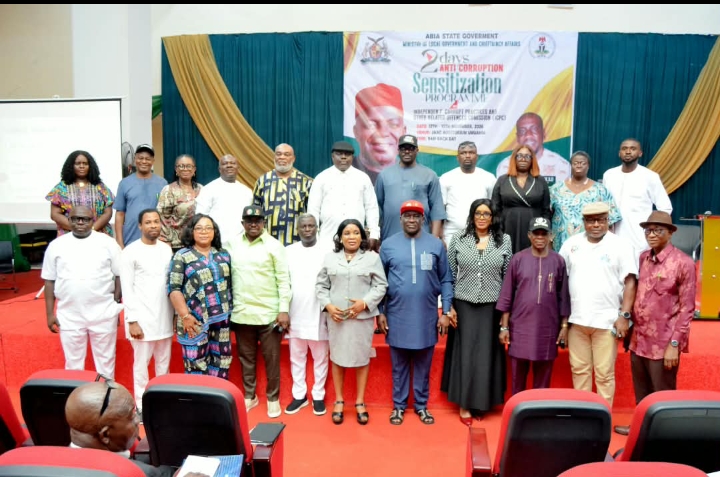
Abia State Government, in collaboration with the Independent Corrupt Practices and Other Related Offences Commission (ICPC), has intensified efforts to strengthen accountability and curb corruption in local government administration, warning officials against the diversion and mismanagement of public funds.
The Commissioner for Local Government and Chieftaincy Affairs, Prince Uzor Nwachukwu, gave the warning on Thursday during the opening of a two-day anti-corruption sensitisation programme organised by the Ministry in partnership with the ICPC at the JAAC Secretariat, Umuahia.
Prince Nwachukwu charged Executive Mayors of the 17 Local Government Areas and other senior officials to strengthen financial and administrative control systems, insisting that transparency, discipline and accountability must underpin the management of public resources.
The Commissioner pointed out that the administration of Governor Alex Otti is committed to conducting government business with discipline, transparency and measurable results, adding that the principles must be reflected in the operations of local governments.
He noted that Local Governments were expected to go beyond their traditional administrative functions and become effective drivers of development, economic opportunities and improved living conditions at the grassroots.
Prince Nwachukwu said the state government’s interventions in agriculture, youth development, rural infrastructure and local economic empowerment required adequate resources, effective coordination and responsible management to deliver the desired impact.
According to him, the success of government programmes should be assessed by their outcomes rather than the volume of funds released for their execution.
“The success of any government programme is not determined by the amount of money released. It is determined by what is achieved with that money.
“A project that exists only on paper is not development. An expenditure without proper accountability is not good governance.
“And an approval that disregards established procedures cannot be justified simply because the intention was good”, he said.
Prince Nwachukwu urged the Mayors and senior local government officials to take responsibility for financial discipline and administrative integrity through proper record-keeping, transparent procurement, effective supervision and timely financial reporting.
He cautioned that the delegation of duties should not be interpreted as a waiver of oversight responsibilities, stressing the need for stronger internal controls, adequate documentation and strict compliance with financial regulations.
The Commissioner said the training should equip public officers with practical knowledge of their legal obligations and the standards required in managing public resources.
He also urged participants to develop practical recommendations that would improve financial and administrative controls across the 17 local government areas.
“We cannot continue to attend workshops, collect certificates and return to our offices to do things exactly the same way. There must be a difference”, Prince Nwachukwu said.
He assured the ICPC of the Ministry’s readiness to sustain collaboration with the Commission in promoting integrity and institutional accountability and urged participants to make meaningful use of the engagement.
In her goodwill message, the ICPC representative, Chinwe Egbeocha, commended the Commissioner and the myinistry for extending the sensitisation programme to all Local Government structures, describing the initiative as evidence of the state’s commitment to tackling corruption.
Egbeocha urged participants to take advantage of the programme to seek clarification on issues relating to corruption and their responsibilities as public officers.
“This is an opportunity for some of you seeing ICPC staff in person, and an opportunity for you to ask all the questions agitating your minds about corruption,” she said.
Earlier, the Permanent Secretary of the Ministry of Local Government and Chieftaincy Affairs, Lady Oge Maduka, commended the ICPC for initiating the programme and partnering with the Ministry to promote accountability and ethical conduct in local government administration.
She also acknowledged the Commissioner’s leadership and support towards the successful organisation of the exercise.
Maduka observed that corruption did not always begin with large sums of money or major financial scandals, noting that seemingly minor actions such as bending rules, disregarding established procedures and deliberately overlooking wrongdoing could also constitute corrupt practices.
She reminded participants that public officers occupied positions of trust and that their decisions and management of public resources had direct consequences for citizens, particularly those at the grassroots.
The Permanent Secretary said the Otti administration has placed renewed emphasis on transparency, accountability and responsible governance, urging public servants to reflect these values in the discharge of their duties.
She stressed that good intentions alone were insufficient without a sound understanding of applicable rules and the ability to recognise practices that could expose public officers to violations of the law.
Maduka urged participants to engage actively in the programme, ask practical questions and translate the knowledge acquired into improved professional conduct and a public service culture anchored on integrity.