NRCRI, Chinese Scientists Partner to Boost Cassava Production, Target 20–25 Tonnes Per Hectare
The National Root Crops Research Institute (NRCRI), Umudike, Abia State, has strengthened its agricultural research partnership with the Chinese Academy of Tropical Agricultural Sciences (CATAS), with a target of increasing Nigeria’s cassava yield from the current average of about 9.1 tonnes to between 20 and 25 tonnes per hectare.
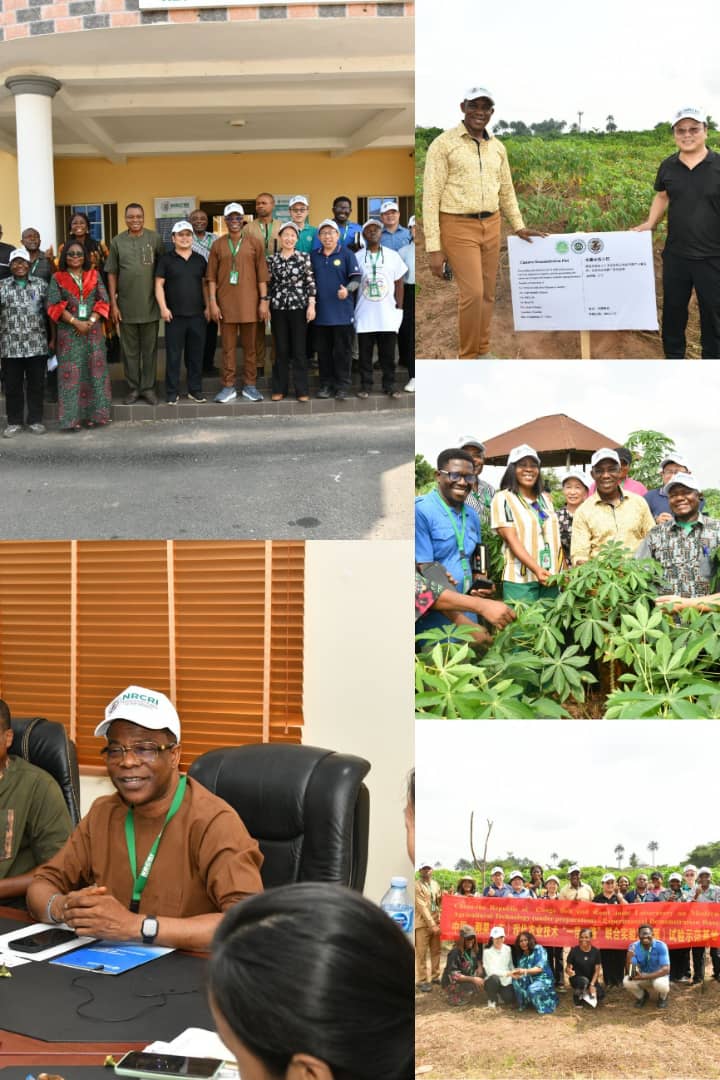
The Executive Director/Chief Executive Officer of NRCRI, Prof. Chiedozie Egesi, disclosed this when he received a high-powered delegation from the Tropical Crops Genetic Resources Institute (TCGRI), an arm of CATAS, led by its Deputy Director and Team Leader, Prof. L I Qiong , during a working visit to the institute in Umudike, Abia State.
Prof. Egesi, who welcomed the delegation, described the relationship between NRCRI and CATAS as a longstanding partnership spanning about two decades, expressing satisfaction with the progress recorded through their collaborative efforts in cassava development.
He reaffirmed NRCRI’s commitment to building a productive, enduring and mutually beneficial scientific partnership with China, noting that the collaboration would help address Nigeria’s cassava productivity gaps despite its position as the world’s largest cassava producer.
According to him, the next phase of the partnership would go beyond expanding cultivated land to substantially increasing productivity per hectare, improving farmers’ profitability, promoting environmental sustainability and strengthening the industrial competitiveness of cassava.
According to him, the next phase of the partnership would go beyond expanding cultivated land to substantially increasing productivity per hectare, improving farmers’ profitability, promoting environmental sustainability and strengthening the industrial competitiveness of cassava.
The NRCRI boss said the institute was committed to making its facilities a reference centre for cassava research, technology validation and farmers’ training across Africa.
He explained that the proposed demonstration base would integrate improved cassava varieties, climate-smart agricultural practices, efficient nutrient management and mechanisation, adding that the facility would also serve as a training hub for agricultural researchers and farmers from other African countries.
Prof. Egesi further expressed the institute’s readiness to promote scientific personnel exchanges, joint research, germplasm exchange within established phytosanitary regulations, equipment support and the adaptation of relevant Chinese agricultural technologies to Nigerian conditions.
He stressed the need for the partnership to move beyond meetings and agreements to measurable results that would positively affect farmers, particularly those in rural communities.
He also called for a clearly defined implementation roadmap with measurable productivity targets, timelines, institutional responsibilities and resource commitments to ensure the sustainability of the collaboration.
Earlier, the leader of the Chinese delegation,Deputy Director of TCGRI, Prof. L.I.Qiong said the visit was aimed at strengthening the existing relationship between the two institutions and expanding cooperation in agricultural research, technology development, joint projects and personnel exchanges.
Prof. Qiong described NRCRI as a strategic research partner in Africa, commending the institute’s scientific achievements, research commitment and practical approach to agricultural development.
She said CATAS was interested in deepening its collaboration with NRCRI, particularly in the areas of cassava research, genetic resources, technology innovation and international scientific cooperation.
She explained that the Chinese government was promoting international agricultural partnerships under the Belt and Road Initiative, adding that the collaboration with NRCRI would contribute to advancing tropical agriculture globally.
In a related presentation, the Director of Research Support Services, Dr. Mark Tokula, reviewed the progress of the CATAS–NRCRI collaboration and highlighted the institute’s mandate in the genetic improvement, production, processing, storage and utilisation of root and tuber crops.
He disclosed that Nigeria currently records an average cassava yield of about 9.1 tonnes per hectare, expressing optimism that the intervention under the Nigeria Cassava Yield Doubling Programme would increase production to between 20 and 25 tonnes per hectare.
Dr. Tokula revealed that the institute had established cassava demonstration farms across Umudike in Abia State, Amakama, Uyo in Akwa Ibom State and Igbariam in Anambra State, with about 50 cassava germplasm accessions maintained at the joint demonstration nursery
He said the programme had also recorded progress in screening improved cassava varieties, conducting fertilizer experiments and establishing green and efficient cassava production systems across different agroecological locations.
According to him, the institute has received Chinese-developed cassava planting and harvesting equipment, which is awaiting assembly and technical training before deployment for field operations.
He, however, identified the need for heavier tractors with appropriate horsepower to effectively operate the imported mechanisation equipment.
Dr. Tokula explained that the partnership would benefit Nigerian farmers through increased yields, improved varieties, reduced labour and production costs, better access to processing industries and increased income.
He added that the collaboration would also promote scientific exchanges, advanced breeding technologies, biotechnology, improved seed systems and the development of a regional hub for cassava research and training in West Africa.
Also speaking, the Associate Research Professor of CATAS, Dr. Gao Fei, presented a proposal on the establishment of the Global Cassava Alliance (GCA), describing it as an international platform designed to strengthen global cooperation in cassava research, food security and industrial utilisation.
He disclosed that the three-year initiative, supported by the Hainan Provincial Government of China, was expected to bring together research institutions and agricultural organisations across more than 34 countries and nine international organisations.
Dr. Gao said NRCRI was being considered as a founding member and the African implementation hub of the proposed alliance, while Hainan would serve as its headquarters.
He explained that the alliance would promote international research collaboration, exchange of genetic resources, scientific capacity building and the development of high-value cassava products.
He further disclosed that research was ongoing on the development of cassava-based fortified rice and other nutritious products, including low-glycaemic-index food products that could be beneficial to consumers.
The proposed alliance, he said, would operate under the slogan, “One Cassava, Zero Hunger,” reflecting its commitment to using cassava to address global food security and industrial development challenges.
The visit also featured the inauguration and unveiling of the China–Republic of Congo Belt and Road Joint Laboratory for Modern Agricultural Technology Experiment and Demonstration Site, as well as the unveiling of the Memorandum of Understanding to strengthen the collaborative framework between the participating institutions.
The Chinese delegation also toured NRCRI’s research facilities, experimental farms and farm mechanisation unit, where they inspected ongoing research activities, cassava demonstration plots and agricultural implements supplied through the collaboration.
The engagement attracted the top management Team of NRCRI, including researchers and other technical personnel, who participated in the presentations, discussions and inspection of the institute’s facilities.
The partnership is expected to strengthen Nigeria–China agricultural scientific cooperation, enhance cassava productivity, promote technology transfer and position NRCRI as a major centre for cassava research, training and innovation in Africa.