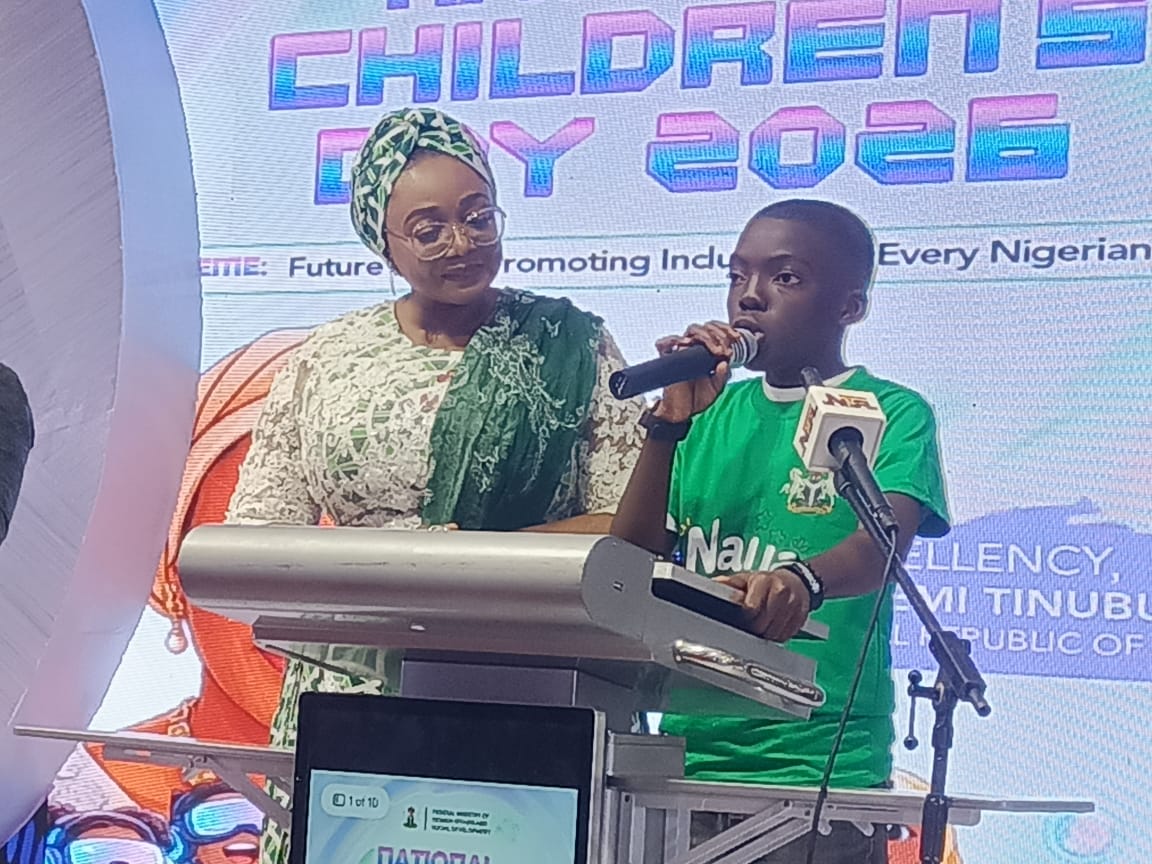
The Federal Government has reaffirmed its commitment to safeguarding the rights and future of Nigerian children as government officials, development partners, and young innovators gathered in Abuja for the 2026 National Children’s Day celebration.
The event, held at the State House Banquet Hall and hosted by First Lady Senator Oluremi Tinubu, brought together children from across the federation under the theme: “Future Now: Promoting Inclusion for Every Nigerian Child.”
Addressing participants, the First Lady described Nigerian children as the foundation of the nation’s future, stressing the need to ensure equal access to quality education, healthcare, protection, digital opportunities, and safe living conditions for every child.
She praised the Minister of Women Affairs and Social Development, Hajia Imaan Sulaiman-Ibrahim, for organizing the event ahead of the official May 27 Children’s Day celebration due to this year’s Sallah festivities.
Senator Tinubu said the theme of the celebration highlights the importance of building a society where no child is marginalized because of gender, ethnicity, religion, disability, or economic background.
She assured children that the administration of President Bola Ahmed Tinubu remains committed to investing in their future through the Renewed Hope Agenda, with emphasis on education, nutrition, vocational development, STEM innovation, and stronger child protection systems.
Encouraging the children, the First Lady urged them to stay focused and determined despite life’s challenges.
“Never allow your circumstances limit your dreams. Nigeria believes in you, and Nigeria expects you to make her proud,” she stated.
She also applauded winners of the National Essay Competition and participants in the innovation exhibitions, describing them as symbols of the country’s growing potential.
In her keynote address, Minister of Women Affairs and Social Development, Hajia Imaan Sulaiman-Ibrahim, said Nigeria’s more than 100 million children remain the nation’s greatest resource and responsibility.
According to the Minister, the Federal Government is implementing the Renewed Hope Social Impact Intervention–774 framework aimed at creating a coordinated and accountable child development system across the country.
She revealed that the government is reviewing outdated policies, including the National Child Policy of 2009, while modernizing adoption regulations and strengthening child protection laws to reflect present-day realities and global standards.
Sulaiman-Ibrahim explained that the reforms are designed to address growing concerns such as child trafficking, bullying, digital exploitation, mental health challenges, harmful practices, and cross-border adoption issues.
She added that the strengthened National Council on Women Affairs and Child Development now serves as a central platform for coordinating child-focused programmes across federal, state, and local governments.
The Minister further noted that child development initiatives now go beyond education to include emotional wellbeing, digital safety, moral values, life skills, and support for children with special needs.
She praised the National Children’s Parliament for nurturing young leaders who are already contributing to governance and advocacy, while also highlighting the participation of Nigerian children at the CSW69 Side Event in New York in 2025.
According to her, Nigeria’s recognition as a Pathfinding Country under the Global Partnership to End Violence Against Children reflects the country’s determination to combat abuse, exploitation, trafficking, and violence against children.
She also disclosed that ongoing reforms to the Child Rights Act are focused on strengthening enforcement mechanisms and aligning child protection laws with modern technological realities.
A UNICEF representative at the event commended Nigeria for its efforts in advancing child protection and inclusion, while emphasizing the need to ensure every child is safe at home, in school, in communities, and online.
The representative also praised Nigerian children for their creativity and innovation displayed during the exhibitions and reaffirmed UNICEF’s commitment to supporting Nigeria in promoting children’s rights and wellbeing.
The celebration featured cultural performances, talent displays, innovation showcases, and award presentations honoring outstanding children from across the country.
Stakeholders at the gathering emphasized that protecting children requires collective action from government institutions, parents, caregivers, schools, communities, and development partners.
The event ended with renewed calls for stronger collaboration to guarantee equal opportunities and a safer future for every Nigerian child.