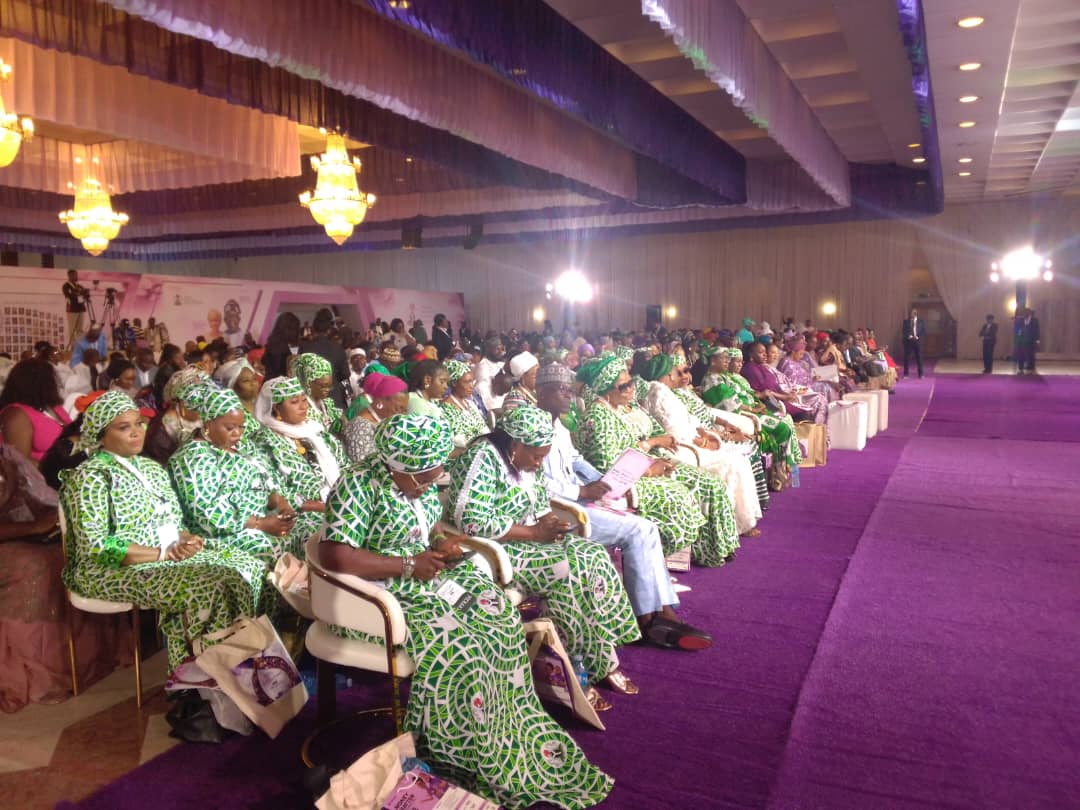
The Honourable Minister of Women Affairs and Social Development, Hajiya Imaan Sulaiman-Ibrahim, has reaffirmed the Federal Government’s commitment to empowering Nigerian women as a strategic pathway to national development.
Speaking at the grand finale of the “Give to Gain” Summit held at the State House Banquet Hall, Abuja today, to mark the 2026 International Women’s Month, the Minister described the gathering as a convergence of “power, promise, and possibility,” stressing that advocacy for women must extend beyond symbolic observances.
“Every day is Women’s Day, and every month bears her mark,” she said, noting that women make up over 50 percent of Nigeria’s population and contribute more than 40 percent of the agricultural labour force, yet remain largely excluded from access to finance, land, and formal economic systems.
She emphasized that closing this gap is not charity but a strategic necessity, adding that over 80 percent of women-owned businesses operate in the informal sector without access to formal credit or structured markets.
To address this, the Minister announced the implementation of the Renewed Hope Social Impact Interventions (RH-SII 774), a comprehensive programme designed to deliver economic empowerment, skills acquisition, agricultural support, clean energy solutions, and social protection across all 774 local government areas.
She also highlighted President Bola Ahmed Tinubu’s declaration of 2026 as the “Year of Families and Social Development,” describing it as a strategic move to strengthen family systems and recognize the central role of women in national stability.
According to her, the initiative aligns with global priorities, including outcomes from the 70th Session of the Commission on the Status of Women (CSW70), particularly in addressing unpaid care work.
The Minister further outlined key policy frameworks supporting women and vulnerable groups, including the National Gender Policy, the Child Rights Act, the Violence Against Persons (Prohibition) Act, and the newly approved Affirmative Procurement Policy aimed at increasing women’s participation in public contracting.
Addressing emerging challenges such as insecurity and climate change, she pointed to Nigeria’s Third National Action Plan on Women, Peace and Security as a critical step toward enhancing women’s role in peacebuilding.
In her remarks, the First Lady of Nigeria, Senator Oluremi Tinubu—represented by the wife of the Speaker of the House of Representatives, Hajiya Fatima Abbas Tajudeen—emphasized the importance of sustained action in promoting women’s empowerment and inclusion.
She noted that empowering women is key to building stronger families and communities, urging stakeholders to move beyond celebration to deliberate investments that expand opportunities for women and girls.
Also speaking, the Director, Development Department, Mrs. Chikoko called for accelerated efforts to deepen women’s inclusion across all sectors, stressing that women must not only participate in development but also lead it.
She described women’s empowerment as both a social responsibility and an economic imperative, noting that when women are supported, communities thrive and economies grow.
Chikoko also highlighted the importance of collaboration among government, private sector, and development partners in expanding opportunities for women, enabling women-owned businesses to scale and compete globally.
The event also featured reflections on the 30 years of impactful service by the Federal Ministry of Women Affairs and Social Development. The Director of the Development Department, Mrs. Chikoko, described the Ministry’s journey as one marked by resilience, dedication, and sustained progress.
Participants shared success stories from various empowerment initiatives, citing improvements in financial inclusion, healthcare access, and family well-being as evidence of the impact of targeted programmes.
Looking ahead, the Minister announced a “10 Million Women Mega Empowerment and Rally” scheduled for May 5 at the Moshood Abiola Stadium, Abuja, aimed at amplifying women’s voices and strengthening collective action nationwide.
The summit concluded with a call for sustained commitment to women’s empowerment, with stakeholders urging that it be treated as a continuous movement toward inclusive growth and national development.