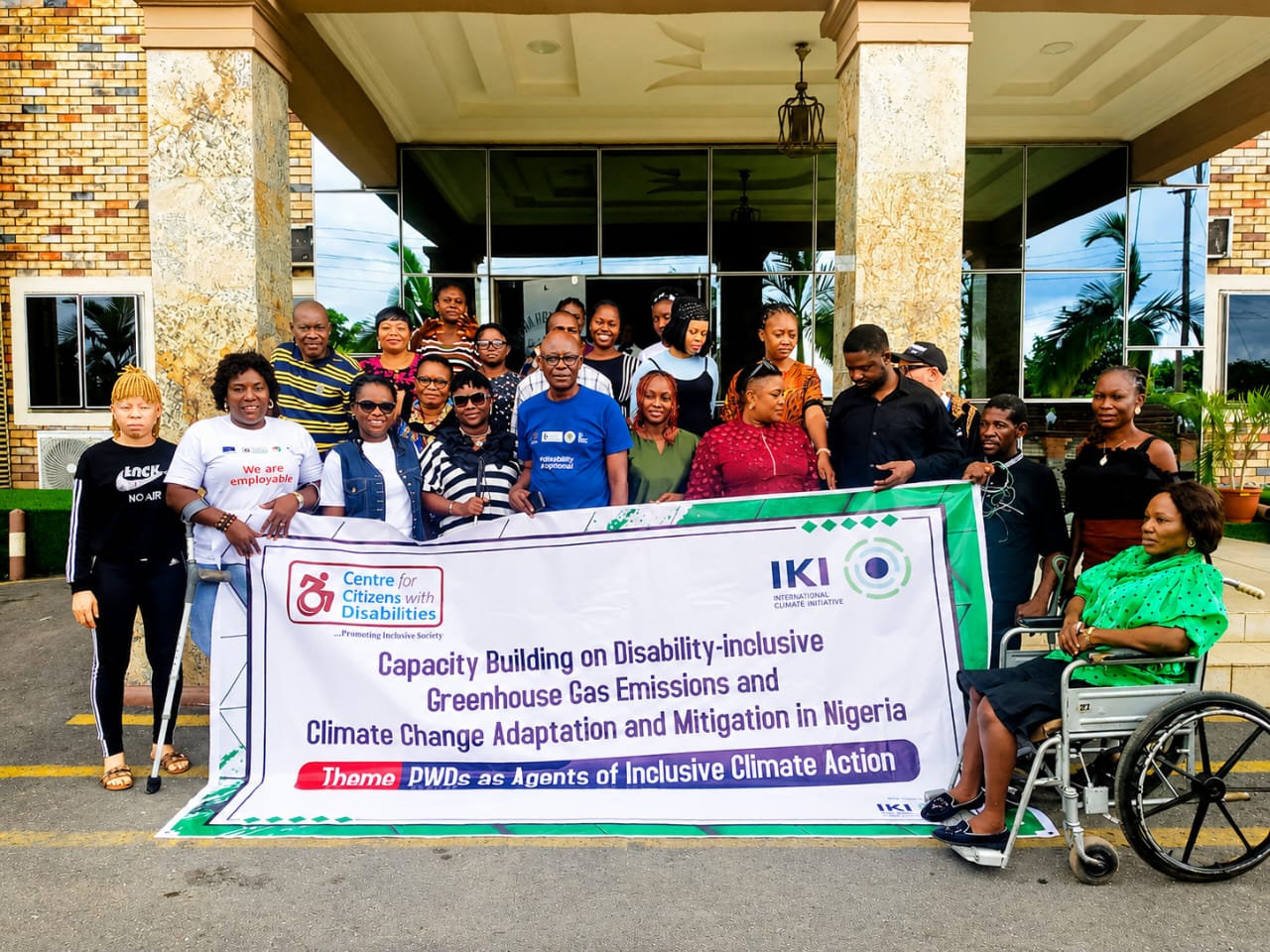
Persons with disabilities in Abia State have called for their full and meaningful inclusion in climate change policies, programmes and infrastructure planning, saying their needs are often overlooked in decisions that directly affect their lives.
The call was made today in Umuahia, Abia State by the Acting Director of the Centre for Citizens with Disabilities (CCD), Godwin Unumeri, and representatives of disability groups, Agu Patience and Chioma Precious Ekoro, in separate interviews following a two-day capacity-building workshop and the launch of a research report on disability inclusion in climate change policies.
Unumeri said CCD was focused on building the capacity of persons with disabilities and relevant institutions to take ownership of advocacy for their inclusion, rather than relying solely on the organisation to drive implementation of the research recommendations.
He said CCD would periodically monitor the implementation of the recommendations by engaging persons with disabilities, the relevant commission and other stakeholders to assess their impact on policies, programmes and actions.
“We are trying to capacitate persons with disabilities to implement the issues that concern them,” Unumeri said.
According to him, advocacy remains central to the initiative, as disability organisations need to understand climate change issues and engage the appropriate government institutions and other stakeholders.
He said CCD had identified key actors involved in the implementation of climate change policies and programmes and equipped participants with the knowledge to engage them effectively.
Unumeri said the ultimate objective was to see more persons with disabilities actively participating in climate change programmes and governance.
“The bottom line, the overall outcome, we are expecting that we’ll see more persons with disabilities in the climate change space,” he said.
However, he identified bureaucracy, inadequate funding and the ability of trained participants to replicate the knowledge acquired among other members of the disability community as potential challenges.
He explained that the current CCD project had no provision for funding participants to step down the training to other members of the disability community, expressing hope that the relevant commission would facilitate the process.
Similarly, a representative of the Spinal Cord Association, Agu Patience, said the training had opened her eyes to the need for persons with disabilities to be considered whenever climate change policies and development projects were being designed.
Patience raised concerns over the accessibility of public infrastructure, particularly hotels, saying some spinal cord-injured persons are forced to sleep on the floor after paying for accommodation because the beds are too high for them to access.
She also cited inaccessible entrances and other structural barriers as challenges confronting persons with disabilities.
“Whenever climate change policy is made, people with disabilities should be put into consideration,” Patience said.
She commended the Abia State Government for what she described as efforts to improve accessibility of public buildings and facilities, while urging developers and relevant authorities to prioritise inclusive infrastructure.
On her part, the Public Relations Officer of the National Resources Section of the Blinds, Abia State Chapter, Chioma Precious Ekoro, described the CCD programme as an eye-opening experience that had highlighted gaps in existing climate change policies concerning persons with disabilities.
Ekoro said the research report had identified important areas requiring attention to ensure that persons with disabilities were adequately considered in national climate change planning, policy formulation and implementation.
She said the programme had also sensitised participants on their roles in advocating for inclusion and engaging policymakers, ministries, non-governmental organisations and other stakeholders.
“It has been a life-changing one. It has been an eye-opener, bringing us to the limelight that we also, as persons with disabilities, have our own roles to play,” Ekoro said.
She urged persons with disabilities to move beyond being passive beneficiaries of government policies and become active participants in processes affecting their lives.
Ekoro also commended the Abia State Government for its attention to disability-related matters, particularly through the establishment of the Abia State Commission for the Welfare of Persons with Disabilities.
She said the commission had provided an avenue for disability concerns to be channelled to the appropriate authorities, but stressed the need for sustained advocacy to achieve greater inclusion.
The stakeholders expressed optimism that the CCD research and capacity-building initiative would strengthen the ability of persons with disabilities to engage policymakers and other stakeholders and ensure that disability concerns remain central to climate change action and governance.