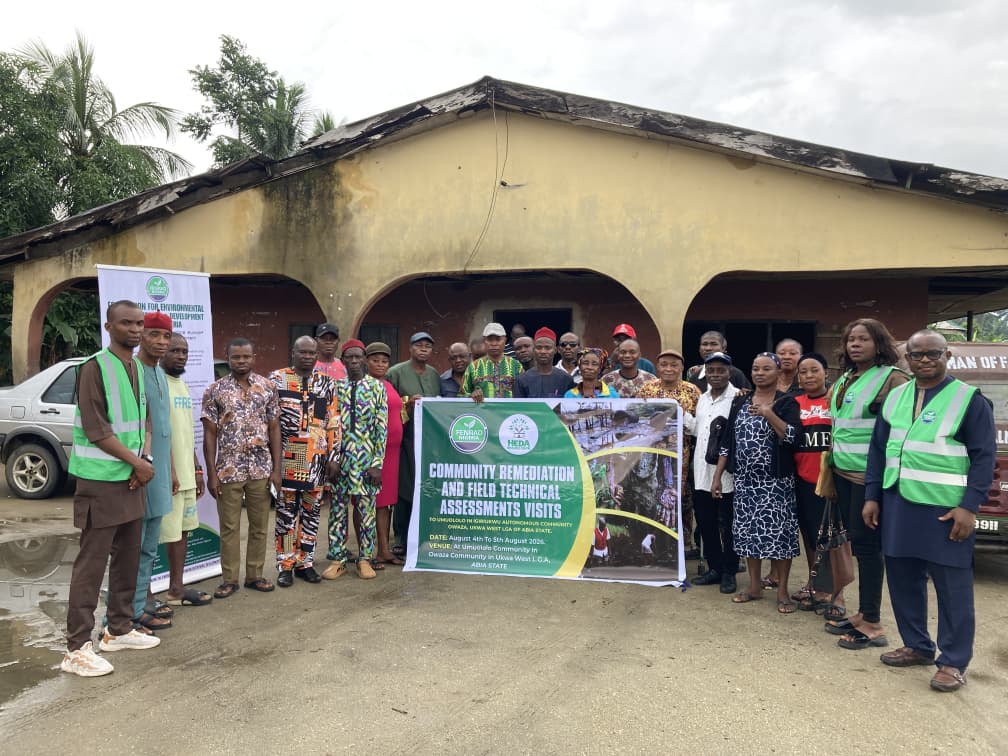
The Foundation for Environmental Rights, Advocacy and Development (FENRAD), in collaboration with the Human and Environmental Development Agenda (HEDA Resource Centre), has called for a transparent and comprehensive Joint Investigation Visit (JIV) into the June 10, 2026 crude oil pipeline explosion at Umuololo, Igiriukwu Autonomous Community, Owaza, Ukwa West Local Government Area of Abia State.
The call followed a three-day joint civil society investigation and community engagement mission by FENRAD and HEDA to the affected community to document the circumstances and impacts of the incident, engage residents and assess concerns relating to the environment, livelihoods and public safety.
Speaking during the engagement, the Executive Director of FENRAD Nigeria, Comrade Nelson Nnanna Nwafor, stressed the need for credible investigation and accountability, noting that the exercise was an independent civil society fact-finding mission aimed at documenting verifiable information and community experiences.
Nwafor said the mission did not seek to prejudge the cause of the explosion or assign liability without adequate evidence, but was focused on gathering field-based information that could support further investigation and appropriate intervention.
The FENRAD-HEDA team inspected the affected area and interacted with community leaders, residents and other stakeholders on issues including pipeline integrity, emergency response, environmental protection, remediation and the possible effects of the incident on livelihoods.
The organisations said concerns raised during the engagement included possible impacts of the explosion and crude oil release on farmlands, soil and vegetation, surface and groundwater, agricultural activities, livelihoods, public health and safety, as well as the wider ecosystem.
Nwafor called for comprehensive environmental sampling and technical assessment by competent authorities to determine whether contamination occurred and establish its extent before appropriate remediation is undertaken.
Also speaking, the Head of Media and Communications at FENRAD, Comrade Chinonso Dinnaya, stressed the importance of involving the affected community in the investigation and subsequent remediation process.
Dinnaya said residents who bear the consequences of environmental incidents should have their voices reflected in investigations, environmental monitoring, remediation, compensation discussions and decisions concerning petroleum infrastructure in their communities.
FENRAD and HEDA consequently demanded a Joint Investigation Visit involving relevant regulatory agencies, the operating company, affected communities and civil society organisations.
They said the investigation should determine the circumstances and immediate causes of the explosion, assess the integrity of the affected pipeline, establish the volume and geographical extent of any crude oil released, and evaluate the adequacy of emergency response and containment measures.
The organisations also called for an assessment of the effects of the incident on livelihoods and community resources, as well as concrete measures to prevent a recurrence.
They urged relevant authorities and petroleum operators to strengthen pipeline integrity management, preventive maintenance, emergency response systems, environmental monitoring and community engagement across the Owaza axis and other oil-producing communities.
According to FENRAD and HEDA, the Umuololo incident has further highlighted concerns over ageing petroleum infrastructure in the Niger Delta, particularly pipeline maintenance, environmental degradation, public safety and emergency preparedness.
The organisations said information gathered during the mission would guide further engagement with regulatory institutions and other stakeholders on environmental assessment, remediation, protection of community livelihoods, accountability and long-term environmental monitoring.
They added that a detailed joint assessment and advocacy report would subsequently document the findings and recommendations arising from the engagement.
FENRAD and HEDA called on government agencies, regulatory authorities, petroleum operators and community leaders to treat the incident with urgency, ensure transparent communication of investigation findings, undertake effective remediation where pollution is established and provide appropriate redress for verified environmental and livelihood impacts.
The organisations maintained that the June 10 explosion should not be treated as an isolated infrastructure incident, but as an opportunity to address broader concerns surrounding pipeline integrity, environmental protection, regulatory oversight and community rights in oil-producing areas.
They reaffirmed their commitment to environmental justice, responsible natural resource governance, accountability and the protection of communities affected by extractive activities.
FENRAD and HEDA said the people of Umuololo and the wider Owaza oil-producing communities deserved transparency, environmental protection and meaningful participation in decisions affecting their lives and livelihoods.