Federal Government has reaffirmed its commitment to advancing organic agriculture as key stakeholders gathered in Umuahia, Abia State, for the 2026 Technical Workshop, Organic Fair and Annual General Meeting of the Association of Organic Agriculture Practitioners of Nigeria (NOAN).
Declaring the event open, the Minister of State for Agriculture and Food Security, Senator Aliyu Sabi Abdullahi, said agriculture remains central to Nigeria’s economy, contributing about 22–25 per cent of GDP and employing over 60 per cent of the workforce. Represented by the Executive Director of the National Horticultural Research Institute (NIHORT), Ibadan, Prof. Atanda Muhammed Lawal, the minister called for the adoption of organic agriculture and agroecology to boost climate resilience, improve soil health, reduce dependence on chemicals and ensure sustainable food systems.
He highlighted ongoing government initiatives, including the 2025 National Agroecology Strategy and the Nigerian Farmers Soil Health Scheme, aimed at enhancing productivity and sustainability. Abdullahi also stressed the need for youth engagement and digital innovation to transform smallholder farming into viable enterprises, urging stronger policy collaboration and investment to position Nigeria as a regional leader in agroecology.
In his welcome address, Abia State Governor, Dr. Alex Otti, represented by the Commissioner for Agriculture, Dr. Cliff Agbaeze, reiterated the state’s commitment to sustainable agriculture, climate resilience and food security. He outlined efforts to promote regenerative farming, soil restoration and climate-smart practices, alongside support for farmers through access to credit, extension services, training and the development of a digital agricultural database.
Otti also highlighted initiatives in renewable energy, afforestation and circular economy practices aimed at improving resource efficiency and driving economic growth.
Earlier, the Permanent Secretary, Federal Ministry of Agriculture and Food Security, Dr. Marcus Olaniyi Ogunbiyi, emphasized the need to strengthen institutional support and capacity building to scale sustainable agricultural practices nationwide.
In her goodwill message, the Vice-Chancellor of Michael Okpara University of Agriculture, Umudike, Prof. Ursula Ngozi Akanwa, described organic agriculture as a science-based solution to Nigeria’s food security and climate challenges. She warned of growing threats from climate change, soil degradation and biodiversity loss, stressing that agroecology has become a “national security imperative.”
Akanwa called for stronger collaboration among government, academia, the private sector and farmers to drive innovation, research and value chain development.
In his remarks, NOAN President, Prof. Jude C. Obi, described the gathering as a “historic convergence of policy, practice and people,” marking a turning point for organic agriculture in Nigeria. He announced the inauguration of a Technical Drafting Committee for the Nigeria Organic Agriculture Policy (NOAP) to fast-track its implementation.
Obi also disclosed plans for a Memorandum of Understanding between NOAN and the Federal Ministry of Agriculture to drive practical interventions, including youth-focused programmes such as the ECOWAS Youth Employability Initiative. He further revealed plans to launch a digital marketplace, supported by AfrONet and the Agroecology Fund, to improve market access for organic producers.
The event featured key capacity-building milestones, including the graduation of participants from the Agroecology and Organic Leadership Course (AOLC) and the Africa Women Leaders in Agroecology (AWOLA) programme, as well as the introduction of a new cohort of female leaders. Obi reaffirmed NOAN’s commitment to empowering women as critical drivers of sustainable food systems.
He acknowledged the support of international partners, including the African Union Commission, Biovision Africa Trust and IFOAM Organics International, in promoting sustainable agriculture across the continent.
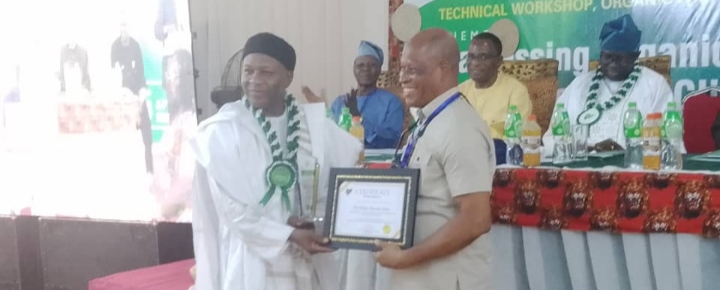
Highlights of the ceremony included the inauguration of a nine-member Technical Policy Drafting Committee, presentation of Awards of Excellence to key stakeholders, and the unveiling of an organic agriculture book titled Green Gold.
Participants were urged to leverage the three-day event to strengthen collaboration, drive innovation and advance policies that will ensure food security, environmental sustainability and inclusive economic growth.