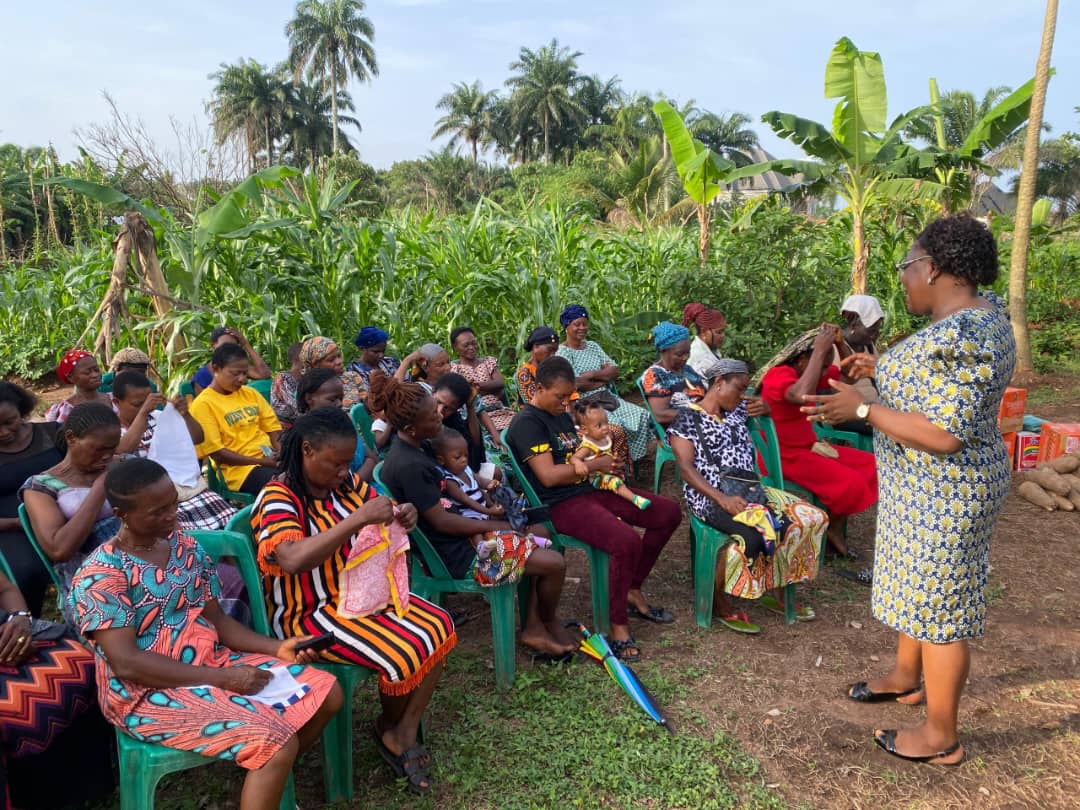
Rural women farmers in Ikputu Nsulu, Isiala Ngwa North Local Government Area of Abia State, have embraced compost and biochar technologies as part of efforts to promote sustainable agriculture, improve soil fertility, and enhance food security in their communities.
Prof. Mabel Ifeoma Onwuka with rural women during an outreach in Abia community recently.
The women benefited from a two-phase capacity-building programme conducted between May and June 2026 by Professor Mabel Ifeoma Onwuka, Director of the Centre for Gender, Youth and Child Development, Michael Okpara University of Agriculture, Umudike (MOUAU), and Founder of Hope for Farmers, Women and Girls Initiative.
The programme was designed to encourage rural women farmers to utilize locally available resources for soil improvement rather than relying heavily on costly inorganic fertilizers.
During the first phase of the training held in May, 60 women farmers received intensive training on soil fertility management, compost production, and biochar technology. Participants were taught practical methods of converting agricultural and household waste into nutrient-rich soil amendments capable of improving soil health, increasing crop productivity, reducing environmental pollution, and supporting a bio-circular economy.
Speaking during the training, Professor Onwuka emphasized the importance of maintaining soil fertility and identified continuous cultivation, erosion, bush burning, nutrient mining, and poor land management practices as major causes of soil degradation.
She encouraged the women to adopt sustainable soil management practices that would improve crop yields while reducing production costs.
A key feature of the programme was the hands-on demonstration of compost and biochar production, which enabled participants to gain practical experience in producing organic soil inputs from materials readily available within their communities.
At the end of the training, food items, including noodles and tubers of yam, were distributed to participants to support their households.
In her vote of thanks, Mrs. Glads Nwoke expressed appreciation to the organizers for bringing the programme to the community. She commended the facilitators for equipping the women with valuable knowledge and assured them that the participants would apply the skills acquired to improve their farming activities.
The second phase of the programme, held in June 2026, trained an additional 10 women farmers on compost production, soil fertility management, and practical soil testing techniques.
Participants were introduced to the use of soil test kits to assess soil pH and nutrient levels, enabling them to make informed decisions on soil management and crop production. They were also taught how to interpret soil test results and apply appropriate soil improvement measures based on the condition of their soils.
As part of the empowerment initiative, the women received planting materials, including vines of Vitamin A-rich UMUSPO 3 orange-fleshed sweet potato, popularly known as “Mother’s Delight,” and amaranthus seeds. The distribution was aimed at improving household nutrition, food security, and agricultural productivity among rural families.
Professor Onwuka noted that empowering women farmers with knowledge of composting, biochar production, and soil testing would enable them to make better use of local resources, reduce dependence on expensive external inputs, and contribute to sustainable food production systems.
Other members of the training team included Professor Nneoma Elechi Obasi, Dr. Ada Ahamefula, Dr. Chikaodi Orikara, and Mr. Chibueze Onyejuruwa, who provided technical support and guidance throughout the programme.
The training forms part of ongoing efforts by the Centre for Gender, Youth and Child Development and Hope for Farmers, Women and Girls Initiative to improve the livelihoods of rural women through agricultural innovation, environmental stewardship, nutrition-sensitive agriculture, and community development.
Participants said the programme equipped them with practical skills to improve soil fertility, increase crop yields, reduce waste, and strengthen food security in their households and communities.