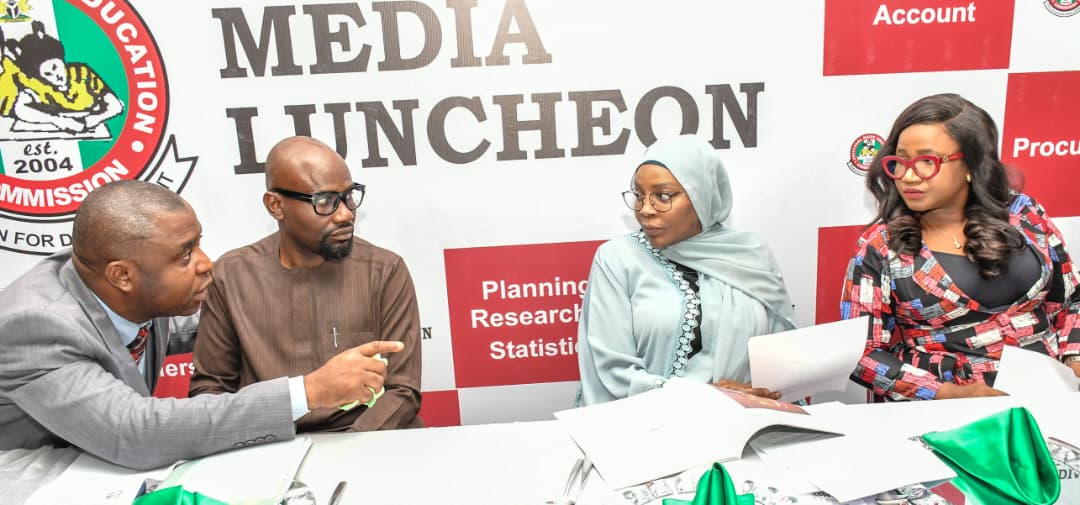
The Universal Basic Education Commission (UBEC) says it has unlocked over ₦100 billion in previously unaccessed matching grants to strengthen basic education across Nigeria through improved infrastructure, teacher development and digital learning initiatives.
UBEC Executive Secretary, Dr. Aisha Garba, disclosed this during a media luncheon with education correspondents in Abuja on Thursday. She said the Commission’s interventions are driven by its 2025–2031 Strategic Blueprint, which aligns with the Federal Government’s Renewed Hope Agenda.
According to Garba, the Commission is prioritising measurable outcomes that will expand access to quality basic education and improve learning across the country.
She revealed that, in partnership with state governments and the Federal Capital Territory Administration, UBEC has financed the construction of more than 4,600 classrooms and the renovation of over 6,100 others. The interventions also include the provision of 2,780 toilet facilities, the drilling of 678 boreholes, and the supply of more than 334,000 pieces of school furniture.
The Executive Secretary added that the Commission has supported the establishment of over 2,300 Early Childhood Care Development and Education Centres to provide a better learning foundation for young children.
On teacher development, Garba said UBEC has invested more than ₦20.4 billion in capacity-building programmes aimed at enhancing classroom teaching and strengthening school leadership. She noted that the funding supports initiatives such as the Effective Schools Programme and the strengthening of School-Based Management Committees to improve accountability and educational outcomes.
She further disclosed that the Commission is accelerating digital education by expanding Digital Literacy Centres, strengthening Smart Schools, and promoting training in artificial intelligence, coding and robotics to equip pupils with future-ready skills.
Garba also announced that more than 7.8 million instructional materials have been distributed nationwide to improve literacy, numeracy and foundational learning.
Beyond infrastructure and technology, she said UBEC is expanding access to education through Open Schooling programmes, the integration of Qur’anic and Tsangaya education, as well as girl-child and inclusive education initiatives.
She added that the Commission has introduced institutional reforms to enhance transparency, strengthen project monitoring and promote data-driven decision-making to ensure accountability in the use of public funds.
In her goodwill message, President of the Nigeria Union of Journalists (NUJ), Grace Ike, described the media as a vital partner in promoting transparency and accountability in the education sector.
She called for sustained engagement between UBEC and education correspondents through regular media briefings, project inspection tours and collaborative storytelling that highlights both achievements and challenges within the sector.
Ike also advocated improved access to education data, specialised training for education reporters, greater transparency in project implementation and procurement, investigative journalism grants, organised field visits and effective feedback mechanisms for journalists.
She urged government, teachers, communities, development partners and the media to strengthen collaboration in ensuring that every Nigerian child has access to safe, inclusive and quality basic education.
Also speaking, Chairman of the Education Correspondents Association of Nigeria (ECAN), Chux Ukwuatu, appealed for closer collaboration between UBEC and education correspondents.
He recommended that journalists be included in project monitoring and inspection visits across the country, noting that firsthand access would enable the media to provide balanced, accurate and comprehensive reports on UBEC’s interventions.
The media engagement marked the first structured interaction between UBEC and education correspondents in over nine years.
Stakeholders at the event described the renewed engagement as a significant step towards improving transparency, strengthening public accountability and advancing quality basic education across Nigeria. They also noted that communication within the education sector has gained fresh momentum following the appointment of Ikharo Attah as Special Adviser on Media and Communications to the Minister of Education.