Emetu Moves to Strengthen Road Safety in Abia, Backs Functional Advisory Council.
— Deputy Governor seeks improved emergency response, safer school zones, support for FRSC operations
The Abia State Government has pledged to strengthen road safety management, improve emergency response to road crashes and support the implementation of the Nigeria Road Safety Strategy II as part of efforts to protect lives and property across the state.
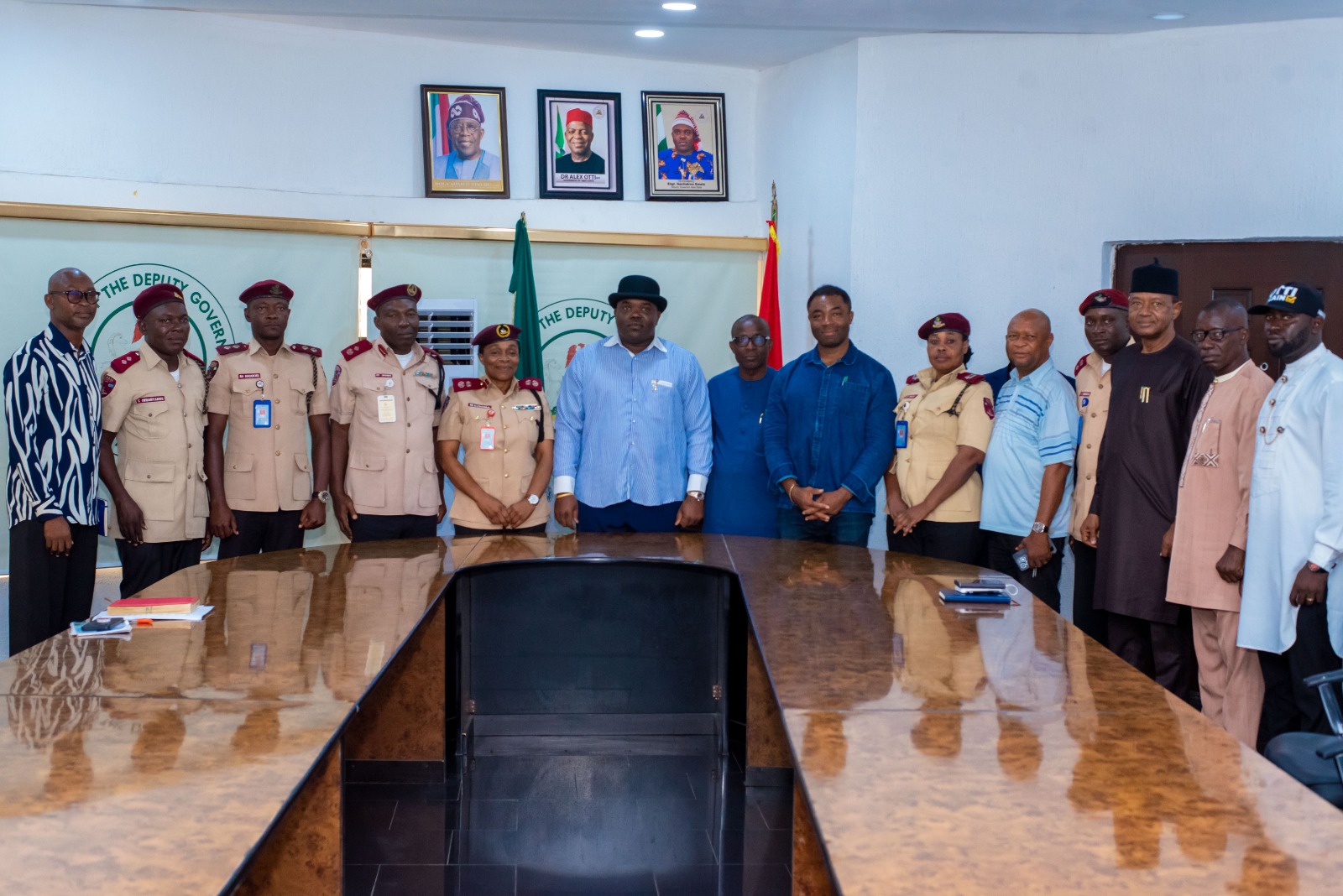
The Deputy Governor, Engr. Ikechukwu Emetu, made the commitment when the Abia State Sector Commander of the Federal Road Safety Corps (FRSC), Corps Commander Ngozi Ezeoma, and her team paid him a courtesy visit at Government House, Umuahia.
Emetu said the state government would give serious consideration to the establishment and strengthening of a functional Abia State Road Safety Advisory Council to coordinate road safety initiatives and ensure effective collaboration among relevant ministries, departments, agencies and security institutions.
He described the FRSC commander’s presentation on the Nigeria Road Safety Strategy II as informative, assuring the delegation that the issues raised would be presented to Governor Alex Chioma Otti for consideration and approval.
According to him, the government’s commitment to a people-oriented administration makes the protection of lives and property a priority.
In the New Abia, we are well known to have a human face, and anything that will keep people on the path of safety is exactly what His Excellency will always champion,” Emetu said.
The Deputy Governor commended the FRSC for providing technical knowledge, data and institutional support to help the state improve its road safety framework.
He also acknowledged the operational challenges confronting the corps, noting that the limited availability of patrol vehicles affected its ability to carry out effective road surveillance.
Emetu said Governor Otti was aware of the challenges and that the state government would gradually provide additional vehicles to the FRSC and other security agencies to strengthen their operational capacity.
On emergency response to road crashes, the Deputy Governor called for a clear policy framework to identify priority areas, define responsibilities and establish the necessary support for effective rescue operations.
He stressed the need for collaboration among the FRSC, the Ministries of Health, Works, Transport, Environment and Education, the Nigerian Society of Engineers and other relevant stakeholders.
Emetu also expressed support for the introduction of speed breakers and other traffic-calming measures around primary and secondary schools to protect children and other vulnerable road users.
He identified road-user behaviour, impatience, disregard for traffic signs, drug and alcohol abuse, and inadequate driver training as some of the factors contributing to road crashes.
The Deputy Governor particularly described the Okwoyi axis as a critical area requiring attention because of reported crashes, adding that accident-prone locations across the state should be identified and appropriate safety measures introduced.
He called for a coordinated approach to road safety, stressing that the government and relevant institutions must work together to make Abia safer for residents and visitors.
Earlier, the Abia State Sector Commander of the FRSC, Corps Commander Ngozi I. Ezeoma, presented the Nigeria Road Safety Strategy II, covering the 2021–2030 period, and solicited the state government’s support for its implementation.
She explained that the strategy seeks to achieve at least a 50 per cent reduction in road traffic fatalities and injuries by 2030, with a long-term vision of zero deaths from road crashes.
Ezeoma said the framework was built around five pillars: road safety management, safer roads and mobility, safer vehicles, safer road users, and post-crash care.
She noted that achieving the objectives required collective responsibility beyond traffic enforcement, with state governments playing important roles in road construction, urban planning, transportation policies, healthcare delivery and public education.
The sector commander urged the state government to strengthen the Road Safety Advisory Council, which would coordinate stakeholders, establish measurable targets and monitor progress towards achieving road safety objectives.
She also called for the integration of road safety features into infrastructure projects, including appropriate road signs, road markings, pedestrian crossings, street lighting, safety barriers and traffic-calming measures at identified high-risk locations.
According to her, the FRSC had previously conducted road safety audits on newly constructed and existing roads in Abia with support from the state government through the Ministry of Works.
Ezeoma further sought improved emergency medical response, stronger ambulance services, better referral arrangements and support for designated hospitals to ensure prompt treatment of crash victims.
She appealed for incentives to sustain the National Community Post-Crash Care Initiative, explaining that trained community volunteers could provide initial assistance to victims before the arrival of emergency responders.
She also advocated road safety clubs in schools, safe-school-zone programmes, public awareness campaigns on children’s transportation and improved pedestrian facilities around schools, markets, hospitals and motor parks.
On operational needs, Ezeoma requested additional patrol and rescue vehicles, as well as support to enable the newly established FRSC units at Ekwunna and Obowo to commence full operations.
She commended Governor Otti for his commitment to infrastructure development and road safety, particularly the donation of a new official vehicle to the sector commander for operational purposes.
Also speaking, the Commissioner for Transport, Sir Isaac Ukaegbu, described the visit as an important engagement that would strengthen collaboration between the state government and the FRSC.
Ukaegbu said the discussions aligned with the administration’s transformation of infrastructure and public transportation, adding that the state was also working towards a smart national transport database focused on electronic ticketing and traffic-violation control.
He assured the FRSC of the ministry’s willingness to collaborate with the corps, particularly on safety concerns identified at the Prof. Nnenna Oti Mega Bus Terminal and other public transportation facilities.
The meeting underscored the need for sustained cooperation between the Abia State Government and the FRSC to improve road safety, strengthen emergency response and reduce traffic-related deaths and injuries across the state.