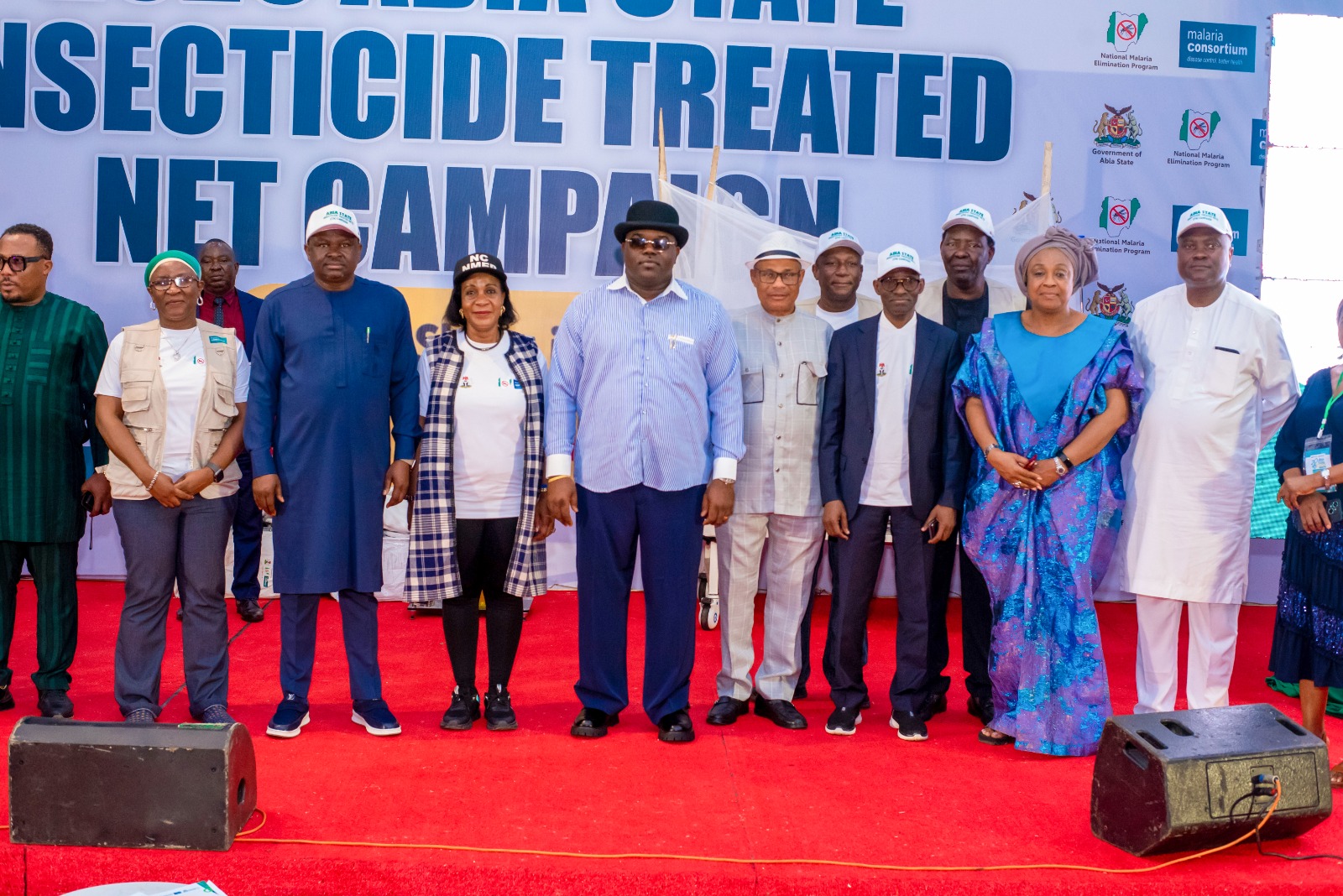
Otti Flags Off ITN Campaign, Targets Malaria Reduction Across Abia.
—-Over Three Million Mosquito Nets to Be Distributed to Households in 17 LGAs.
Abia State Governor, Dr. Alex Chioma Otti, has flagged off the 2026 Insecticide-Treated Nets (ITNs) campaign, aimed at reducing malaria infections and deaths through the distribution of more than three million mosquito nets across the state’s 17 local government areas.
The governor flagged off the campaign at the JAAC Building, Ogurube Layout, Umuahia, Abia State.
Represented by his deputy, Engr. Ikechukwu Emetu, Governor Otti described the campaign as a significant step in his administration’s commitment to protecting residents against malaria, noting that disease prevention was an investment in human capital, productivity and sustainable development.
He observed that malaria remained a major public health challenge, particularly among children under five, pregnant women and other vulnerable groups, while also imposing financial burdens on households and the healthcare system.
According to him, insecticide-treated nets remain one of the most effective and accessible tools for malaria prevention, stressing that the success of the campaign would depend not only on the number of nets distributed but also on their proper and consistent use by beneficiaries.
The governor call
ed on healthcare workers, distribution teams, community volunteers and local government officials to ensure that the exercise was transparent, equitable and effectively monitored, with particular attention to rural and hard-to-reach communities.
He also urged traditional rulers, religious leaders, town union presidents, women and youth organisations to mobilise their communities, address misconceptions about the campaign and encourage households to sleep under the nets every night.
Otti further advised residents to complement the use of mosquito nets with environmental sanitation, the elimination of stagnant water, proper refuse disposal and prompt medical attention whenever malaria symptoms occur.
He reaffirmed his administration’s commitment to improving healthcare delivery through preventive medicine, public education, disease surveillance and community-based interventions.
Earlier, the Commissioner for Health, Professor Enoch Ogbonnaya Uche, said the state had recorded encouraging progress in malaria control, with prevalence declining from 14.5 per cent in 2021 to 11 per cent in 2025.
Uche attributed the improvement to interventions by the state government and its partners, including mass mosquito-net distribution campaigns and larval source management, which targets mosquito breeding sites.
He disclosed that the Otti administration had embarked on the reconstruction of 200 primary healthcare centres, with 185 completed and 151 operationalised, while general hospitals were also being upgraded.
The commissioner added that the Abia State Health Insurance Agency, which previously existed largely on paper, had registered close to 300,000 residents to improve access to affordable healthcare.
He said the 2026 ITN campaign presented another opportunity to further reduce malaria prevalence, emphasising that the nets must reach their intended beneficiaries and be used correctly and consistently.
Also speaking, the Coordinating Minister of Health and Social Welfare, Professor Muhammad Ali Pate, represented by Dr. Nnenna Ogbulafor, described the campaign as significant, noting that Abia had not benefited from a mass distribution of mosquito nets on such a scale for about 10 years.
She said the campaign demonstrated the commitment of the Federal Government, the Abia State Government and development partners to protecting families against malaria through the ownership and consistent use of insecticide-treated nets.
According to her, the 2025 Nigeria Malaria Indicator Survey showed that national malaria prevalence had declined from 22 per cent in 2021 to 15 per cent in 2025, while Abia recorded a reduction from 14.5 per cent to 11 per cent within the same period.
She, however, cautioned that the decline did not mean malaria had been eliminated, urging stakeholders to intensify preventive measures and community engagement.
Ogbulafor disclosed that the campaign would adopt a single-phase, door-to-door distribution strategy across all 17 local government areas, with digital technology deployed to improve household registration, data quality, accountability and operational efficiency.
She added that larval source management had commenced in two local government areas with support from the World Bank-supported Impact Project, while a recycling initiative would ensure the environmentally responsible management of waste generated during the campaign.
The minister’s representative commended the Abia State Government and development partners, including the Global Fund, Malaria Consortium, World Health Organisation and other supporting organisations, for their contributions to malaria prevention.
In his remarks, the West and Central Africa Programmes Director of Malaria Consortium, Dr. Kolawole Maxwell, said more than three million nets would be distributed across the state, with about 5,000 trained personnel expected to commence door-to-door distribution on October 26.
Maxwell explained that the nets contained two active ingredients, a pyrethroid and chlorfenapyr, designed to provide protection even in areas where mosquitoes had developed resistance to older insecticides.
He said households would be digitally registered and the nets tracked, with one net allocated for every two persons to ensure adequate coverage.
The Malaria Consortium director stressed that the nets would be distributed free of charge and warned against their sale, diversion or hoarding.
He urged residents to welcome distribution teams, hang their nets properly, sleep under them every night, repair tears promptly and wash them only when necessary and in accordance with the guidance provided by campaign personnel.
Maxwell further disclosed that the campaign would be monitored by Malaria Consortium and an independent organisation to assess household ownership, consistent use and the intervention’s impact on malaria over time.
He also announced that the First Lady of Abia State, Mrs. Priscilla Chidinma Otti, had agreed to serve as the state’s ITN Ambassador.
In his closing remarks, the Executive Secretary of the Abia State Primary Health Care Development Agency, Dr. Kalu Ulu Kalu, expressed appreciation to the state government, the Ministry of Health, development partners, health workers and other stakeholders for their contributions to the campaign.
He urged the media, community leaders and health authorities to sustain public awareness and ensure that the campaign’s message reached every community in the state.
The highlight of the event was a presentation by Malaria Consortium outlining the ITN campaign’s distribution strategy, household registration process, monitoring arrangements and measures to promote the proper use of the nets.