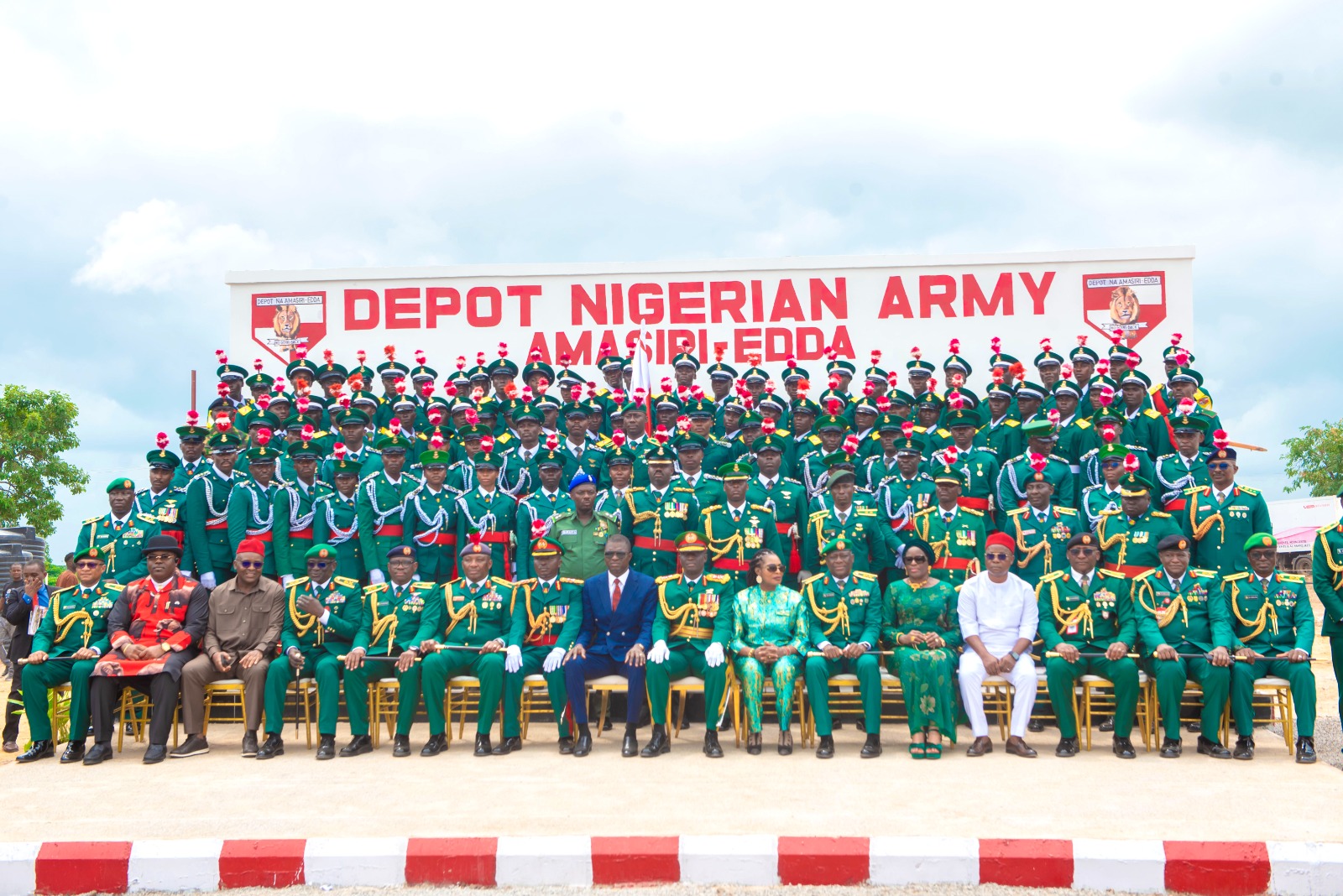
COAS Shaibu, Otti and Nwifuru reaffirm commitment to national security at the passing-out parade of pioneer Army recruits.
The Chief of Army Staff (COAS), Lieutenant General Waidi Shaibu, has called on youths from the South-East to take advantage of opportunities in the Nigerian Army by enlisting for military service, lamenting that recruitment quotas allocated to the region have consistently remained underutilised.
The Army Chief made the appeal on Wednesday during the maiden Passing-Out Parade of the pioneer recruits of the 90 Regular Intake at the newly established Depot Nigerian Army, Amasiri-Edda, in Ebonyi State.
Describing the ceremony as a historic milestone, Shaibu said the depot, established on November 25, 2025, is the third recruit training depot of the Nigerian Army and the first primary military training institution in Nigeria’s South-East geopolitical zone.
According to him, the establishment of the training institution demonstrates the Federal Government’s commitment to national integration, inclusiveness and balanced development, while strengthening the operational capacity of the Nigerian Army to address emerging security challenges.
The Army Chief disclosed that the pioneer recruits are part of the first batch of 14,000 personnel approved under President Bola Ahmed Tinubu’s strategic force expansion initiative, which aims to recruit 28,000 soldiers into the Nigerian Army.
He charged the graduating soldiers to remain disciplined, loyal and professional throughout their careers, stressing that they must uphold human rights, comply with the Armed Forces’ rules of engagement and avoid the misuse of social media.
Shaibu warned that the unauthorised release of operational information, photographs and other sensitive military materials on social media could attract severe disciplinary measures, including dismissal from service.
He also assured personnel of the Federal Government’s continued commitment to improving their welfare through better accommodation, healthcare, training, equipment and investment in local defence production.
The Army Chief commended the Governor of Ebonyi State, Francis Ogbonna Nwifuru, for supporting the establishment of the depot and acknowledged the contributions of the host communities, instructors and training staff towards the successful graduation of the pioneer intake.
Representing the Governor of Abia State, Alex Chioma Otti, the Deputy Governor, Ikechukwu Emetu, described the event as a major boost to Nigeria’s security architecture and regional development.
Emetu said security remains the foundation for sustainable economic growth and investment, noting that the Abia State Government would continue to collaborate with security agencies to promote peace and stability across the South-East.
He commended the Nigerian Army for expanding its training capacity and praised the leadership of the Chief of Army Staff for modernising military training institutions nationwide.
Earlier, Governor of Ebonyi State, Barr. Francis Nwifuru described the establishment of the depot as a landmark achievement for Ebonyi State and Nigeria, saying it would strengthen national security, stimulate economic activities, improve infrastructure and deepen civil-military relations.
The governor reaffirmed Ebonyi State’s commitment to supporting the Nigerian Army and appealed for the completion and equipping of the proposed Nigerian Military Reference Hospital in the state to serve the South-East region.
He also requested the release of about 982.7 hectares of Army land in Abakaliki to facilitate the city’s expansion, pledging that the state government would, in return, construct major healthcare and support facilities for the depot.
The ceremony featured colourful slow and quick march-pasts by the pioneer recruits, presentation of awards to outstanding recruits and instructors, and the conferment of the traditional chieftaincy title “Omeudo I” on the Chief of Army Staff by the Ebonyi State Council of Traditional Rulers.
The event attracted serving and retired military officers, senior government officials, traditional rulers, clergy, captains of industry, members of the diplomatic community, families of the graduating recruits and other distinguished guests from across the country.