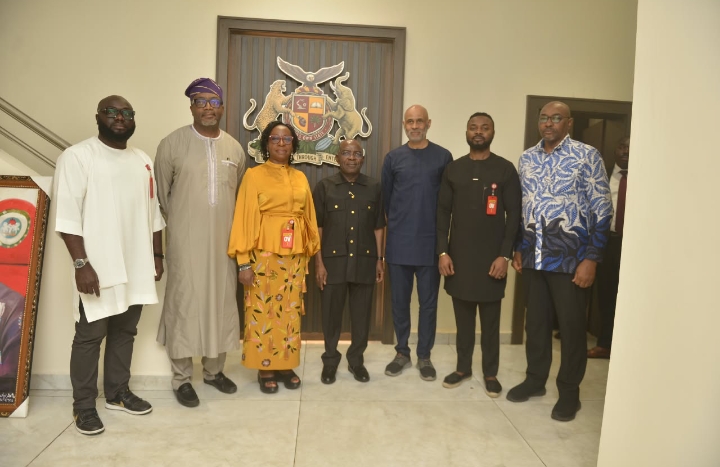
Governor Alex Otti of Abia has backed the training of another 1,000 youths in digital technology following the progress recorded under the ThriveAbia initiative.
Governor Otti gave the indication on Tuesday during a meeting with the TechEccentric team at Nvosi, Isiala Ngwa South Local Government Area.
He said the next phase should commence without delay, stressing the need for a transparent, merit-based selection process.
The governor suggested computer-based testing and staged screening to ensure that qualified candidates benefited from the programme.
He said the initiative aligned with his administration’s commitment to creating jobs, empowering young people and reducing crime through productive engagement.
Governor Otti also said the state’s connectivity project was 77 per cent complete, adding that the government was partnering with MTN to expand 3G network coverage.
He expressed satisfaction that the pilot phase of the initiative comprised 100 participants, with 87 per cent completing the training and about half of the graduates already earning income, some in foreign currencies.
Governor Otti said his administration was modernising education curricula to accommodate emerging technologies, including artificial intelligence and robotics.
He added that the government planned to establish 20 smart schools and cited the recent success of Abia public-school pupils at a competition in Qatar.
The governor reaffirmed his administration’s commitment to expanding digital skills training and working with TechEccentric to determine the requirements and timetable for the next phase.
In his address, the Commissioner for Science and Technology, Mr David Kalu, said that more than 87 per cent of the 100 participants in the pilot ThriveAbia programme successfully completed the training.
Kalu said that more than 50 per cent of the graduates were already earning income, with some working remotely for foreign employers and earning foreign exchange, adding that more than 50 per cent of the participants were female.
Kalu said that the pilot programme had provided valuable lessons, which the TechEccentric team would present in a brief report, alongside requests to the state government.
He said that some graduates faced challenges securing international jobs because certain foreign employers were reluctant to hire Nigerians.
Kalu also cited poor internet connectivity as a barrier, recounting difficulties experienced by a prospective international contact in Morocco.
He appealed to the government to provide shared workspaces with reliable internet access for AbiaThrive and TechRise graduates.
In her remark, the Programme Implementation Manager of TechEccentric,Mrs Doris Akpovwa, attributed the achievements recorded under ThriveAbia to the support of the state government.
Akpovwa said the dedication and commitment of government officials working with her team had contributed significantly to the milestones recorded by the programme.
She thanked the state government for providing the opportunity to train Abia youths in digital technology.
In his presentation, the co-founder of TechEccentric,Mr Gilbert Igwe, said the team was considering expanding the programme to 2,000 participants, as part of a broader target to train 10,000 Abia residents.
Igwe said the team was developing three startup ideas focusing on an emergency alert application designed to work without internet access, early diabetes tracking and food technology.
He also discussed a proposed digital marketplace for artisans, initially targeting the leather industry, with identity verification and safeguards to protect payments during transactions.
Igwe proposed using the United Nations Development Programme-supported UniPod at Michael Okpara University of Agriculture, Umudike, to train youths in embedded systems, flat-pack furniture production and battery storage technology.
He projected that the initiative could contribute up to 100 million dollars to Abia’s gross domestic product if fully developed.
Igwe also proposed an initiative, Abia for Global Services, to connect trained workers with opportunities in customer support, data processing, research, design, social media and virtual assistance.
According to him, the initiative could provide opportunities for up to 5,500 people within three years.
He further highlighted Steluma, a digital STEM learning tool that uses interactive visualisation to teach subjects including physics, mathematics, chemistry and biology.