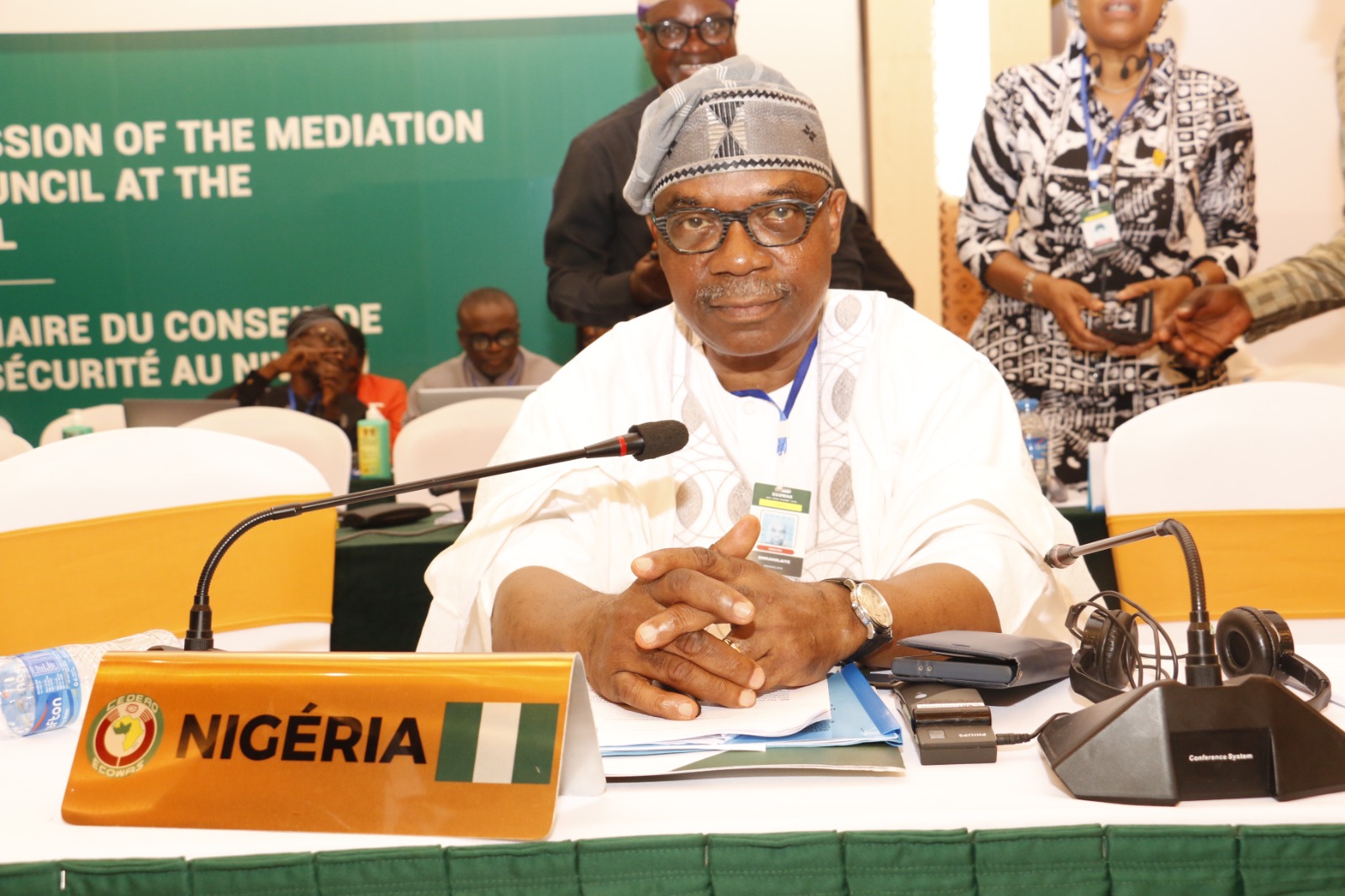
Nigeria has reaffirmed its commitment to regional peace, security, democracy and economic integration, calling on member states of the Economic Community of West African States (ECOWAS) to strengthen collective action against terrorism, transnational crime and emerging security threats across West Africa.
The position was presented by the Honourable Minister of State for Foreign Affairs, Ambassador Sola Enikanolaiye, during the 56th Session of the ECOWAS Mediation and Security Council at the Ministerial Level, held last ,Wednesday in Freetown, Sierra Leone.
Responding to remarks by the President of the ECOWAS Commission, Dr. Omar Alieu Touray, the Chairperson of the Council and Sierra Leone’s Minister of Foreign Affairs, Timothy Musa Kabba, alongside other regional leaders, Ambassador Enikanolaiye outlined Nigeria’s position on key issues affecting the sub-region.
The Minister stressed the importance of the prompt payment of the ECOWAS Community Levy by member states, describing it as the financial backbone of the regional organisation. He noted that Nigeria has continued to demonstrate leadership by meeting its obligations despite facing significant domestic economic and developmental challenges.
Addressing the growing threat of terrorism, piracy, banditry and transnational organised crime, Ambassador Enikanolaiye called for a renewed and coordinated regional strategy. He highlighted Nigeria’s intensified security operations, saying improved collaboration among security, intelligence and law enforcement agencies has resulted in the rescue of kidnapped victims, the arrest of criminal elements and enhanced security in the Gulf of Guinea, allowing uninterrupted economic activities.
On democracy and governance, the Minister highlighted reforms and achievements under the administration of President Bola Ahmed Tinubu and reaffirmed Nigeria’s commitment to conducting credible, free and fair general elections in 2027. He noted that Nigeria’s uninterrupted democratic transitions since 1999 demonstrate the country’s dedication to constitutional governance and extended an invitation to ECOWAS member states and international observers to monitor the 2027 elections.
Ambassador Enikanolaiye also condemned rising Afrophobic violence in South Africa, describing attacks against fellow Africans as unacceptable and contrary to the ideals of African solidarity. He recalled Nigeria’s historic sacrifices during the struggle against apartheid, including financial contributions through public sector deductions and sustained diplomatic support for South Africa’s liberation.
He urged the Council to adopt a strong collective position on the issue for onward submission to the African Union, in line with an earlier proposal by Ghana.
The Minister further advocated sustained dialogue with Burkina Faso, Mali and Niger—the member states of the Alliance of Sahelian States (AES)—as well as continued engagement with Guinea-Bissau. He said inclusive dialogue remains essential to promoting democracy, regional stability, peace and sustainable development across West Africa and the Sahel.
According to him, ECOWAS should develop innovative and effective engagement strategies that reflect the changing global security environment and the evolving geopolitical realities affecting the region.
The 56th Session of the ECOWAS Mediation and Security Council brought together foreign ministers and senior regional officials to deliberate on pressing political, security and governance challenges facing West Africa, with Nigeria reaffirming its leadership role in advancing regional cooperation and collective security.