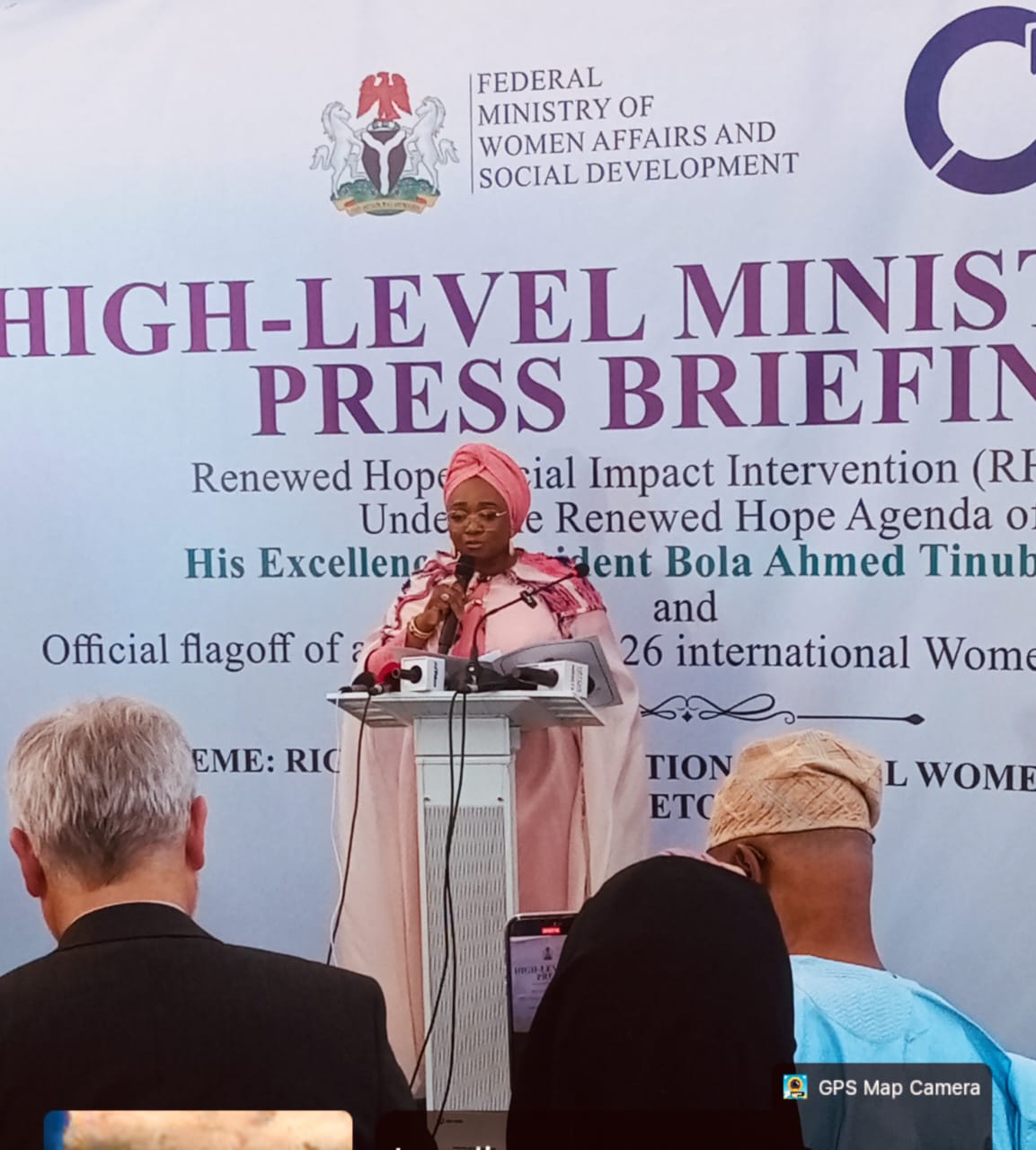
The Federal Ministry of Women Affairs and Social Development has officially flagged off activities marking the 2026 International Women’s Day and Women’s Month, while unveiling a series of social impact programmes aimed at empowering women, strengthening families and protecting vulnerable groups across the country.
Speaking during a ministerial press briefing in Abuja ahead of Nigeria’s participation at the 70th Session of the Commission on the Status of Women (CSW70) in New York, the Minister of Women Affairs and Social Development, Imaan Sulaiman-Ibrahim, said the 2026 commemoration goes beyond ceremony and reflects a national commitment to achieving measurable progress for women and families.
According to the minister, this year’s celebration, themed “Rights. Justice. Action. For All Women and Girls,” with the campaign slogan “Give to Gain,” underscores the need to institutionalise equality, enforce justice and deliver tangible outcomes for women and girls across Nigeria.
She reaffirmed the commitment of President Bola Ahmed Tinubu’s administration to advancing inclusive development through the Renewed Hope Agenda.
“Under the leadership of President Bola Ahmed Tinubu, the Federal Ministry of Women Affairs will not relent in its pursuit of a Nigeria where every family is stable and economically secure, every woman and girl is empowered to realise her full potential, and every child is protected and nurtured to thrive,” she said.
Highlighting progress in social protection programmes, Sulaiman-Ibrahim disclosed that Nigeria has significantly expanded its safety net interventions over the past decade.
She explained that while fewer than one million households were enrolled in formal social protection programmes in 2015, the figure has increased to over 9.4 million households by 2026, with women accounting for more than 70 per cent of the primary beneficiaries.
The minister also commended President Tinubu for declaring 2026 as the Year of Families and Social Development, describing the move as a strategic step that places families, women and children at the centre of Nigeria’s development agenda.
She further unveiled key initiatives under the Renewed Hope Social Impact Interventions 774, which she described as one of the most extensive investments in women’s empowerment in Nigeria’s history.
The initiatives include the EmpowerHer774 Programme, Nigeria for Women Programme Scale-Up, Women Agro-Value Expansion and Farm-to-Feed Initiative, PowerHer774, Women in Gas Programme, Women-on-Wheels Initiative, Women-Led MSME Expansion and Access to Finance Programme, as well as the Family First Project and Care Economy reforms.
According to the minister, the programmes are designed to expand access to livelihoods, digital inclusion, clean energy, enterprise development and financial support for women across all 774 local government areas of the country.
She also disclosed that the Federal Government is intensifying efforts to address gender-based violence through the expansion of Sexual Assault Referral Centres (SARC) nationwide.
“Nigeria currently operates about 50 Sexual Assault Referral Centres across the country. While this marks progress, it remains insufficient for a population exceeding 200 million,” she noted, stressing the need to strengthen survivor-centred services and prevention mechanisms.
Speaking at the event, the Minister of Finance and Coordinating Minister of the Economy, Wale Edun, reaffirmed the government’s commitment to inclusive economic growth and social protection.
“A resilient and prosperous economy cannot be built without empowering women, strengthening families and safeguarding the wellbeing of vulnerable members of society,” he said.
Edun added that direct benefit transfers under social investment programmes have already reached about nine million households, with plans to expand coverage to 15 million households nationwide.
Also speaking, the Minister of State for Education, Suwaiba Said Ahmad, praised the administration’s commitment to women’s empowerment and social development, noting that the declaration of 2026 as the Year of Social Development further demonstrates government’s dedication to supporting women and strengthening families.
Similarly, the Minister of State for Labour and Employment, Nkeiruka Onyejeocha, called for stronger political representation for women and advocated support for the proposed Reserved Special Seats Bill.
She stressed that Nigerian women possess the capacity to excel in leadership and governance if given greater opportunities.
Delivering remarks on behalf of development partners, the Country Representative of UN Women in Nigeria, Beatrice Eyong, described women’s empowerment as both a human rights obligation and an economic necessity.
“Empowering women is not charity; it is a smart economic strategy. When women earn income, families become stronger, communities improve and national economies grow,” she said.
Eyong added that UN Women continues to support Nigeria in advancing women’s leadership, economic empowerment, prevention of gender-based violence, and women’s participation in peace and security processes.
Also speaking, the Head of the European Union Delegation to Nigeria, Gautier Mignot, emphasised that gender equality is essential for societal prosperity.
According to him, societies that fully harness the potential of women and girls are more productive, prosperous and inclusive.