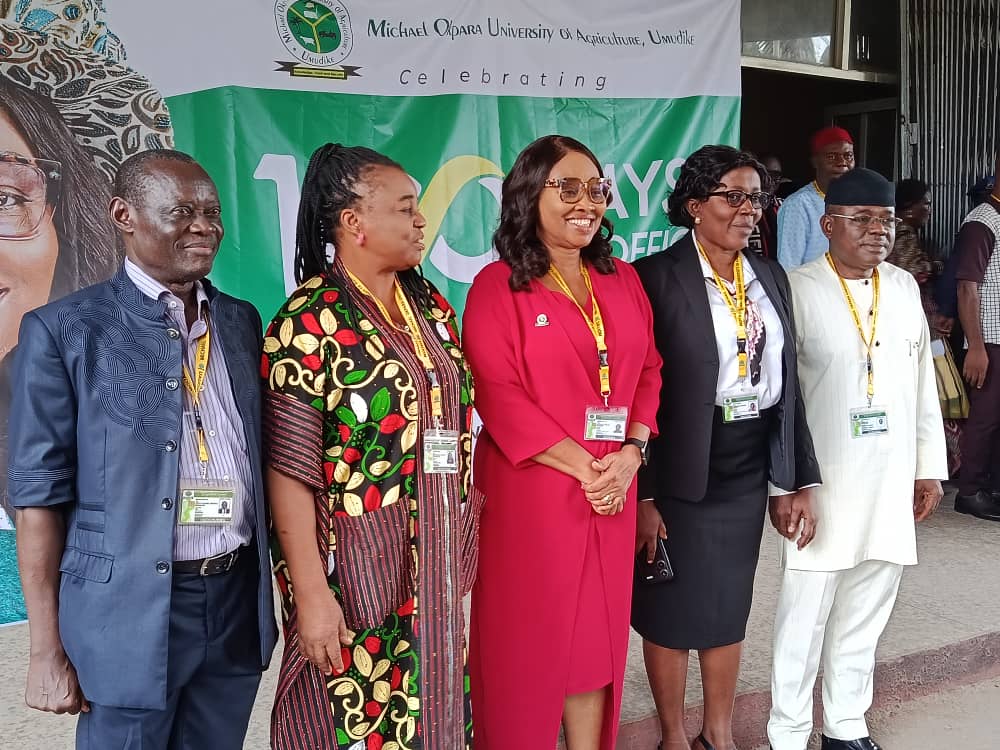
The Vice-Chancellor of Michael Okpara University of Agriculture, Umudike (MOUAU), Prof. Ursula Ngozi Akanwa, has highlighted a series of transformative achievements recorded within her first 100 days in office, describing the period as one focused on consolidation, innovation, institutional reforms, and sustainable development.
Speaking during the celebration of her 100 days in office held at the New Public Lecture Theatre on Monday, Prof. Akanwa the institution’s seventh and first female Vice-Chancellor—said her administration has taken deliberate steps to strengthen academic excellence, staff and student welfare, security, research, agricultural development, and the university’s global visibility.
She noted that the revival of the university’s once-moribund AGRI-VOICE 106.9 FM station stands out among the achievements, as it now serves as a platform for agricultural extension services, dissemination of research findings, climate-smart farming education, and improved communication within the university community.
The Vice-Chancellor disclosed that her administration had cleared salary shortfalls and arrears, paid outstanding allowances and honoraria to staff, improved promotion processes, and introduced policies that have made course registration and examination administration more seamless for students.
She further revealed that major governance reforms including the separation of the Procurement Unit from the Directorate of Physical Planning and the restructuring of the university’s security architecture have significantly improved transparency and campus safety.
According to her, security operatives have successfully curbed burglary incidents and contained cult-related disturbances, restoring confidence among staff and students.
Prof. Akanwa also announced ongoing efforts to position the university for greater international recognition through improved research visibility, global ranking initiatives, staff development programmes, and strategic collaborations.
She added that the university has invested in research projects, expanded agricultural production through large-scale cassava cultivation, secured support from intervention agencies, restored environmental sanitation across the campus, and strengthened relations with host communities.
The Vice-Chancellor expressed gratitude to the Governing Council, management team, staff, students, and stakeholders for their support, pledging to sustain reforms that will enhance academic excellence, food security, innovation, and institutional growth in the years ahead.