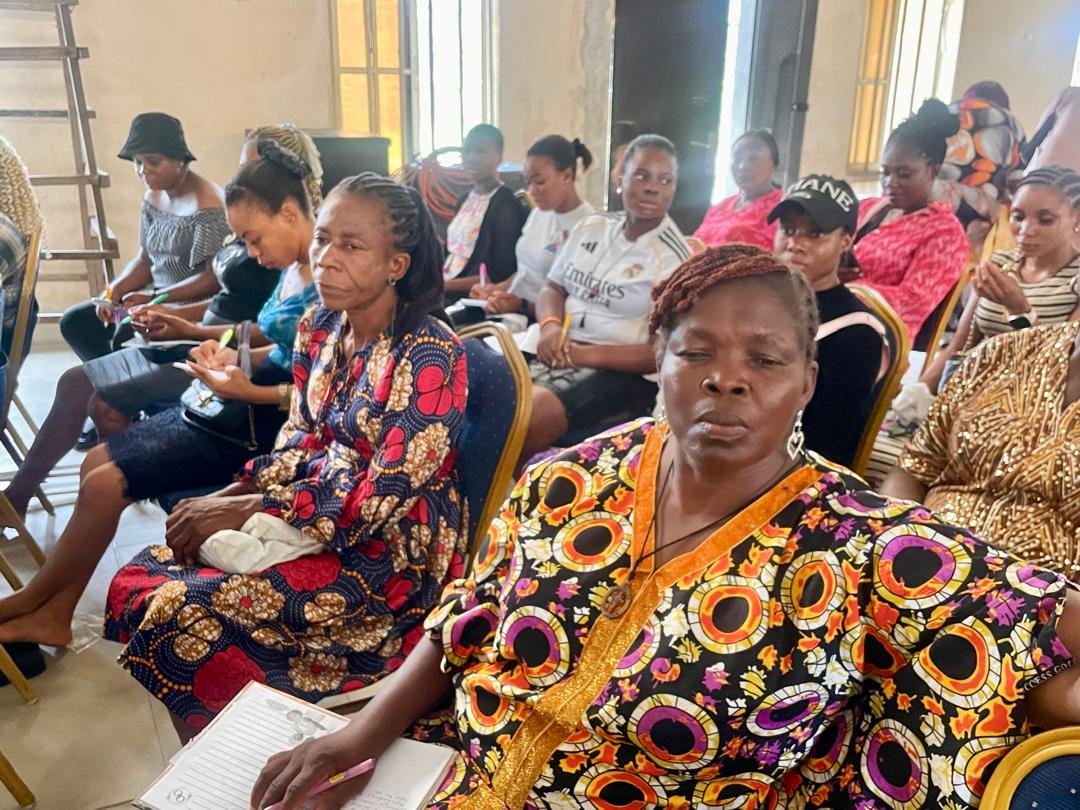
The Health of Mother Earth Foundation (HOMEF), alongside its partners, have trained over 60 farmers in Abia State on agroecology and the potential implications of genetically modified organisms (GMOs) on farming, food systems and the environment.
The practical training, held at the incubation centre in Aba, exposed farmers to the principles of agroecology, organic farming practices and the need for farmers to maintain greater control over their seeds, soil and food production systems.
The programme also provided participants with information on genetically modified crops and encouraged them to critically examine the implications of adopting GMO-based agricultural practices.
Speaking during the sensitization, the founder of Network of Women in Agriculture Nigeria, Ejim Lovelyn Nnenna, urged farmers to prioritize organic farming practices and avoid agricultural products that could negatively affect soil fertility.
She also advised farmers to distinguish between genetically modified crops and hybrid varieties, stressing the importance of using appropriate planting materials suited to their farming systems.
Mrs Ejim Lovelyn Nnenna
Another facilitator and Farm Manager of Be The Help Foundation Agro Forestry, Chukwu Agozirim, explained that agroecology promotes farming practices that work with nature while preserving the productive capacity of the soil for future generations.
He identified several principles of agroecology, including the production and use of organic manure and pesticides, mulching, mixed cropping or polyculture, crop rotation, composting and avoidance of bush burning.
According to him, crop rotation can help reduce pest attacks, while other agroecological practices contribute to improving soil fertility and protecting the environment.
The training culminated in a practical session where participants were taught how to produce organic fertilizer and pesticides using locally available materials.
A cassava farmer and participant, Uju Nwankwo, during an interview, commended HOMEF and its partners for organizing the programme, saying the knowledge acquired on organic fertilizer production would be useful in her farming activities.
She said she would also share the knowledge with other farmers in her community to encourage reduced dependence on chemical fertilizers.
Another participant, Precious Chima, a vegetable farmer, said the training had increased his understanding of agroecology and strengthened his interest in organic farming practices.
He called for greater attention from government and policymakers to sustainable agricultural practices and measures that would protect farmers, consumers and the environment.
Representing HOMEF, Gift Esele Ojeanelo explained that the foundation organized the practical training because it considers agroecology an important pathway towards sustainable food production and addressing environmental and climate-related challenges.
She said the organization was concerned about the growing presence of GMOs within food systems and the promotion of genetically modified seeds as part of efforts to address food insecurity.
According to her, HOMEF believes agroecology can contribute to food security while promoting food sovereignty, protecting ecosystems and improving the economic value of farming.
She noted that HOMEF, alongside its partners and the GMO-Free Alliance Network, had been promoting agroecology for more than six years and advocating for policies that would establish agroecology as a key approach to Nigeria’s food system.
She said similar training programmes had been organized in Abuja, Ogun, Osun, Lagos, Enugu and other parts of the country, adding that the Aba programme was designed to extend the initiative to farmers in Abia State.
She further disclosed that a pre-training survey was conducted to assess participants’ existing knowledge of agroecology and GMOs, while a post-training assessment showed increased knowledge among the farmers.
The organization urged the participants to put the knowledge acquired into practice and share it with other farmers in their communities.
HOMEF said the training was part of its broader effort to promote sustainable farming, strengthen farmers’ control over their food systems and encourage agricultural practices that protect soil fertility and the environment.
The farmers were also trained on the production and application of organic fertilizers and pesticides.