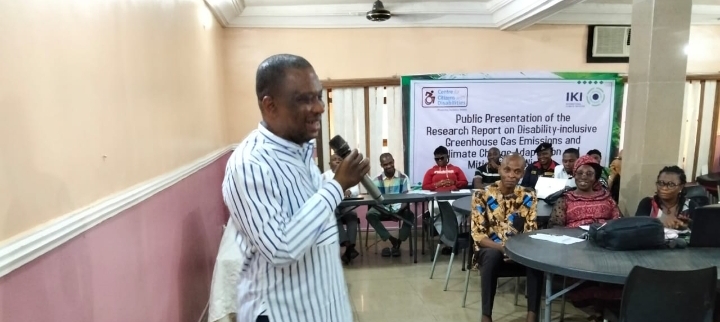
The Centre for Citizens with Disabilities (CCD) has called for a review of Nigeria’s national climate change policy to ensure that persons with disabilities are fully integrated into climate change planning, adaptation and mitigation programmes.
The call was made by the Founding Executive Director of CCD and Chairman of the Abia State Commission for the Welfare of Disabled Persons, Dr. David O. Anyaele, during the unveiling of the organisation’s research report, Disability-Inclusive Greenhouse Gases and Climate Change Adaptation and Mitigation in Nigeria, in Umuahia, Abia State.
Anyaele said while climate change affects everyone, persons with disabilities often face disproportionate impacts due to barriers to essential services, information, participation and decision-making.
He said the research revealed gaps in Nigeria’s national climate change policy regarding the recognition and participation of persons with disabilities.
He therefore called for their inclusion in the Climate Change Council and other relevant decision-making structures, stressing that government agencies implementing climate-related programmes must take the specific needs of persons with disabilities into consideration.
“We strongly believe that implementing the recommendations of this research will go a long way towards reducing exclusion and non-participation of people with disabilities in climate change responses in Nigeria,” he said.
Anyaele explained that persons with disabilities were directly involved in the research, with data gathered from members of the disability community to assess their experiences and interactions with government agencies, non-governmental organisations and development partners working on climate change issues.
He said their perspectives were also incorporated into the design and finalisation of the report, noting that the objective was to ensure that persons with disabilities were not left behind in Nigeria’s climate change response.
The CCD director disclosed that the research had already contributed to climate policy discussions in Abia State, where relevant government agencies participated in the report’s validation process.
He added that members of the disability community were also given an opportunity to contribute to the state’s emerging climate change policy.
According to him, CCD, in collaboration with stakeholders, engaged the Special Assistant to the Abia State Governor on Climate Change and presented the policy document to representatives of the disability community for their contributions.
Anyaele expressed optimism that the initiative would help produce a stronger and more inclusive climate change policy for Abia State, with the needs and interests of persons with disabilities adequately reflected in mitigation and adaptation programmes.