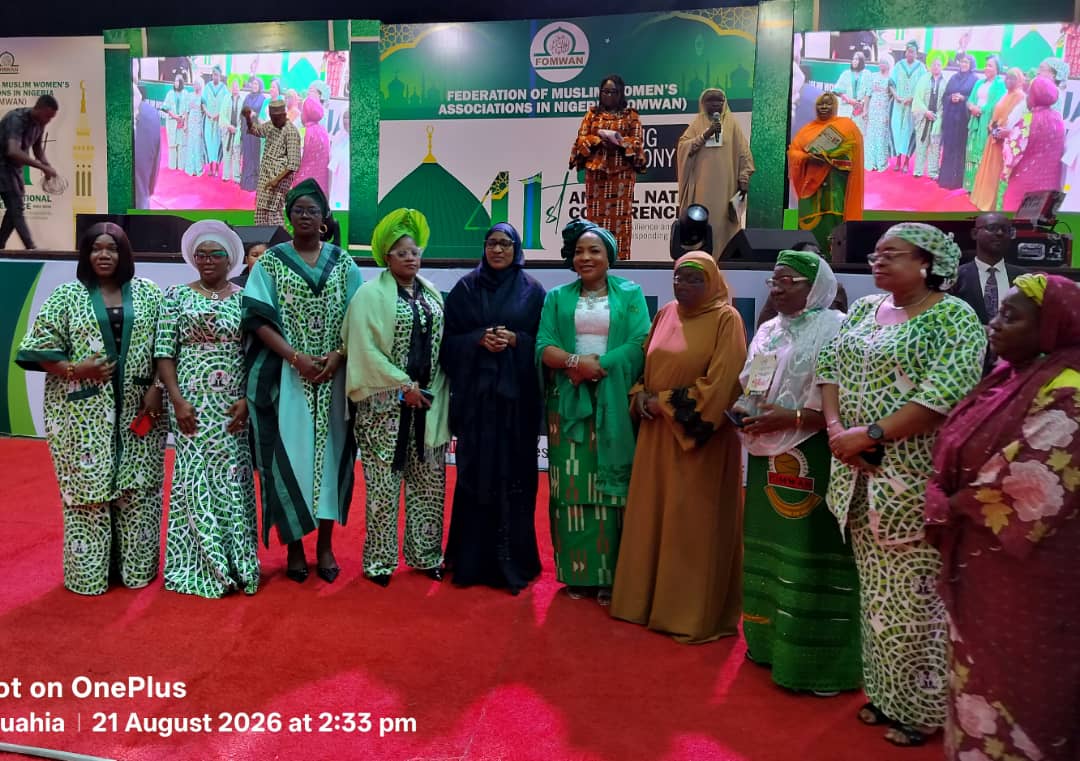
The First Lady of Nigeria, Senator Oluremi Tinubu, has charged Muslim women across the country to continue promoting peaceful families, stronger communities and a better Nigeria.
Senator Tinubu gave the charge at the 41st National Conference of the Federation of Muslim Women’s Associations in Nigeria (FOMWAN), held in Umuahia, Abia State.
Represented by the wife of the Vice President, Hajia Nana Shettima, the First Lady urged Muslim women to lead by example through love, compassion and mutual support.
She also encouraged them to instil sound moral and religious values in their children, stressing that children are the future of society.
According to her, the conference provided an opportunity for participants to exchange ideas, learn from one another and strengthen unity among Muslim women across the country.
Also speaking at the conference, the wife of the Abia State Governor, Mrs. Priscilla Otti, reaffirmed her commitment to the inclusion and empowerment of Muslim women in the state.
Mrs. Otti said religion should never be a barrier to opportunities, development or participation in government programmes. She described Muslim women as an important part of the Abia family and stressed that her support for them had never been based on religious affiliation.
She said she had consistently sought to involve Muslim women in key government and empowerment initiatives because no woman should be left behind because of her faith.
Mrs. Otti added that the State Woman Leader, Hajia Azizat Jimo, could testify to her commitment to inclusiveness and support for Muslim women.
The Governor’s wife stressed that such efforts went beyond ceremonies, noting that they reflected her belief that public service should focus on people rather than slogans.
“Service is about people first, not slogans,” she said, reaffirming her commitment to building an inclusive society where women of all faiths can participate fully in development and empowerment programmes.
In her remarks, the 41st National Amirah of FOMWAN, Dr. Sumaye Fadimatu Hamza, expressed gratitude to Almighty Allah and welcomed members of the Board of Trustees, led by Her Excellency, Hajia Lateefat Modupe Okunnu, OON, delegates, distinguished guests, Islamic scholars, development partners, government representatives and members of the association to the conference.
Dr. Hamza commended the Abia State Government, under the leadership of Governor Alex Chioma Otti, for its hospitality and support in hosting the conference. She also praised the national and local organising committees for their efforts in ensuring the success of the event.
Speaking on the theme of the conference, “Faith, Resilience and Responsibility: Muslim Women Responding to Challenges,” Dr. Hamza said the theme was timely and reflected the responsibilities of Muslim women in addressing contemporary challenges.
She noted that faith was not merely a personal conviction but a force capable of shaping actions, strengthening relationships and inspiring responsible responses to issues affecting families, communities and the nation.
According to her, every challenge presents an opportunity for renewal, service and positive transformation.
Dr. Hamza said FOMWAN had, for more than four decades, remained a beacon of hope through its contributions to education, healthcare, women’s empowerment, humanitarian intervention, peacebuilding and community development.
She acknowledged the contributions of generations of Muslim women who, she said, had dedicated themselves to serving Allah through service to humanity.
“Nation-building is a shared responsibility, and faith serves as our moral compass in times of uncertainty,” she said.
She urged Muslim women to remain committed to justice, moderation and service to humanity, particularly at a time of misinformation, ethical challenges and growing tensions in society.
Dr. Hamza added that Islam provided guidance not only in worship but also in leadership, responsible citizenship and community development.
The conference brought together Muslim women from across Nigeria to deliberate on contemporary challenges, strengthen their networks and explore ways of contributing to national development.