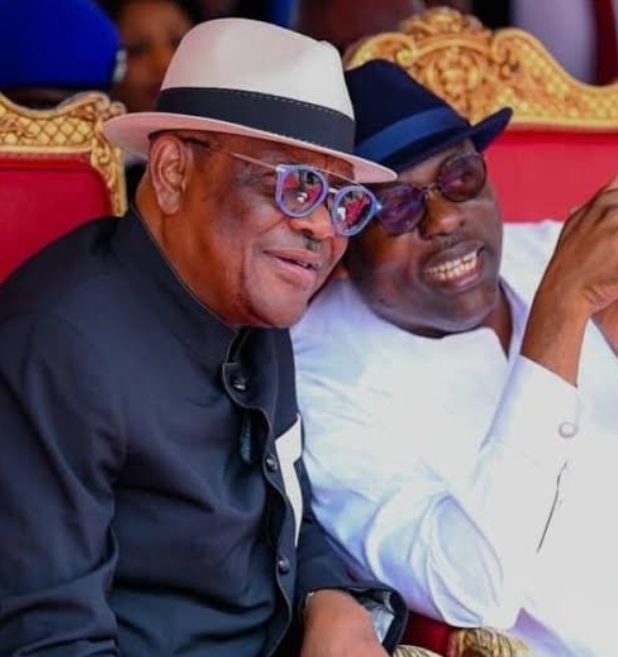
As political activities gradually gather momentum ahead of the 2027 general elections, a recent closed-door meeting involving FCT Minister Nyesom Wike, Rivers State Governor Siminalayi Fubara, APC governorship candidate Kingsley Chinda and their supporters has continued to generate mixed reactions among political stakeholders in Rivers State.
While some observers view the meeting as a deliberate effort to ease political tension and foster unity in the state, others suspect that the reconciliation move may be a strategy to harness the political influence and grassroots support of key political figures for electoral advantage.
An APC stakeholder in Ikwerre Local Government Area, Achineke Williams-Wobodo, has described the move as a positive step towards reducing political tension in Rivers State, particularly through the introduction of the Rainbow Coalition.
Wobodo made this known during an interview with our reporters, stating that the coalition was established to minimise political friction and encourage cooperation among political leaders and their supporters.
According to him, the recent meeting represents an opportunity to strengthen the understanding among the political leaders and demonstrate their commitment to peace.
“The Honourable Minister, Nyesom Ezenwo Wike, made it very clear from the beginning that the purpose of the Rainbow Coalition is to, as much as possible, minimise friction in Rivers State. You know that Rivers State has experienced several challenges. So, I think the move last week was to finally engage the governor in that direction.
“Now, the meeting is to cement that understanding and also to show the public and their supporters that the leaders mean business,” Wobodo said.
He further argued that the emergence of the coalition could weaken the influence of opposition parties in the state, insisting that political cooperation among the participating parties would reduce confrontation and reshape the political narrative ahead of the 2027 elections.
“Obviously, it will reduce political tension. Don’t forget that the Rainbow Coalition comprises at least four prominent political parties. Members of these political parties, who would otherwise have been at loggerheads, will now see reasons to work together.
“So, for me, it would reduce friction. Those parties have not made any significant impact in Rivers State and are still struggling. The ADC has not contested any election in Rivers State on a scale that makes it a significant threat, and the same applies to the NDC,” he added.
However, a public affairs analyst, Ijeoma Obi, holds a different view, describing the reconciliation efforts as a possible smokescreen for political manoeuvring.
Obi alleged that the FCT Minister was more interested in leveraging Governor Fubara’s popularity and political influence to boost the electoral prospects of candidates aligned with the Rainbow Coalition.
According to the analyst, the governor’s popularity among Rivers voters makes his political support an important factor that cannot be ignored as political parties prepare for the next general election.
“Politics is about numbers. The Rainbow Coalition, which is the platform the FCT Minister uses to promote candidates of interest to him, has been finding it difficult to sell some of its candidates.
“The FCT Minister is seizing every opportunity to gather support for his candidates. We cannot play down the popularity and level of influence that the governor wields. Ignoring him means losing a considerable number of supporters who will be voting during the election,” Obi said.
Obi also maintained that Governor Fubara would need to do more to convince Rivers voters of his political strength rather than dismissing the opposition parties.
The analyst argued that opposition parties could still spring a surprise in the 2027 general elections, particularly because of what Obi described as the sympathy many voters have for Governor Fubara.
As political alignments continue to evolve in Rivers State, the implications of the meeting remain a subject of debate, with questions lingering over whether the engagement will lead to lasting political reconciliation or serve primarily as a strategy for securing electoral advantage in 2027.