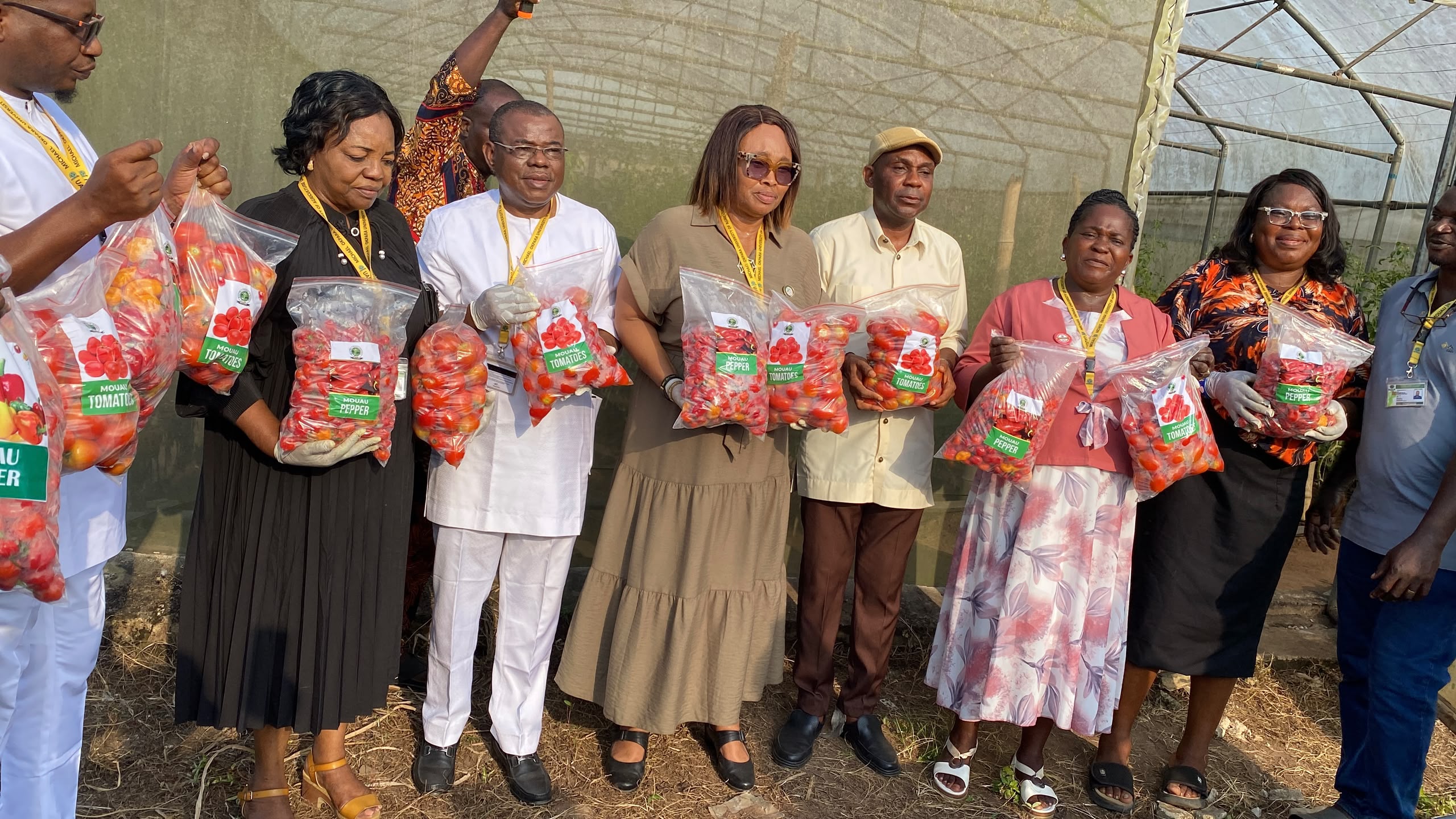
Michael Okpara University of Agriculture, Umudike (MOUAU), Abia State, has moved to position its greenhouse farming initiative to boost tomato production, strengthen food security and reduce seasonal shortages across the South-East and Nigeria at large.
The Vice-Chancellor, Prof. Ursula Ngozi Akanwa, disclosed this yesterday during the flag-off of tomato harvesting at the university’s greenhouse farm, where she announced plans to seek support from the Tertiary Education Trust Fund (TETFund) to expand the facility and increase production capacity.
Akanwa stressed the need for increased investment, mechanisation and modern agricultural practices to ensure sustainable food production, noting that a fully developed greenhouse facility could contribute significantly to the availability of fresh tomatoes and other agricultural produce throughout the year.
Prof. Ursula Ngozi Akanwa
She expressed concern over declining interest among young people in agriculture-related courses, maintaining that modern greenhouse farming had demonstrated that agriculture could be profitable, attractive and less labour-intensive.
According to her, expanding and mechanising the project would create opportunities for employment, entrepreneurship and investment while encouraging young people to embrace agriculture as a viable business.
The Vice-Chancellor also emphasised the need to develop the facility into a practical learning centre where students could acquire modern agricultural skills, explore innovations and establish businesses before graduation.
She commended the Director, Centre for Gender, Youth and Child Development (CGYCD), Prof. Mabel Ifeoma Onwuka, and her team for sustaining the initiative, urging the public to patronise the university’s produce to support further expansion.
Prof. Mabel Ifeoma Onwuka
Earlier in her speech, Prof. Onwuka disclosed that the centre operates seven greenhouses cultivating different varieties of tomatoes peppers, among others.
She said the produce had attracted customers beyond the university community because of its quality and shelf life, adding that the peppers could remain fresh for between two and three weeks without refrigeration.
The agriculturist explained that the current harvest marked the centre’s second attempt at greenhouse tomato cultivation, following an initial planting affected by bacterial blight.
She expressed delight that the centre had overcome the setback and successfully returned to production.
She further affirmed that the expansion and full mechanisation of the greenhouse project would provide a model for increased tomato production, strengthen agricultural value chains, create employment and contribute to food security in the South-East and Nigeria.