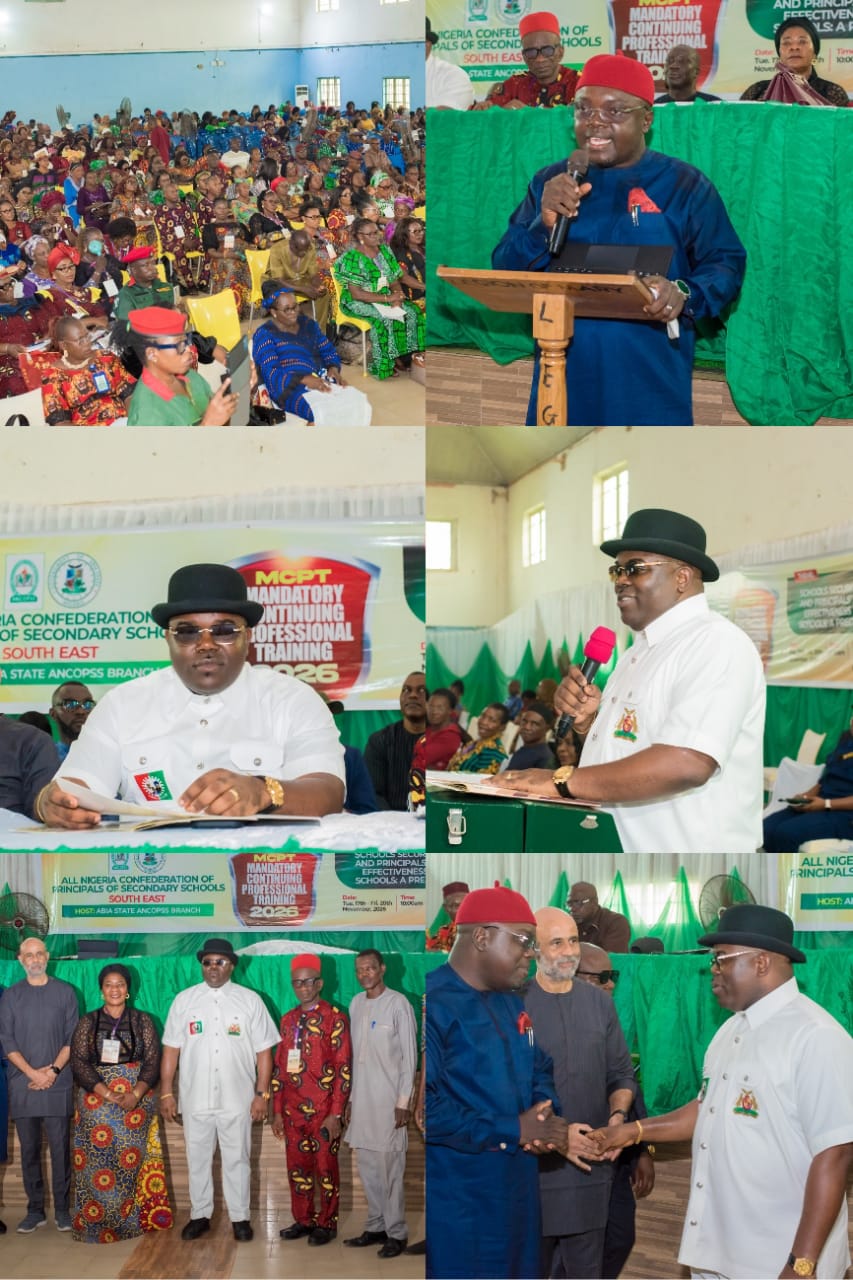
OTTI REAFFIRMS COMMITMENT TO SAFE SCHOOLS, EDUCATIONAL TRANSFORMATION IN ABIA.
Abia State Governor, Dr. Alex Chioma Otti, has reaffirmed his administration’s commitment to strengthening security in schools and improving the quality of education, assuring principals of continued government support to create a safe and conducive learning environment for students across the state.
Governor Otti gave the assurance during the opening ceremony of the 2026 Mandatory Continuing Professional Training (MCPT) of the All Nigeria Confederation of Principals of Secondary Schools (ANCOPSS), South-East Zone, held at Jubilee Hall, Mater Dei Cathedral, Umuahia.
The four-day training, which runs from November 17 to 20, 2026, has as its theme, “School Security Management and Principals’ Administrative Effectiveness in Secondary Schools: A Predictive Analysis.”
Represented by his Deputy, Engr. Ikechukwu Emetu, the Governor described the theme as particularly relevant in view of growing concerns over the safety of students, teachers and school communities.
He stressed that schools must not only be centres of academic excellence but also safe environments where children can learn and teachers can work without fear.
He reaffirmed that education remains central to his administration’s development agenda, highlighting deliberate investments in free and compulsory basic education, massive teacher recruitment, school infrastructure, digital learning, teacher development and improved welfare.
Otti identified the recruitment of over 9,400 teachers, the Abia First education transformation initiative, the development of SMART schools and the provision of free electric bus transportation for schoolchildren as evidence of his administration’s commitment to repositioning the education sector.
He also expressed satisfaction with the outstanding performances of Abia students in national and international academic competitions, noting that the achievements had reinforced his administration’s conviction that sustained investment in education produces measurable results.
The Governor, however, acknowledged that more work remained to be done and assured that his administration would continue to collaborate with relevant stakeholders to address infrastructure gaps, strengthen school security and improve teaching capacity.
He urged principals to take full advantage of the training, describing them as leaders, mentors and custodians of the future of children, whose ability to identify security threats, manage resources and motivate teachers would significantly determine the quality of education.
Earlier, the Abia State President of ANCOPSS, Sir John Ngozi Anthony, commended Governor Otti for making education a priority and highlighted achievements of the administration, including the recruitment of over 9,400 teachers, free and compulsory basic education, construction and rehabilitation of 221 model secondary schools, development of 20 SMART schools and training of 7,454 educators under the Abia First transformation programme.
He also cited the outstanding performances of Abia students in NECO examinations and international academic competitions, including their achievements at the 2026 International Schools Debate Championship in Doha, Qatar.
Anthony, however, appealed to the state government to address outstanding challenges facing secondary schools, including inadequate laboratories, libraries, operational funds, security personnel, computers and additional classrooms.
In a goodwill message, the State Coordinator of NECO, Abia State, Lady Chidinma Ola Okoro represented by the Deputy Director,State Office, , MR. Chima Onyebuagu urged principals of public secondary schools to register their eligible students for the 2027 Senior School Certificate Examination (SSCE) Internal, stressing the need for stronger collaboration between NECO and ANCOPSS to improve participation of public schools in the examination.
In his presentation, the Special Adviser to the Governor on Basic and Secondary Schools, Mr. Kenechukwu Nwosu, charged principals to take personal responsibility for security in their respective schools, describing them as chief executives, chief accounting officers and chief security officers of their institutions.
Nwosu identified cultism, drug and substance abuse, bullying, sexual abuse, kidnapping, fire outbreaks, flooding, erosion and laboratory accidents as some of the security threats confronting secondary schools.
He recommended annual security risk assessments, establishment of school safety committees, appointment of designated safety officers, controlled access gates, perimeter fencing, adequate lighting and regular headcounts of students.
The Special Adviser disclosed that Abia State inaugurated its Safe School Committee in January 2026 and reaffirmed the government’s commitment to the initiative, adding that security considerations were being incorporated into ongoing school rehabilitation projects.
He also announced that the state was collaborating with the Nigeria Security and Civil Defence Corps (NSCDC) to expose teachers to safety and security training programmes.
Similarly, the Chief Superintendent Corps of the NSCDC, Mrs. Chinyere Umezurike, in a paper presentation titled “Safe School Policy in Action: The Principal’s Role to Enhance School Safety,” described principals as primary safety managers of their schools.
She advocated secured school perimeters, controlled access points, written safety policies, trained security personnel, regular sensitisation programmes and the establishment of school safety clubs.
Umezurike also emphasised the importance of collaboration with host communities, parents and security agencies in identifying threats, preventing vandalism and protecting students and school facilities.
The training brought together principals and education stakeholders from across the South-East to deliberate on school security, professional development and strategies for strengthening secondary school administration.