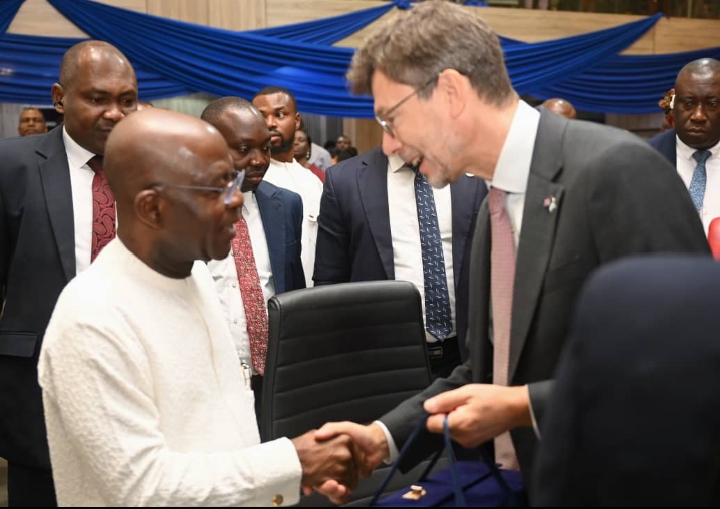
Abia State Governor, Dr Alex Otti, and the British Deputy High Commissioner to Nigeria, Mr Jonny Baxter, have jointly declared open the State-level Policy, Regulatory and Institutional Reforms Enabling Digital Transformation (SPRIRET) programme in the state.
The initiative, supported by the United Kingdom’s Foreign, Commonwealth and Development Office (FCDO), is aimed at strengthening the policy, regulatory and institutional environment for digital transformation in Abia.
Speaking at the Programme held at the Michael Okpara Auditorium Umuahia, on Thursday, Governor Otti urged stakeholders to explore how digital technology could be deployed to address pressing social and economic challenges confronting communities.
In a speech titled, “Partnership and the Dreams of Tomorrow”, the governor described technology as an indispensable accelerator of development and a gateway to the opportunities of the modern age.
“My charge to all of us, as I declare this event formally open, is to identify ways of leveraging the possibilities of digital technology to solve much of the real problems confronting our communities
“With particular attention to security challenges, unemployment, post-harvest losses for agro produce, urban property rentals, environmental degradation and other challenges that threaten our economic and social wellbeing.
“This is the age of knowledge where wealth is tied to the capacity to create solutions that enrich the human experience”, Governor Otti said.
He noted that the gathering provided an opportunity for stakeholders to examine how the state’s technology regulatory architecture could be re-engineered to remove structural barriers and stimulate private sector investment.
“The general idea is to liberalise the gains of the digital solutions revolution for expanded benefits,” he said.
Governor Otti explained that SPRIRET was established by the UK FCDO to support states in developing robust policy frameworks, resilient systems and critical institutions required for connected and accountable digital economic ecosystems.
According to him, Abia’s commitment to technology development, particularly information and communication technology, has contributed to the growth of the state’s technology ecosystem.
He said the state government, through its TechRise skills acquisition programme, had sponsored the training of more than 2,200 young people in a wide range of in-demand ICT skills.
“The focused training programme offered at TechRise has opened for several beneficiaries, the door to local and international job opportunities, collaborations and new ventures”, the governor stated.
He also cited other government-supported initiatives, including ThriveAbia, Abia Digi-Upskill and the Girls-in-ICT programme, as interventions aimed at equipping residents with skills needed to compete in the global digital economy.
The governor acknowledged the support and interest of the British Deputy High Commissioner and the immediate-past British High Commissioner to Nigeria, Dr Richard Montgomery, in the development of Abia.
In his remarks, the British Deputy High Commissioner, Mr Jonny Baxter said the UK was pleased to partner with Abia on the initiative.
Baxter described digital technology as an important tool for improving public services, creating economic opportunities and strengthening government effectiveness.
The diplomat said the partnership reflected the shared commitment of the UK and Abia to creating a supportive digital environment.
He added that meaningful progress required leadership, collaboration and active participation by the private sector, civil society, academia and the wider technology ecosystem.
“Digital transformation cannot be achieved by government alone. It requires collaboration and open dialogue”, Baxter said.
He disclosed that the UK had supported about 450 civil servants in Abia to upgrade their digital skills, while community-owned connectivity hubs were being developed to expand affordable access to digital services and improve digital literacy.
Baxter said one of the hubs was already operational at Okporoenyi Community, while another was being established at Arochukwu, describing the interventions as foundations for the next phase of the state’s digital development.
The UK Deputy High Commissioner noted that Nigeria’s digital economy was already making a significant contribution to the national economy but could achieve greater impact through improved infrastructure and a coherent policy and regulatory environment.
He expressed hope that the initiative would stimulate further investment, including from British companies and create opportunities for innovation, inclusion and sustainable economic growth.
Earlier, the Chief Information Officer to the State Government, Mr Gerald Illukwe, took participants through Abia’s digital transformation journey.
Illukwe, said the programme would assess the state’s digital ecosystem and identify areas that require improvement across government, the private sector, civil society, the technology ecosystem and digital inclusion.
The Chief Information Officer said the state has recorded progress in digital infrastructure, connectivity, e-health services, digital public administration and support for technology entrepreneurs.
He added that the present administration was pursuing a whole-of-government approach to ICT to promote efficiency and prevent duplication of efforts.
Illukwe, disclosed that the FCDO, through its Digital Access Programme, was supporting five Nigerian states, including Abia, to undertake policy, regulatory and institutional reforms aimed at advancing digital development.
The Chief Information Officer, said Abia remains open to technical assistance and partnerships with the FCDO and other stakeholders as the state continued to strengthen digital public services, human capacity and inclusive access to technology.
Illukwe added that the state government was seeking further support from the UK Government to fast-track its digital transformation agenda.