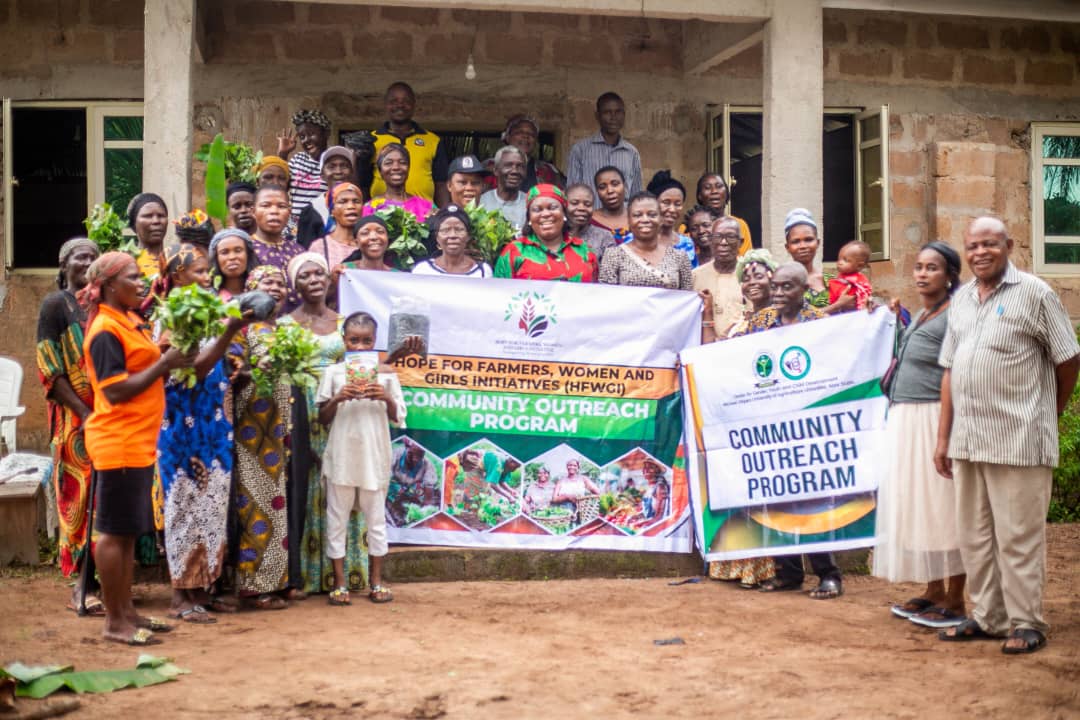
The Centre for Gender, Youth and Child Development (CGYCD), Michael Okpara University of Agriculture, Umudike (MOUAU), in collaboration with Hope for Farmers, Women and Girls Initiative, has trained community members in Ntalagwu, Ikwuano Local Government Area of Abia State, on climate-smart agriculture, sustainable soil management and family nutrition.
The programme, held recently (22 August 2026), was convened by Professor Mabel Ifeoma Onwuka, Director of CGYCD, MOUAU, and founder of Hope for Farmers, Women and Girls Initiative. Dr. Lawretta Ijeoma Princewill-Ogbonna assisted with the training and delivered a session on family nutrition.
A major highlight was a practical demonstration on producing an organic soil amendment using a blend of vermicompost, biochar and a suitable binder. The technique is designed for localized application around plant roots and offers farmers a practical way to utilise locally available organic materials to support soil health and crop production.
In her speech, Professor Onwuka explained the benefits of recycling organic waste into useful agricultural inputs, noting that appropriate use of vermicompost and biochar can improve soil conditions, support nutrient retention and moisture management, and contribute to more sustainable farming practices.
To support the adoption of the techniques demonstrated, participants received improved sweet potato vines, Amaranthus seeds, liquid organic fertilizer, and biochar-compost blend fertilizer.
Food palliatives were also distributed to support participating households.
The distribution complemented the practical training by providing participants with planting materials and organic inputs they could use to establish crops and apply the knowledge gained.
Sweet potato and Amaranthus can contribute to household food availability, while the organic fertilizers offer additional options for managing soil fertility.
The programme also emphasised the importance of integrating climate-smart agriculture with social inclusion and gender-responsive approaches. By equipping women and men with practical agricultural skills and resources, the initiative seeks to strengthen local livelihoods, encourage environmentally responsible farming and create opportunities for small-scale agribusiness.
Dr. Princewill-Ogbonna’s session highlighted the relationship between agricultural production and family nutrition, reinforcing the importance of food diversity and access to nutritious foods for household well-being.
In her vote of thanks, Mrs Ngozi Ogbonna, leader of the participating group, appreciated the organisers for bringing the training, agricultural inputs and food support to the community. She acknowledged the value of the knowledge shared and the assistance provided to participating households.
The outreach reflects the commitment of the Centre for Gender, Youth and Child Development, MOUAU, and Hope for Farmers, Women and Girls Initiative to community empowerment, sustainable agriculture and improved family welfare.
By combining practical agricultural training, the distribution of planting materials and organic fertilizers, and nutrition education, the initiative demonstrates how community-based interventions can support healthier soils, more resilient livelihoods and improved food security.