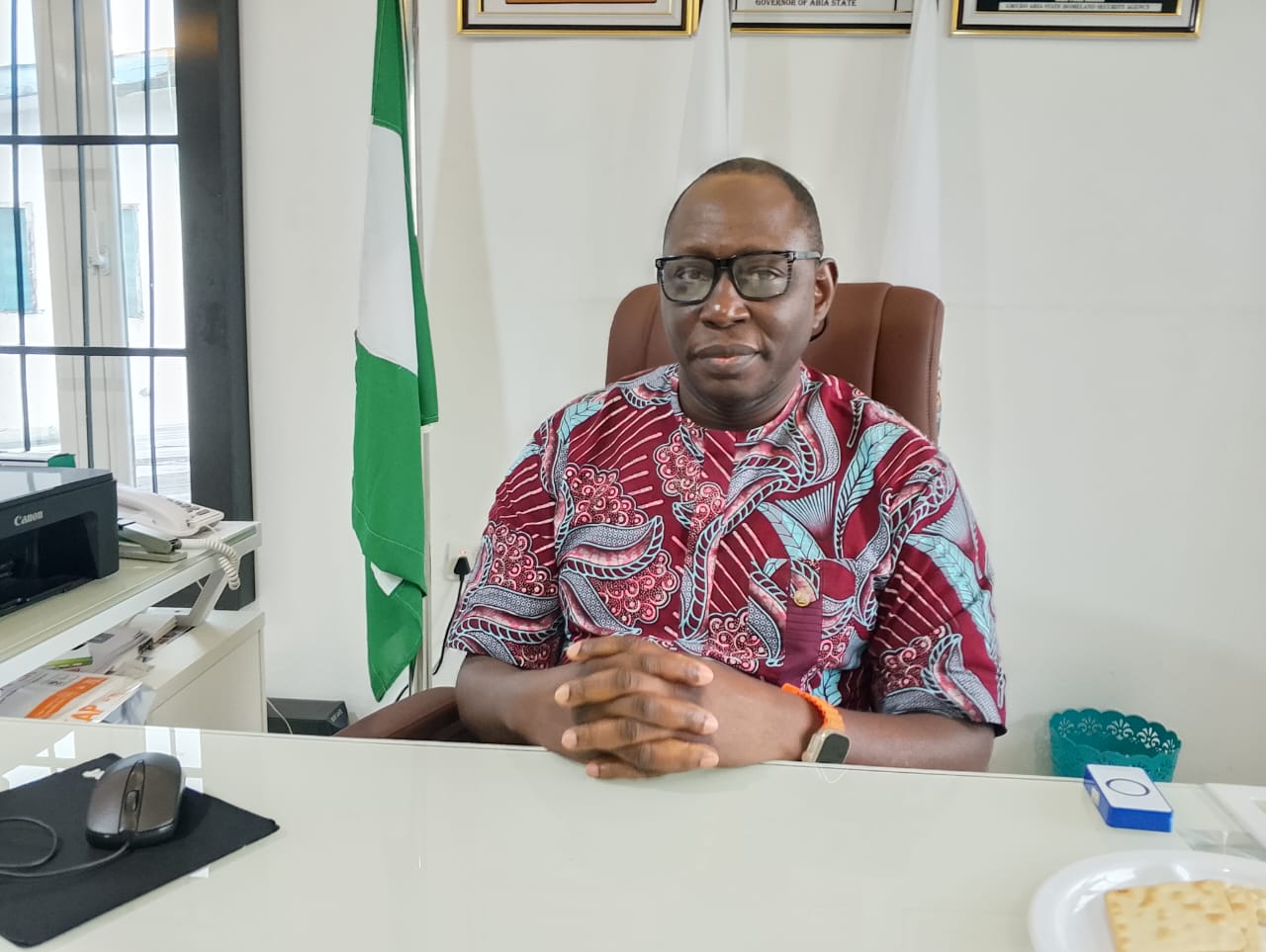
…Insists Agency Knows No Political Party, Only Peace and Security
Security remains the bedrock upon which sustainable development, economic growth and investors’ confidence are built. In Abia State, the steady improvement in the security environment has been credited with boosting business activities, attracting new investments and restoring public confidence in governance.
In this exclusive interview, the General Manager/Chief Executive Officer of the Abia State Homeland Security Agency, Col. Chidi Kalu Ukoha (Rtd), offers an in-depth assessment of the state’s security landscape, the agency’s achievements, and the collaborative efforts that have made Abia one of the safest states in Nigeria. He also speaks on intelligence gathering, the fight against cultism, kidnapping, drug-related crimes and other security threats, the proposed State Police, preparations for the 2027 general elections, and the agency’s unwavering commitment to professionalism and political neutrality.
Declaring that “Abia is safe and ready for business,” the Homeland Security boss assures local and foreign investors of a conducive environment for investment, while emphasizing that the agency remains completely apolitical, with its sole mandate being the protection of lives and property.
The Editor, National Ambassador Newspapers, Dcn. Chukwuemeka Egejuru, anipr,alongside Stephanie Nneoma Okoroafor,engaged the retired military officer in this revealing conversation.
Excerpts:
Can you assess the current security situation in Abia State. What was it like before, and what is it like now?
I won’t say much about what the security situation was before because I came on board after the law establishing this agency was enacted not quite long. However, from available records and reports, the state faced serious security challenges, including cult-related violence, kidnapping, and activities of the proscribed Indigenous People of Biafra (IPOB) and the Eastern Security Network (ESN). At one point, two Chinese nationals were kidnapped and a person was killed.
Since the establishment of the Abia State Homeland Security Agency, working alongside Operation Crush, local vigilantes, conventional security agencies and, most importantly, the people of Abia State, there has been a remarkable improvement.
Kidnapping has reduced drastically, cult-related crimes have declined significantly, and IPOB/ESN activities have been reduced to almost zero, except for isolated incidents, particularly in parts of Abia North, where concerted efforts are still being made to address them.
Overall, I can confidently say that the security situation in Abia State has improved dramatically.
If you were to rate the state’s security on a scale of one to ten, what score would you give it?
I would rate it seven out of ten. There is still room for improvement, but considering where we are coming from, a score of seven represents significant progress.
What would you consider the greatest achievement of the Homeland Security Agency under your leadership?
Our greatest achievement is the increased confidence citizens now have in the security of Abia State.
Businesses are thriving, investors are coming into the state, and residents feel safer. Those are the clearest indicators that our efforts are yielding positive results.
Col. Chidi Kalu Ukoha (Rtd.)
Many people now describe Abia as one of the safest states in the South-East. What factors have contributed to this achievement?
The first factor is leadership.
Governor Dr. Alex Chioma Otti, OFR, has demonstrated exceptional commitment to security. He understands that without security, development cannot thrive. He has consistently provided the necessary support, funding, logistics, training and equipment required by security agencies.
Secondly, the personnel of the Homeland Security Agency have shown dedication and professionalism.
Finally, the citizens themselves deserve commendation. They now understand that security is everyone’s responsibility.
Recently, during a kidnapping incident around the Ibeku axis, residents mobilised and confronted the kidnappers, forcing them to abandon their victims and flee. That level of public participation is encouraging and demonstrates collective ownership of security.
What are the major security threats confronting Abia State, and how has your agency addressed them?
Security threats vary across the state’s three senatorial zones.
In Abia South, we mainly contend with cult-related killings, child trafficking and drug-related crimes.
In Abia Central, there are occasional cases of kidnapping and armed robbery.
In Abia North, the challenges include isolated activities of proscribed groups and kidnapping.
One major factor driving many of these crimes is drug abuse. We therefore work closely with the National Drug Law Enforcement Agency (NDLEA), carrying out raids on suspected drug locations and dismantling criminal networks.
We have also intensified public enlightenment, encouraging residents to “See Something, Say Something.” This has generated useful intelligence that has led to several arrests.
Occasionally, we record herder-community conflicts. Abia State has zero tolerance for open grazing. While we allow herders who are merely passing through the state to do so peacefully, anyone who violates the law is arrested and, where necessary, their cattle are confiscated. Fortunately, such incidents are becoming increasingly rare.
As a security expert, do you think Governor Alex Otti has done enough to strengthen security in Abia State?
His Excellency has done exceptionally well.
Beyond what has already been achieved, more security infrastructure is being put in place and will be unveiled in due course to improve emergency response across the state.
For example, the Homeland Security Agency operates a call centre that enables residents to report emergencies.
Our goal is to shorten response time significantly. Rather than taking 30 minutes or an hour to respond, we are working towards a situation where security personnel can arrive at any incident scene within five minutes.
Security and business are closely linked. How has improved security impacted investment in Abia State?
Improved security has greatly boosted investor confidence.
We have witnessed increased visits by local and foreign investors conducting feasibility studies and establishing businesses.
Businesses that had almost collapsed due to insecurity are becoming active again.
There has also been a noticeable influx of both Abians and non-Abians into the state. Recently, non-indigenes residing in Aba organised an event to appreciate the state government. That clearly reflects the confidence people now have in the security and business environment in Abia.
What message do you have for investors both within Nigeria and in the Diaspora?
My message is simple:
Abia State is safe, and Abia is open for business.
How does the Homeland Security Agency collaborate with other security organisations?
We maintain excellent working relationships with local vigilante groups, private security organisations and all national security agencies, including the Police, Military, NDLEA, Immigration Service, Customs Service and the Fire Service.
Regular Security Council meetings enable us to coordinate operations effectively, eliminate duplication of efforts and maximise available resources.
What exactly is the mandate of the Abia State Homeland Security Agency?
Our mandate is to ensure peace and security across Abia State and to protect the lives and property of residents and visitors.
Does the agency prosecute offenders?
No.
The agency is not part of the criminal justice system. Our responsibility is to make arrests, gather preliminary intelligence and hand suspects over to the Nigeria Police or other relevant agencies for investigation and prosecution.
How does the agency coordinate intelligence gathering and emergency response?
Our personnel are deployed across all 17 Local Government Areas of the state.
They conduct daily monitoring and submit intelligence reports.
Whenever actionable intelligence is received, we respond immediately.
We also operate a call centre through which residents report emergencies, enabling rapid deployment of personnel.
Depending on the nature of the offence, suspects are handed over to the appropriate agency, whether the Police, NDLEA, Immigration Service or others.
What is your view on the proposed establishment of State Police, and how prepared is Abia State?
The proposal is still undergoing legislative consideration at the federal level.
Once the legal framework is finalised, the state will determine how best to integrate with the system.
There will certainly be a need for specialised training, institutional restructuring and clear operational guidelines.
The exact responsibilities of State Police will depend on the eventual law, particularly regarding the division of responsibilities between State Police and the Nigeria Police Force.
As for readiness, Abia is well-positioned in terms of commitment, although institutional structures are still evolving.
Many Nigerians are hearing about State Police for the first time. Can you explain what it means?
State Police will essentially be community-based policing.
It will be responsible for maintaining law and order within individual states, while the Nigeria Police Force retains nationwide jurisdiction.
The objective is to bring policing closer to the people because crime is often local.
I strongly support the initiative because localised policing will improve crime prevention and response.
Some people fear State Police could be abused by state governments. What is your view?
That is why the legal framework is extremely important.
There must be clearly defined jurisdiction, operational guidelines and safeguards to prevent political interference.
State Police should never become a political tool. The law must ensure professionalism and accountability.
What relationship does the Homeland Security Agency maintain with traditional institutions?
We work closely with traditional rulers through community vigilante groups.
They provide valuable local intelligence and help us understand the unique security dynamics within their communities.
Their support has been extremely beneficial.
What message do you have for residents regarding security?
Residents should be law-abiding, loyal to the state and the Federal Republic of Nigeria, and always remember:
If you see something, say something.
Together, we can keep Abia safe.
Does the agency also handle cybercrime and technology-related offences?
Where such cases are reported to us, we act as the first responder by making arrests where necessary before handing suspects over to the Police and other competent agencies for detailed investigation and prosecution.
With the 2027 elections approaching, how neutral will the agency be?
The Homeland Security Agency is a professional and completely apolitical organisation.
Our responsibility is to ensure peace and security before, during and after the elections.
We do not recognise political parties or candidates. We are apolitical.
We are completely colour-blind when it comes to politics.
Our loyalty is to peace, security and the people of Abia State.
What is your vision for the agency over the next couple of years?
Our vision is to build a stronger and more technologically equipped agency capable of combating sophisticated crimes.
Our ultimate goal is to ensure that Abia State remains one of the safest states not only in Nigeria but across West Africa.
Your final message to Abians and its residents?
Everything is well. I simply encourage everyone to continue supporting security agencies because security is a collective responsibility. Together, we can sustain the peace and progress that Abia State is currently enjoying.