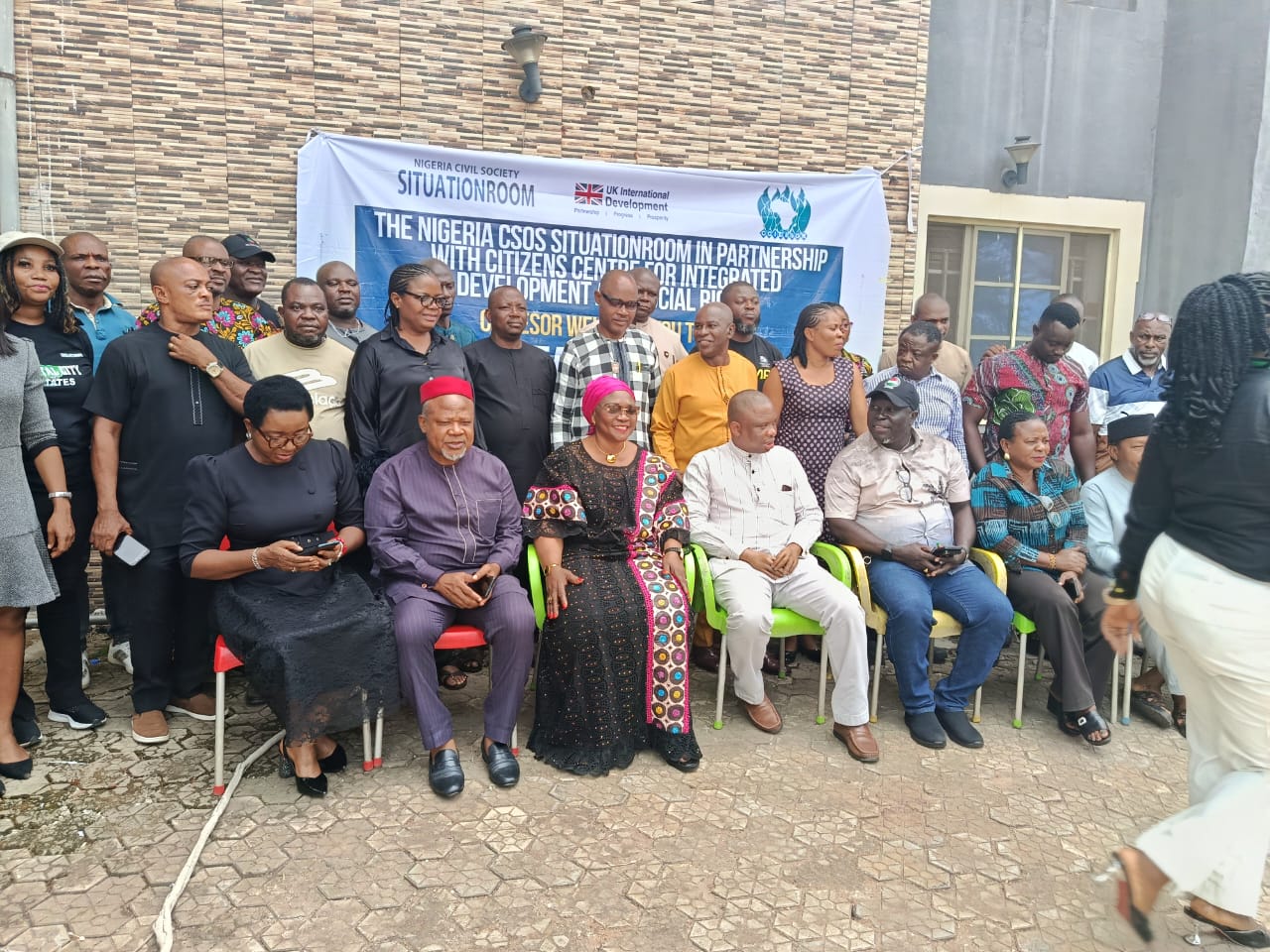
Stakeholders across Nigeria’s Southeast have renewed their call for full political, financial, and administrative independence for local governments. They believe this is necessary to improve development at the grassroots level.
The call was made during a one-day Southeast Summit on Local Government Autonomy and Accountability. The event was organized by the Nigeria Civil Society Situation Room in partnership with the Citizens Center for Integrated Development and Social Rights (CCIDESOR).
The summit, themed “Reviving Local Governance Through Local Government Autonomy and Accountability: A Pathway to Grassroots Development in Southeast Nigeria,” was held at the Bishop Nwaedo Pastoral Centre in Umuahia. It brought together civil society leaders, government officials, labour representatives, and community members.
In his keynote speech, the Executive Director of CCIDESOR, Emeka Ononamadu, described local government as the foundation of grassroots democracy. He explained that under Section 7 of the 1999 Constitution (as amended), local governments are recognized as the third tier of government. Their duties include primary education, primary healthcare, rural roads, sanitation, markets, agricultural services, and community development.
Dr. Ononamadu said that since the 1976 local government reforms and Nigeria’s return to civilian rule in 1999, the independence of local councils has reduced, especially in the Southeast. He blamed Section 162(6) of the Constitution, which created the State Local Government Joint Account system. According to him, this system allows state governments to control local government funds, sometimes leading to delays, diversion of funds, or replacement of elected councils with caretaker committees.
“The problem is not lack of money,” he said. “The real issue is lack of financial independence, accountability, and responsible leadership.”
He added that weak local governance has led to slow rural development, unemployment, migration to cities, and rising insecurity. He noted that proper use of local government funds could boost local economies and reduce pressure on state and federal governments.
He also gave a breakdown of the 95 Local Government Areas (LGAs) in the Southeast: 27 in Imo, 21 in Anambra, 17 each in Enugu and Abia, and 13 in Ebonyi. Despite increased federal allocations in recent years, development at the grassroots level remains poor.
Also speaking at the event, the Senior Special Assistant on Local Government and Chieftaincy Affairs, Magdalena Ugoansi, called for unity and cooperation among stakeholders. She admitted that although reforms are ongoing, more work needs to be done.
She mentioned a state programme called “Changing the Narrative at the Local Government,” which encourages dialogue between council chairmen, councillors, women and youth leaders, and other stakeholders. The programme has been carried out in 11 of the 17 LGAs in the state and aims to improve accountability and public participation.
Participants, including the NULGE President in Imo State, Charles Okere, as well as David Anyaele and Eze Eluchie, said many local councils in the region are not performing well. They noted that many primary healthcare centres do not function, rural roads are in bad condition, waste management is weak, agricultural services have collapsed, and public primary schools are in poor shape.
Some LGAs reportedly have annual budgets between ₦6 billion and ₦10 billion, and some have received over ₦20 billion since 2023. However, there are few visible improvements in services and infrastructure.
Stakeholders welcomed recent federal reforms under President Bola Ahmed Tinubu, including a Supreme Court judgment supporting the constitutional and financial independence of local governments. They described this as a major opportunity to strengthen grassroots governance and improve service delivery.
While supporting autonomy, the summit stressed that independence must come with accountability.
Key recommendations included amending Section 162(6) to remove state control over local government funds, direct electronic transfer of federal allocations to local government accounts, and the conduct of democratic local government elections.
Other proposals were participatory budgeting at ward level, yearly independent audits, public disclosure of allocations and internally generated revenue, and training for local government administrators.
The summit also called on civil society groups, the Nigerian Union of Local Government Employees (NULGE), and the media to monitor how funds are used and promote transparency.
Participants agreed that full political, financial, and administrative independence for local governments combined with strong accountability remains the most practical way to achieve lasting grassroots development in the Southeast.