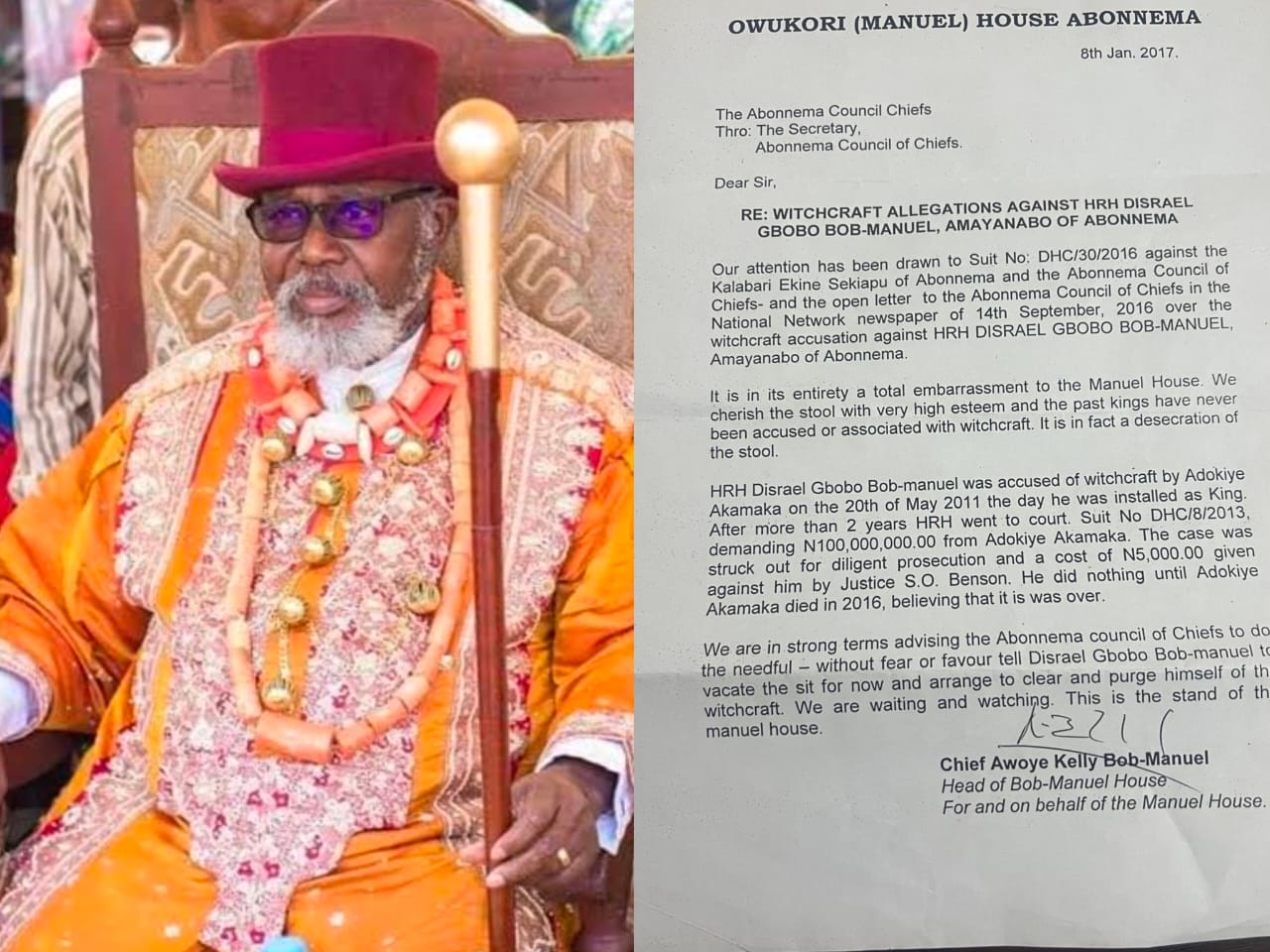
Fresh controversy has erupted over the Amayanabo stool of Abonnema as new allegations of internal pressure and intimidation surface within the Owukori (Manuel) House — the same ruling house that, in 2017, formally called for the temporary withdrawal of HRM King Dr. Disrael Gbobo Bob-Manuel II (Owukori IX) over witchcraft allegations.
The latest development follows the recent public release of Certified True Copies (CTCs) of a judgment of the Rivers State Customary Court of Appeal, which dismissed an appeal in a case bordering on the witchcraft allegations against the monarch and affirmed the decision of the lower court.
While the court ruling has reignited public discourse on the long-running dispute, attention has now shifted to claims of renewed internal manoeuvring within the ruling house.
Sources within the Owukori House allege that the Amayanabo is exerting pressure on some chiefs to issue a fresh letter passing a vote of confidence in him — a move said to be aimed at countering the widely circulated January 8, 2017 letter signed by the Head of the Bob-Manuel House, Chief Awoye Kelly Bob-Manuel.
The 2017 correspondence, addressed to the Abonnema Council of Chiefs, advised that HRM Disrael Gbobo Bob-Manuel should temporarily vacate the stool and take steps to clear himself of the witchcraft allegations. The letter described the situation at the time as a desecration of the revered stool and called for actions to preserve the sanctity of the traditional institution.
A chief of the Owukori House, who spoke on condition of anonymity for security reasons, alleged that the current push for a counter-letter is not based on collective agreement but on fear.
“There is serious intimidation going on. Some people are being pressured to sign another letter just to neutralise the earlier one. That letter from 2017 remains the true position of the house,” the source claimed.
According to the source, the information has been independently corroborated within the house, raising concerns that silence could allow coercion to override established positions and documented history.
The alleged attempt to secure a new letter under what insiders describe as threats has sparked moral and customary concerns, particularly as the 2017 letter remains a matter of public record and has resurfaced amid renewed legal and community scrutiny.
Observers note that the controversy has moved beyond the courtroom and now touches on broader questions of integrity within traditional governance structures. Some concerned members of the ruling house argue that customary authority must be anchored on consensus and moral legitimacy rather than intimidation.
They contend that any effort to alter a documented family resolution through alleged coercion risks undermining both tradition and justice.
With the appellate court judgment affirmed, the resurfaced 2017 family letter back in public focus, and fresh allegations of internal pressure, attention has now turned to the Abonnema Council of Chiefs. Many in the community believe the council faces a critical test of transparency and independence in navigating the crisis.
As tensions continue to build, residents say the unfolding events represent a defining moment for the Abonnema traditional institution — one that will determine whether due process and truth prevail or whether internal divisions deepen further.
For now, the Abonnema stool controversy remains not only a legal and customary matter, but also a question of credibility, conscience and leadership within the historic riverine kingdom.