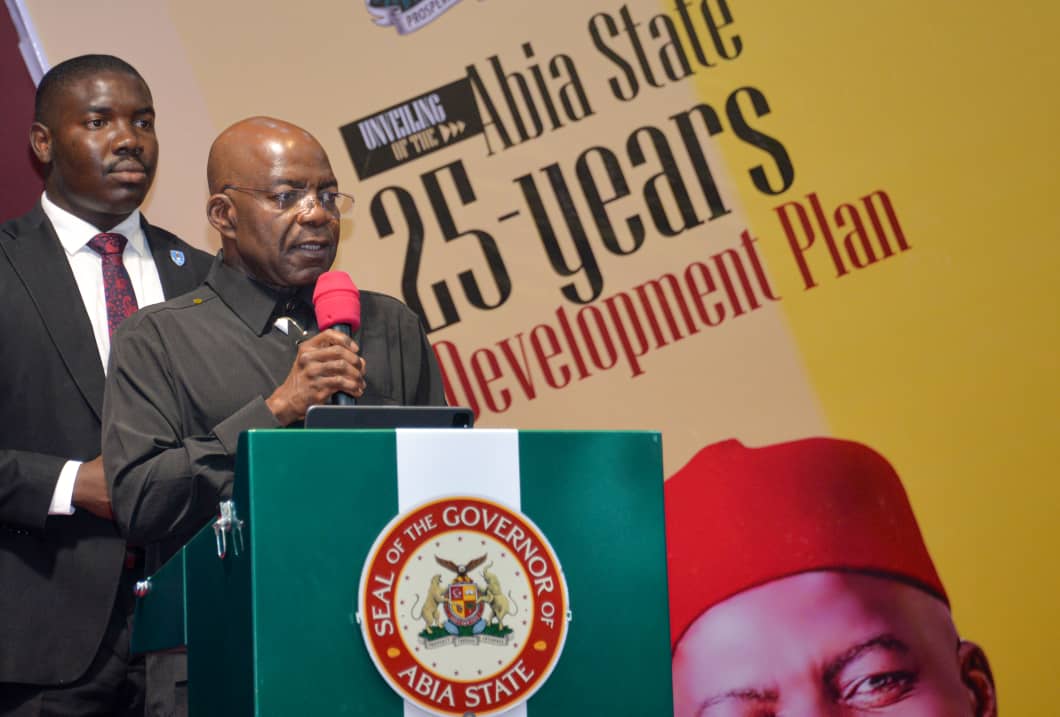
Governor Alex Otti of Abia State on Tuesday , unveiled and signed into law a comprehensive 25-year Abia State Development Plan, describing it as a binding framework that will guide policy direction, budgeting and resource allocation in the State from 2025 till 2050.
Speaking after unveiling and signing into law the document themed; “Building Resilience, Driving Innovation, Safeguarding Our Future”,at the International Conference Center Ogurube layout Umuahia, Governor Otti said that the State has been secured against policy reversals by successive administrations to a disciplined pathway of growth, resilience and prosperity up to 2050.
Governor Otti who titled his speech “Mapping the Future”, said the document unveiled by his administration goes beyond a mere policy proposal, describing it as a binding legal framework that will guide governance and development in the State for the next 25 years, irrespective of successive administrations.
“What we have just unveiled is more than a proposal. It is a binding law that this administration and the ones to succeed it are obliged to follow over the next two and a half decades.
“The New Abia Project is our collective responsibility. The future of Abia is now mapped, and I shall be the first to ensure that we will not depart from this path that we have set for ourselves”, the Governor assured.
Governor Otti further noted that future governments would find it “very, very difficult” to discard the plan, as doing so would require returning to the State House of Assembly and convincing the people to chart a different course.
The Governor emphasized on the need for strategic planning noting that development does not happen by chance but through deliberate planning backed by discipline and law.
Governor Otti added that the volatile economic realities of recent years had rendered the previous administrations earlier 30-year plan, launched in 2020, obsolete.
“In 2023, when we took over in May, a dollar exchanged for less than ₦500. Then something happened, and the dollar almost got to ₦2,000 before settling at around ₦1,400. So if you planned with ₦500, even ₦1,000, that plan has gone belly up”, he stated.
Governor Otti said that the new development plan is not a speculative document but a realistic and dynamic framework that reflects changed global and local fundamentals, recent economic reforms and Abia’s accelerated development trajectory over the past 30 months.
“We have gathered not to cast Abia in the light of an imaginary El Dorado by 2050, but to present a holistic development framework upon which our policy direction and resource allocation outlook will be evaluated”, the Governor pointed.
He explained that the document captures Abia’s resource advantages, its current position on the development ladder and clearly defined pathways for governance, infrastructure, human capital development and institutional strengthening.
According to Governor Otti, beginning from 2026, the Sate’s annual budgets and project implementation plans would be drawn directly from the development framework, making it the benchmark for measuring progress across key sectors such as education, healthcare, infrastructure, transportation, housing, water and sanitation and the environment.
He added that the Development Plan provides for a comprehensive review every five years, with flexibility to recalibrate priorities in the event of major socio-economic disruptions.
The Governor also outlined a major fiscal shift, revealing that the State aims to achieve self-sufficiency in funding recurrent expenditure through Internally Generated Revenue, while committing all external receipts to capital projects.
He expressed gratitude to development partners including the United Nations Development Programme (UNDP), PIND, PACE and PwC, as well as the Abia Global Economic Advisory Council, for their contributions to the plan.
In a goodwill message, the United Nations Development Programme Resident Representative Ms Elsie Attafuah represented by Ms Maureen Okoro said Abia State’s 25-year development plan aligns with UNDP’s core principles of evidence-based planning, strong institutions, inclusive growth, sustainable finance and human development that leaves no one behind.
She reaffirmed UNDP’s readiness to support Abia State in implementing, monitoring and reviewing the plan through data-driven systems, innovative financing, inclusive governance and institutional capacity building.
In his contribution, the representative of Partnership Initiative In Niger Delta, PIND , Mr Chuks Ofolue noted that the 25 years development plan which is a review of the 30-years development plan of the previous administration is more focused, and emphasized that effective implementation, continuity and capacity-building within the civil service are critical to the plan’s success.
Also the Strategy, Institutions and Policy Advisor at the Partnership for Agile Governance and Climate Engagement (PACE), Mr. Obibuaku Ordu, the President of the Aba Chamber of Commerce, Industries, Mines and Agriculture, Mazi Jude Nwosu, described the 25-year development plan as a clear demonstration of Governor Otti’s resolve to transform Abia State into a hub of innovation and assured that they would partner the Government to support the successful implementation of the plan.
Earlier in his address, the Commissioner for Budget and Economic Planning, Mr Kingsley Anosike, said the development plan was built on the solid record of the Otti administration’s first 30 months, which he described as a period when “focused leadership compressed years of development into months”.
Mr Anosike added that reforms in Education, Healthcare, unprecedented revolution in infrastructure, and the Civil Service had renewed public trust and provided a strong foundation for the long-term development planning.
The Commissioner said that the 25-year plan, aligns with global frameworks including the United Nations Sustainable Development Goals, ECOWAS Vision 2050 and Africa’s Agenda 2063.
He explained that the plan is structured around six strategic pillars, focusing on fiscal strength, industrialization, human capital development, climate resilience, governance reform and private sector engagement.
He described the document as “a plan of and for the people,” noting that it was developed through extensive consultations with traditional rulers, youths, women, civil society groups and development partners.