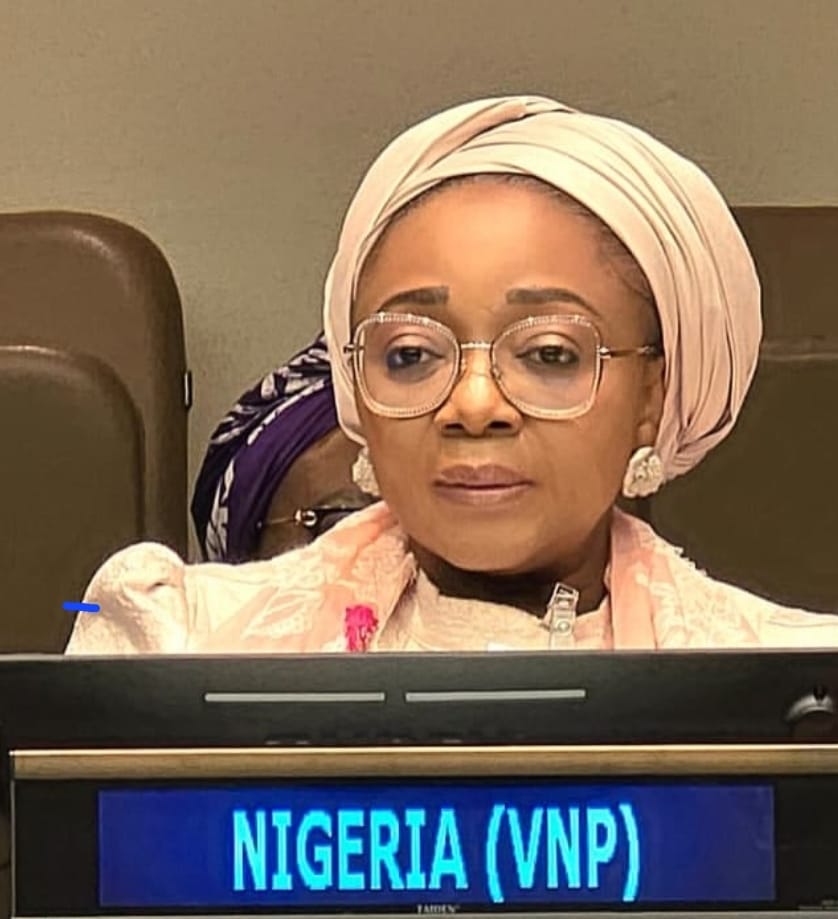
Nigeria has reaffirmed its commitment to advancing gender equality and empowering women globally as the Minister of Women Affairs and Social Development, Imaan Sulaiman‑Ibrahim, addressed delegates at the 70th session of the Commission on the Status of Women held at the United Nations Headquarters in New York City, United States.
Speaking at the global meeting, the minister said the Federal Government under Bola Ahmed Tinubu has continued to implement policies and programmes aimed at improving the welfare of citizens, particularly women and children.
Leading a high-level Nigerian delegation to the annual gathering, Sulaiman-Ibrahim stated that Nigeria aligns with the position of the African Group and remains committed to strengthening global efforts toward gender equality, inclusive action, justice, protection of rights and sustainable development.
She disclosed that as part of the administration’s Renewed Hope Agenda, President Tinubu has declared 2026 as Nigeria’s “Year of Families and Social Development,” stressing that strong families are essential to empowering women, protecting children and building cohesive communities.
According to the minister, Nigeria’s social protection programmes have expanded significantly over the past decade, growing from fewer than one million households in 2015 to nearly 10 million households in 2026. She noted that women account for more than 70 percent of the primary beneficiaries.
Sulaiman-Ibrahim described the development as one of the most significant expansions of social protection in Nigeria’s post-independence history, adding that the government remains committed to sustaining the progress.
She also revealed that the country is accelerating the implementation of its flagship programme, Renewed Hope Social Impact Interventions 774 (RHSI-774), a nationwide initiative designed to empower women through livelihood support, clean energy access, financial inclusion, digital opportunities and social protection.
The minister further highlighted the Women Digital Harmony Initiative, which includes the “Happy Woman App,” a mobile platform expected to connect more than 20 million Nigerian women to information, mentorship opportunities and economic support networks.
On efforts to combat gender-based violence, she said Nigeria is strengthening institutional responses through a comprehensive safeguard mechanism, including the introduction of a National Electronic Dashboard to improve coordination, monitoring and accountability.
She added that the government is also expanding prevention and survivor-support systems to address emerging challenges such as technology-facilitated gender-based violence.
The minister noted that Nigeria is promoting the care economy as a pathway to gender equality and inclusive growth by implementing policies that recognise and reduce unpaid care work while expanding childcare, eldercare and other social support services.
Sulaiman-Ibrahim said Nigeria’s progress on gender equality is supported by strong legal and policy frameworks, including the Violence Against Persons (Prohibition) Act and the Child Rights Act, which remain key instruments for protecting women and children.
She also revealed that the government has introduced an affirmative procurement system aimed at increasing access for women-owned and women-led businesses to public sector contracts.
While acknowledging that women’s political representation in Nigeria’s parliament remains below 10 percent, the minister expressed optimism that the proposed Reserved Special Seats Bill would significantly improve women’s participation in elective governance.
She further noted the growing number of women occupying leadership positions in both the public and private sectors, particularly within the financial sector, where they are contributing to policy development, investment decisions and economic governance.
According to her, Nigeria is also promoting “positive masculinity” as a strategy for advancing gender equality while ensuring inclusive and sustainable development.
The minister disclosed that the National Boy Child Policy is currently undergoing validation alongside other complementary frameworks aimed at addressing gender issues from a broader perspective.
She also highlighted Nigeria’s efforts to promote women’s rights through innovative partnerships at both local and global levels, including the CEDAW Cities initiative, which seeks to translate international commitments on women’s rights into practical actions within cities and communities.
Sulaiman-Ibrahim further provided updates on the Nigeria for Women Programme, a World Bank-supported initiative targeting about 4.5 million women with programmes focused on income generation and the elimination of harmful social norms that limit women’s opportunities.
Reaffirming Nigeria’s position, the minister assured the international community that the country remains committed to strengthening partnerships aimed at accelerating gender equality, expanding opportunities for women and girls, and building stronger families across the country.