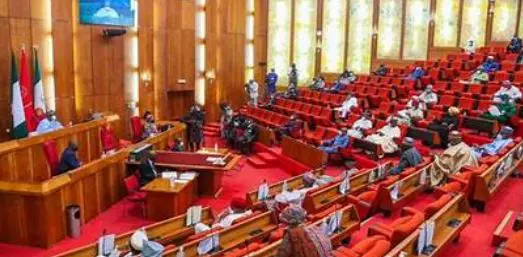
The Senate has endorsed the urgent establishment of State Police as a critical measure to address Nigeria’s worsening security challenges, citing the country’s growing population and the constitutional role of governors as Chief Security Officers of their respective states.
The upper chamber maintained that states and local governments must be empowered to exercise greater control over security architecture within their jurisdictions to effectively respond to local threats.
As part of its resolutions, the Senate recommended that states, with the support of the Federal Government, should establish local security liaison committees in every ward to serve as the primary link between communities and security agencies. The committees are also expected to oversee first-response operations at the grassroots level.
According to the Senate, such committees should comprise community members, traditional rulers, occupational groups, religious leaders, as well as women and youth representatives, to enhance intelligence gathering and build trust between security personnel and local communities.
The lawmakers also resolved that rebuilding affected communities, resettling displaced citizens and ensuring adequate compensation by all tiers of government would help ease tensions, restore normalcy and promote sustainable peace across the country.
On illegal mining activities, the Senate directed all unlicensed mining companies operating nationwide to cease operations immediately and register with the Federal Government. It further called for the development of a comprehensive national policy to regulate mineral extraction, noting that unregulated mining—often involving foreign nationals in collaboration with some Nigerians—has become a major driver of insecurity.
The Senate also urged the National Assembly to fast-track the passage of the bill seeking to establish Forest Guards and to consider additional legislation aimed at safeguarding the lives and well-being of Nigerians, in line with Section 14(2)(b) of the 1999 Constitution (as amended).
The resolutions followed the presentation of the interim report of the Senate Ad-Hoc Committee on the National Security Summit, which reviewed submissions from zonal public hearings across the country. The report was presented by the Senate Leader, Senator Opeyemi Bamidele (APC, Ekiti Central).
In his presentation, Bamidele said: “The Senate receives and considers the interim report of the Ad-Hoc Committee on National Security Summit on the 2025 National Security Summit.”
On religious engagement, the Senate stressed the need for religious leaders to promote peace, tolerance and the sanctity of human life in their teachings. It warned that government must ensure that religious leaders who incite hatred, division or violence are held accountable and made to face the full weight of the law.
To further combat insecurity, the Senate recommended that the Federal Government strengthen existing legal and policy frameworks, including a review of outdated border laws and the implementation of policies that promote effective integration between national and local security structures.
The committee presented a total of 32 recommendations, all of which were adopted by the Senate. Among them, the Senate called on the Federal Government to deepen inter-agency collaboration by strengthening synergy among the military, police, Nigerian Immigration Service, Nigeria Customs Service, Department of State Services, Nigeria Security and Civil Defence Corps, intelligence agencies, vigilante groups, as well as traditional and religious institutions.
The Senate noted that this could be achieved through the establishment of joint operations centres to ensure coordinated responses, improved intelligence sharing, early warning systems and effective communication channels.
It further urged all security agencies to intensify intelligence-driven operations by leveraging digital tools and data-driven analysis, stressing that this approach represents the future of security management in the 21st century. Lawmakers also cautioned Nigerians against profiling individuals or groups along ethnic, regional or religious lines.