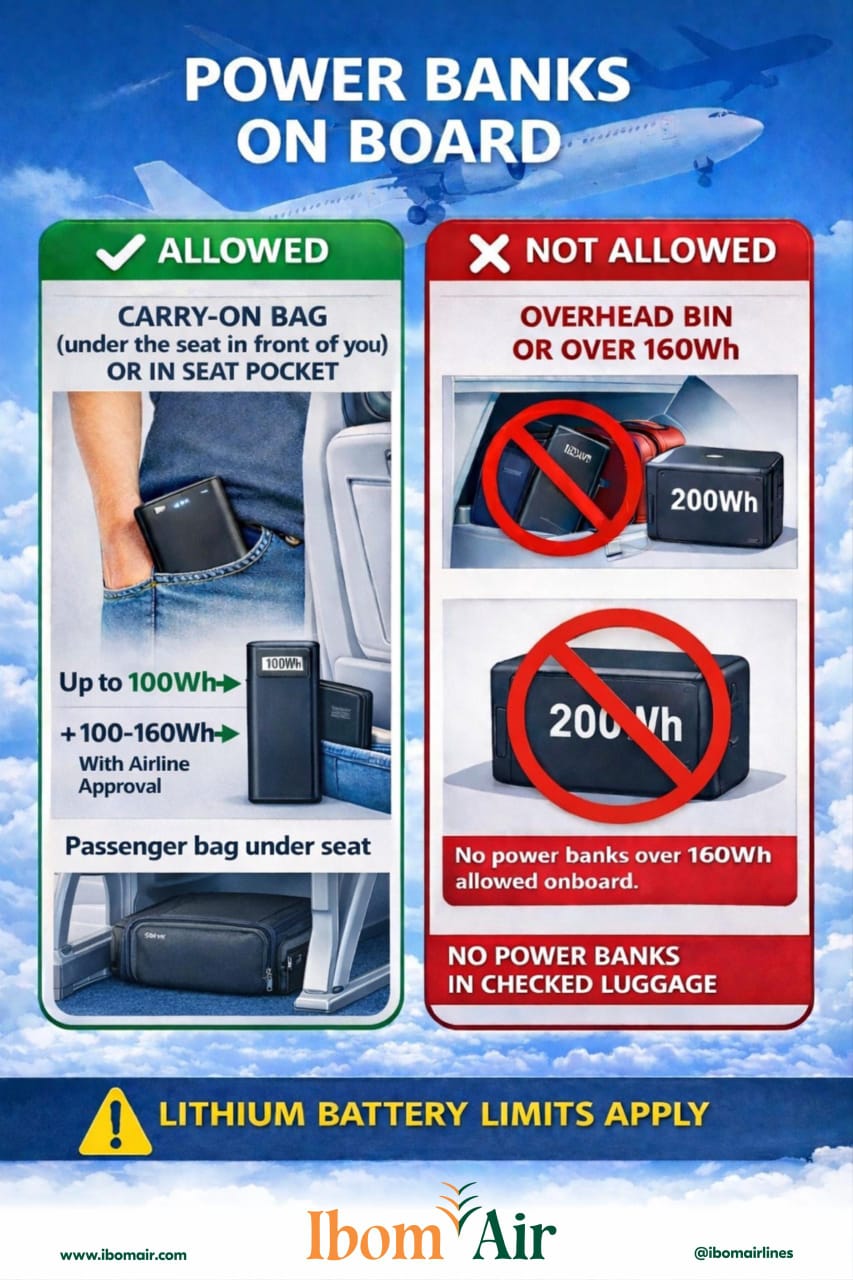
Ibom Air has cautioned passengers against placing power banks in overhead luggage bins during flights.
The airline reiterated that the prohibition of power banks in checked baggage remains in effect, in line with its long-standing policy on lithium battery-powered devices, including laptops and other electronic gadgets.
In a statement signed by the Manager, Marketing and Communications, and made available to journalists on Tuesday, the airline clarified that power banks may only be carried in the cabin. They must be stored under the seat in front of the passenger, in the seat pocket, or inside a carry-on bag that remains easily accessible at all times.
According to the statement, the updated protocol complies with a safety directive issued by the Nigerian Civil Aviation Authority (NCAA) regarding the carriage and use of power banks on commercial flights.
Part of the statement read:
“The NCAA directive, issued in line with global aviation safety standards, introduces a critical new restriction: passengers are prohibited from placing power banks in overhead bins. All power banks must be carried in cabin luggage and stored either in the seat pocket in front of the passenger, under the seat, or in a carry-on bag kept within easy reach throughout the flight.
This measure ensures that in the event of overheating or fire, cabin crew can respond immediately.”
Under the new regulations, power banks with a capacity of up to 100 watt-hours (Wh) are permitted without restriction. However, devices ranging from 100Wh to 160Wh require prior approval from the airline before travel, while those exceeding 160Wh are strictly prohibited onboard.
Passengers are advised to check the watt-hour rating of their power banks before travel, as this information is typically printed on the device.
The airline noted that the directive follows a series of global incidents involving lithium battery fires, which have highlighted the potential dangers of such devices in the aviation environment.
“Lithium-ion batteries, when overheated or damaged, can enter a state known as thermal runaway, causing fires that are extremely difficult to control particularly at cruising altitude, where emergency response options are limited. Storing these devices in overhead bins delays detection and access, increasing the risk of fire spreading before cabin crew can intervene. These incidents reinforce the critical need for strict adherence to safety protocols governing lithium battery devices,” the statement added.