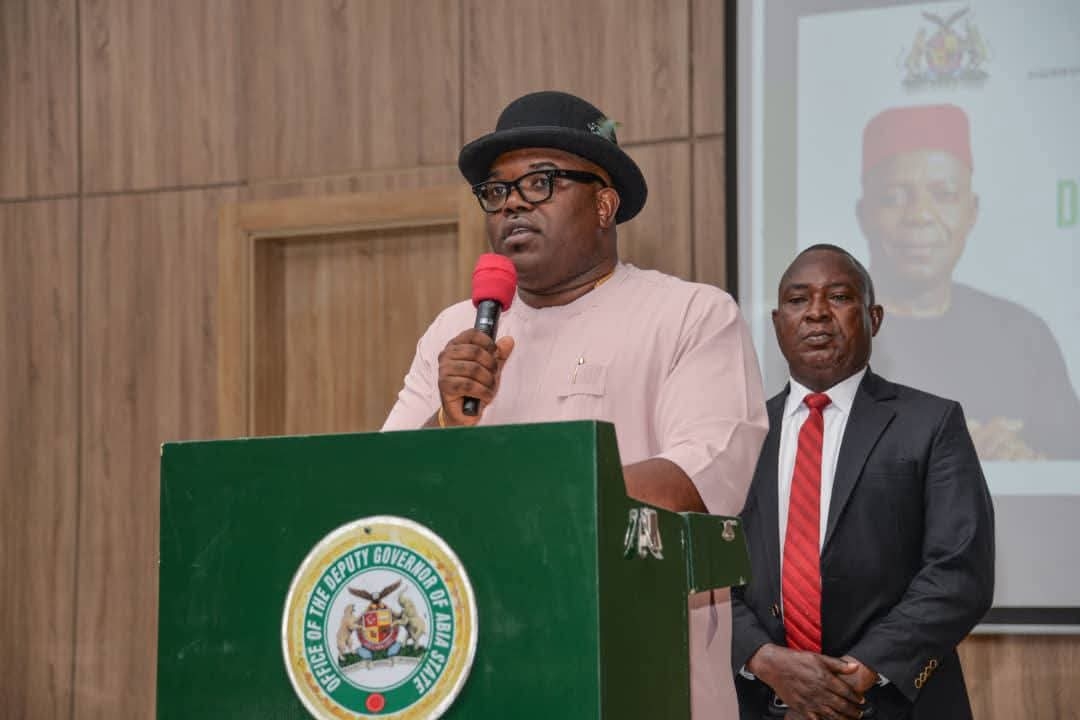
Abia State Governor, Dr. Alex Otti, has unveiled a comprehensive data reform agenda aimed at eliminating revenue leakages, harmonizing government records, and strengthening service delivery across Abia State.
Speaking at the official opening of the Abia State Data and Identity for Governance Workshop held at the Okpara Auditorium in Umuahia, the governor described the initiative as a transformative step toward building a transparent, accountable, and evidence-driven administration.
Represented by his deputy, Engr. Ikechukwu Emetu, Otti emphasized that accurate and harmonized data systems are central to effective governance.
“The theme is not just a slogan; it is a transformational blueprint,” the governor stated.
“It seeks to integrate and harmonize data systems across Ministries, Departments, and Agencies, eliminate duplication, enhance transparency, and ensure that government decisions are measurable, accountable, and impactful.”
The workshop forms part of the state’s “One Data, One Identity, One Government” initiative, designed to create a unified data architecture for public institutions.
According to Otti, the reform will enable the state to track performance more efficiently, allocate resources strategically, boost internally generated revenue, and strengthen social protection systems.
He noted that without reliable data, governance becomes guesswork and service delivery fragmented, stressing that the future of governance lies in digital innovation and analytics.
“The future of governance is digital, the future of planning is analytical, and the future of accountability is data-based. Abia State is ready to lead in this direction,” he declared.
The governor commended the Ministry of Budget and Planning, the Office of the Chief Information Officer, the Office of the Chief Economic Adviser, development partners, and relevant federal agencies for their collaboration in driving the initiative.
Earlier in his remarks, the Secretary to the State Government, Dr. Emmanuel Mmeribole, warned that disconnected data systems often result in conflicting planning baselines, revenue leakages, and slow executive decision-making.
He explained that the reform would institutionalize a unified data governance structure, identity-led integration, privacy compliance mechanisms, executive dashboards, and a revitalized Bureau of Statistics.
Also speaking, the Commissioner for Budget and Planning, Kingsley Anosike, described the existing fragmented system as “flying in a storm without radar,” stressing the need for a single source of truth to eliminate duplication, reduce operational costs, enhance credibility, and boost investor confidence.
He noted that many citizens currently exist under multiple identities across various agencies, undermining efficient service delivery.
Delivering a technical presentation, Chief Information Officer Sir Gerald Ilukwe underscored the importance of structured data in governance and investment attraction. He advocated for a “single view of government,” where citizens provide their information once and agencies access it securely when required. He described digital identity as fundamental to inclusion, transparency, and efficient public service delivery.
Contributions from sectoral leaders, including the Commissioner for Agriculture, Dr. Cliff Agbaeze, and the Commissioner for Poverty Alleviation and Social Protection, Mrs. Blessing Ngozi Felix, reinforced the consensus that digital transformation and identity integration would enhance investment opportunities, improve communication between government and citizens, strengthen social protection targeting, and boost service delivery across sectors.
The workshop brought together stakeholders from key sectors, including agriculture, health, education, lands, revenue, and social protection, focusing on building a secure, interoperable, and scalable data ecosystem to support the state’s long-term development strategy.
With the reform agenda now underway, the Otti administration signals a decisive shift toward digital governance, positioning Abia as a model for data-driven public sector transformation in Nigeria.