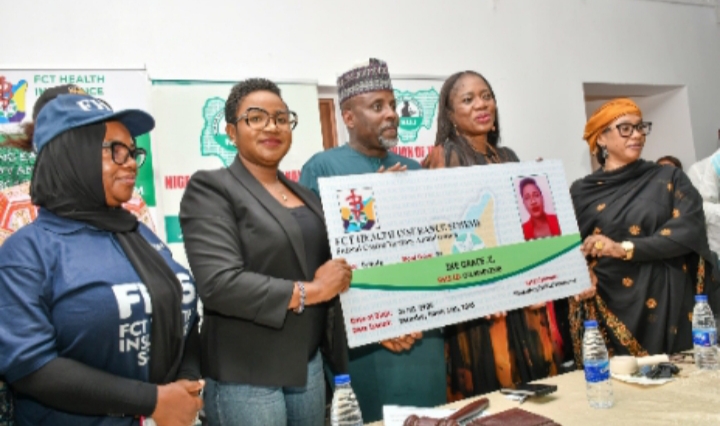
No fewer than 200 journalists in Nigeria’s Federal Capital Territory (FCT), Abuja, have been enrolled in the Federal Capital Territory Health Insurance Scheme (FHIS) in a move aimed at improving healthcare access and welfare for media professionals.
The initiative was unveiled during the Nigeria Union of Journalists (NUJ) FCT Council Congress in Abuja, where stakeholders described the programme as a significant step toward protecting journalists who play a crucial role in informing the public.
Speaking at the event, the Mandate Secretary of the FCT Health Services and Environment Secretariat, Dr. Adedolapo Fasawe, called on philanthropists, political leaders, religious organisations and business executives to sponsor health insurance coverage for journalists.
According to her, access to healthcare should not be treated as a privilege but a fundamental necessity.
“Basic healthcare is not a luxury; it is a necessity. Health must be achievable, affordable and accessible to everyone,” she said.
The scheme was championed by the Chairman of the NUJ FCT Council, Grace Ike, as part of efforts to fulfil her administration’s commitment to prioritising the welfare of journalists in the territory.
Describing the initiative as historic, Ike said it marked the first time the NUJ FCT Council had introduced a dedicated health insurance scheme for its members.
“Journalists are often at the forefront of national discourse, amplifying the voices of citizens and drawing attention to critical issues. Yet, their welfare is frequently overlooked,” she said.
She expressed appreciation to the Chairman of the House of Representatives Committee on Information, Akin Rotimi Jr., for supporting the programme and helping to initiate the scheme.
Ike also commended Fasawe for providing 150 free health insurance slots for journalists, describing the gesture as a strong demonstration of commitment to improving healthcare access for media practitioners.
She further acknowledged the contribution of the Permanent Secretary of the FCT Health Services and Environment Secretariat, Babagana Adam, who pledged to sponsor an additional 50 journalists in memory of his late brother.
Their combined support enabled about 200 journalists in the FCT to benefit from the health insurance coverage, significantly reducing the financial burden of medical care.
Fasawe also announced an additional 50 health insurance slots for journalists, noting that the initiative has already covered about 480 out of the estimated 800 journalists in the FCT.
She said the scheme aligns with the commitment of the FCT Administration under the Minister of the Federal Capital Territory, Nyesom Wike, to strengthen healthcare delivery, particularly in reducing maternal and child mortality.
“In the FCT, the minister has declared zero tolerance for maternal mortality. No woman should lose her life during childbirth, and no child should suffer harm at delivery,” she stated.
She added that pregnant women, especially those who are vulnerable, can access free antenatal care and delivery services, including caesarean sections, at primary healthcare centres across the territory.
Also speaking, the National President of the NUJ, Alhassan Yahya, described the programme as a critical intervention for journalists’ welfare.
He noted that studies indicate less than one per cent of Nigerian journalists currently have health insurance, stressing that the initiative would help bridge the gap.
“Insurance is critical to our job. Through insurance we can reduce healthcare costs, address maternal deaths and move closer to universal health coverage,” Yahya said.
The congress, which attracted over 450 NUJ members, was also attended by the Director of the FCT Health Insurance Scheme, Salamatu Belgore, alongside other stakeholders.
Observers say the initiative marks a significant step toward strengthening journalists’ welfare and advancing universal health coverage in the Federal Capital Territory.