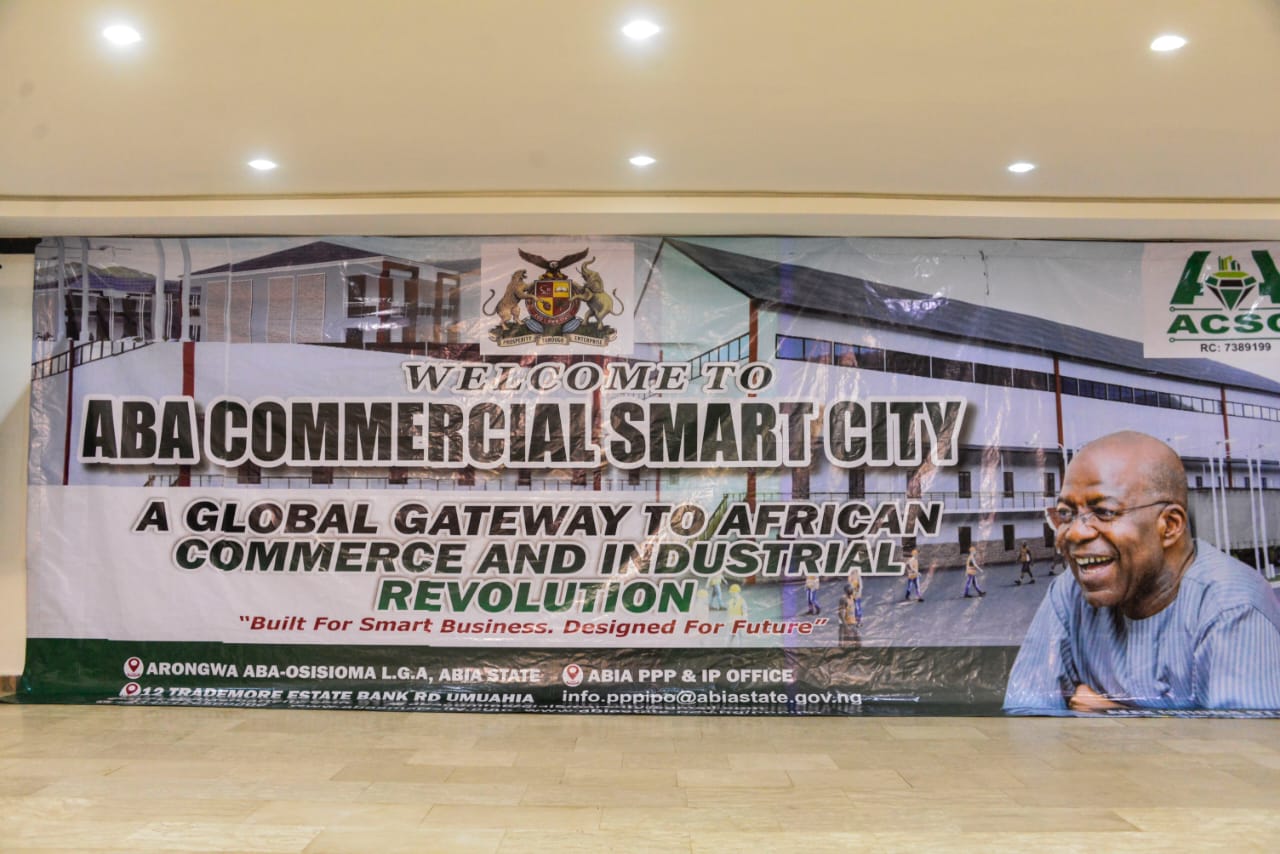
Abia State Governor, Dr Alex Otti, has said that the proposed Aba Commercial Smart City (ACSC), a strategically located Public Private Partnership investment hub sited on 140 hectares of land at Osisioma, will upon completion, launch Aba into a full-fledged industrial centre for sustainable economic development and job creation.
Governor Otti stated this during the signing of a Memorandum of Understanding (MoU) between the Aba Commercial Smart City and United Market Leaders/Traders, held at the Banquet Hall, Government House, Umuahia.
Pastor Caleb Ajagba
The Governor, represented by his Chief of Staff, Pastor Caleb Ajagba, noted that the project, when realised, would practically transform Abia State by modernising trade, commerce, manufacturing and logistics.
Governor Otti said the initiative aligns with the vision of his administration to create prosperity for the people of Abia State.
He assured investors and partners of a conducive business environment, stressing that the necessary infrastructure and support systems have been put in place to ensure the smooth take-off and successful implementation of the project.
In his address, the Group Managing Director of Aba Commercial Smart City, Professor Chinedu Nebo, represented by the President of ACSC, Ambassador Osita Offor, described the project as the first of its kind in Sub-Saharan Africa and a bold step towards positioning Abia as a global gateway to Africa’s commerce and industrial revolution.
He said the Aba Commercial Smart City symbolises prosperity through enterprise and is designed to restore Aba’s pride as Africa’s commercial heartbeat, while connecting it seamlessly to global trade corridors.
“With its integrated power systems, high-speed digital backbone and specialised districts, ACSC stands as a beacon of modernity and resilience, ushering in a new era of opportunity for our people.
“It promises to jobs, skills and urban renewal, while positioning Abia as a hub of excellence in manufacturing, healthcare, hospitality and technology”, the GMD stated.
Delivering a technical presentation, the Manager of Technical Services, Aba Commercial Smart City, Mr David Okoro, explained that the project is built on four core pillars of innovation, including automated manufacturing, medical services, commerce, hospitality and smart housing, logistics efficiency and smart energy.
Mr Okoro described the Smart City as a resilient urban centre where businesses thrive on intelligence and connectivity.
He disclosed that the integration of an e-commerce platform with bonded terminals would end the challenges faced by importers by enabling cross-border transactions from home, with goods delivered directly to their doorsteps.
According to him, the economic benefits of the project are enormous, as it is expected to boost the State’s Internally Generated Revenue (IGR) and create 25,000 direct jobs and 100,000 indirect jobs across construction, ICT, manufacturing and retail sectors.
“The Aba Commercial Smart City will provide a permanent relocation solution with technology driven facilities designed for ease of business, healthy living and long life span”, he stated.
In his remarks, the Group Vice Chairman of the project and former Inspector-General of Police, Dr Mike Okiro, said Governor Otti, through the initiative, is restoring the lost glory of Aba as Nigeria’s commercial and industrial hub.
He added that investors are already committing funds towards the timely realisation of the project for the benefit of Abians and Nigerians at large.
The President of Leather Products Manufacturers Association of Abia, Mr Confidence Nwaobilor, said that the project aligns with the association’s desire to have an efficient industrial cluster to boost leather products manufacturing.
Nwaobilor said that project promises to provide an industrial cluster of international standard which includes a Common Facility Center that would house an equipment that would be used to provide 48,000 pairs of shoes daily.