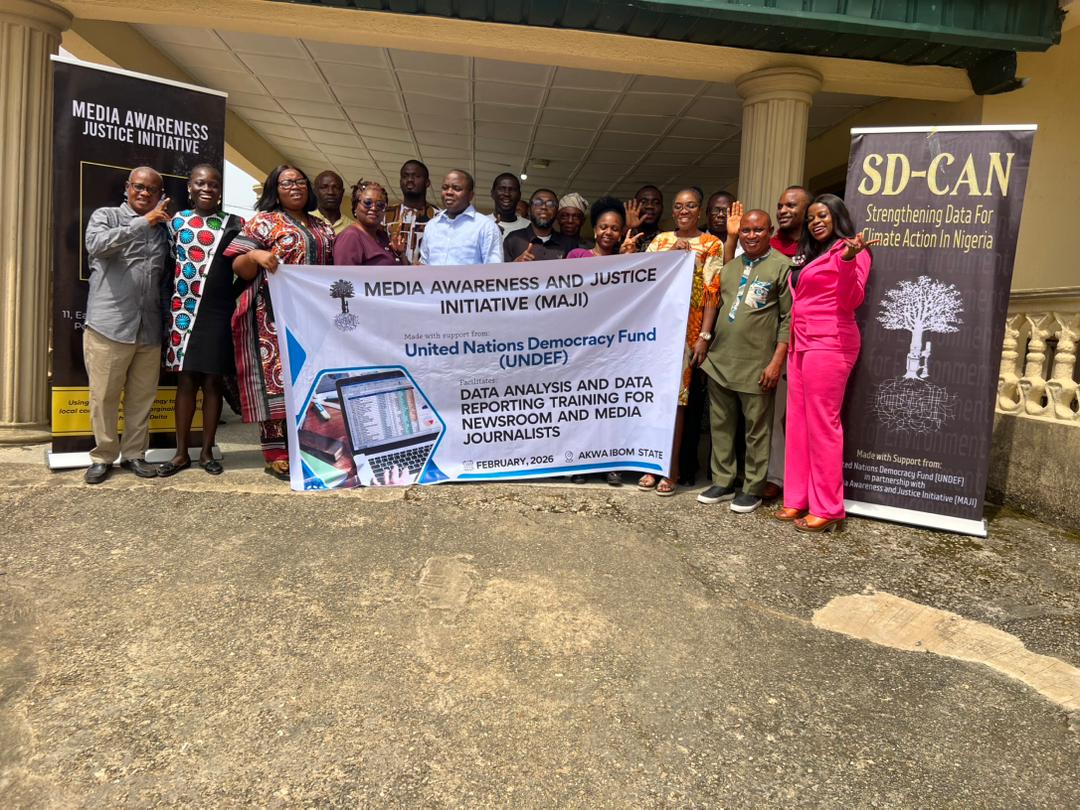
The Media Awareness and Justice Initiative (MAJI) has trained selected journalists in Akwa Ibom State on how to collect and use environmental data for evidence-based reporting.
The training, themed “Environmental Data Collection for Evidence-Based Journalism,” was held at the Nigeria Union of Journalists (NUJ) Press Centre. It was organised by MAJI with support from the United Nations Democracy Fund (UNDEF).
Speaking at the event, MAJI’s Environment and Conservation Officer, Ikechukwu Ahaka, described limited access to credible environmental data as a major challenge affecting effective journalism and public accountability.
He noted that the classification of simple environmental documents and bureaucratic processes in some government agencies have made it difficult for journalists to gather needed information. He advised journalists to partner with research-based institutions and organisations to produce strong environmental reports that can hold the government accountable.
Ahaka also pointed out the growing gap between scientific environmental data and public understanding. According to him, this gap has weakened citizens’ engagement and slowed policy responses to environmental challenges across the Niger Delta region.
He explained that the aim of the training was to equip journalists with the necessary skills to gather and analyse environmental data, raise public awareness, build environmental consciousness, and contribute to better government policies and regulations.
“Environmental stories should be driven by clear and reliable data that will encourage constructive citizens’ participation,” he said. “Journalists face many challenges in accessing reliable data due to government restrictions. To address this, they should collaborate with research institutions and make use of open-source data platforms.”
Participants were introduced to practical tools for data collection, including sensor-based monitoring, field sampling, low-cost IoT devices, satellite imagery, and mobile data applications.
In his presentation on “Effective Advocacy Using Environmental Data,” Prince Eze stressed that advocacy must be based on credible and verifiable data. He added that weak data systems often lead to poor policy decisions and encouraged journalists to adopt a more strategic and evidence-based approach when engaging stakeholders and shaping public discussions.
The training concluded with a hands-on session on data analysis, where participants learned practical skills in data cleaning, organisation, visualisation, and interpretation to improve environmental storytelling.