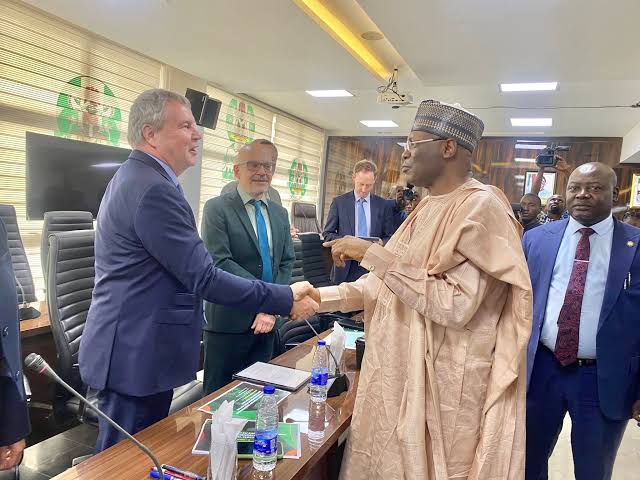
The Chairman of the Independent National Electoral Commission (INEC), Prof. Joash O. Amupitan, SAN, has reaffirmed the Commission’s commitment to conducting credible and inclusive elections as preparations begin for the 2027 general polls.
Amupitan gave the assurance on Thursday in Abuja while receiving the United Nations Resident and Humanitarian Coordinator in Nigeria, Mohamed Fall, and other senior UN officials at the Commission’s headquarters.
The visit followed the conduct of the Federal Capital Territory (FCT) Area Council elections and recent bye-elections in Kano and Rivers states, and focused on deepening collaboration to strengthen Nigeria’s democratic process.
Congratulating the INEC Chairman on his appointment, Fall commended the Commission for the peaceful conduct of the FCT polls.
“On behalf of the United Nations in Nigeria, we congratulate you for taking on this critical responsibility,” he said. “Nigeria’s democracy, given its demographic size and complexity, comes with enormous challenges. We assure you of our prayers and full support.”
Fall emphasised that the UN’s support extends beyond election-day operations to broader issues of inclusivity and ensuring that no segment of society is left behind.
Also speaking, the Resident Representative of the United Nations Development Programme (UNDP), Elsie Attafuah, highlighted the longstanding partnership between INEC and the UNDP in areas including technology, innovation, youth engagement, voter education and institutional strengthening.
She noted that the delegation sought to better understand INEC’s priority needs ahead of 2027, adding that there was room to consider a dedicated election support project outside existing frameworks.
“If Nigeria succeeds, Africa advances,” Attafuah said.
In his response, Amupitan described the elections held on February 21, 2026, including bye-elections in Kano and Rivers states, as generally peaceful. He reiterated that INEC’s constitutional mandate covers elections into the offices of President, Vice President, Governors and Deputy Governors, as well as members of the National and State Assemblies.
“We have been in the business of conducting elections for Nigeria, and we value our partnership with UNDP in several critical areas,” he stated.
However, the INEC Chairman identified key challenges facing Election Management Bodies across Africa, including declining public trust, voter apathy, insecurity, and the growing threat of misinformation and disinformation.
“Disinformation is the most dangerous. It is when someone knowingly spreads falsehood to undermine constitutional institutions,” he warned.
Amupitan reaffirmed INEC’s commitment to gender equality and inclusivity, disclosing that the Commission operates a dedicated Gender and Inclusivity Department. He cited measures introduced to support persons with disabilities, including Braille ballot guides for visually impaired voters and assistive devices for persons with albinism, in line with the Electoral Act and anti-discrimination laws.
On transparency, he said the Commission is strengthening safeguards in its result management systems to eliminate discrepancies and enhance public confidence. He also disclosed that INEC is updating the voters’ register, including the removal of deceased persons, to ensure accuracy and integrity.
“We cannot afford to fail our people. Our aspiration is that every election we conduct will be better than the last,” Amupitan said.
He added that INEC is improving its data management systems to become the primary and most credible source of electoral data in Nigeria, stressing that credible elections remain central to deepening democracy and advancing development, not only for Nigeria but for Africa as a whole.