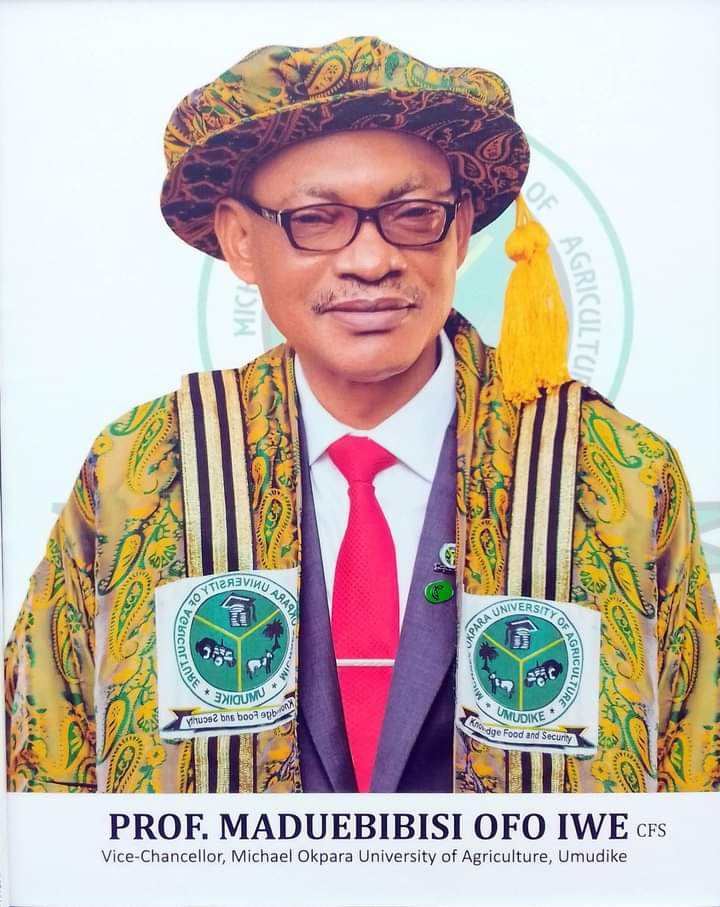
The Vice Chancellor of Michael Okpara University of Agriculture, Umudike (MOUAU), Prof. Maduebibisi Ofo Iwe, who assumed office as the institution’s 6th Vice Chancellor in 2021, speaks with National Ambassador Newspaper as his tenure comes to an end in February 2026. In this interview, with Okereke Kate, he reflects on his five years in office, major achievements, challenges, and recent allegations of financial impropriety against the university’s management.
Excerpt:
Q: An online report alleged that MOUAU plans to spend N252 million on three vehicles for the Pro-Chancellor and two other principal officers in 2026. Is this true, and why would such spending occur as your tenure ends?
A: First, let me welcome you and appreciate your continued interest in the affairs of this university. I also thank you for the positive feedback you have consistently given regarding how we have managed the university over the past five years. I had just returned from Abuja, but I felt it was important to meet with you because I hold the media in high esteem.
Let me state clearly that the allegation is incorrect. The N252 million figure being circulated has nothing to do with the 2026 budget. In fact, the 2026 budget has not even been released. What people are referring to is part of the 2025 appropriation, which was prepared in 2024 based on prevailing market prices at the time.
Public expenditure does not happen overnight, and it is certainly not the decision of one individual. Government first issues an expenditure envelope to the university. From that envelope, we align our needs and prepare a proposal, which is then subjected to several levels of scrutiny. The proposal is defended before the relevant joint committee of the Ministry of Agriculture, after which approvals are granted.
Beyond that, procurement goes through internal processes within the university, including the University Planning Committee (UPPC), which determines realistic costing, including insurance and associated expenses. Contractors submit quotations, which are evaluated before being forwarded to the university’s Tender Board. If the amount exceeds what the university is authorized to approve, it is referred to the Ministerial Tenders Board of the Ministry of Agriculture.
So, this is not a situation where a Vice Chancellor wakes up and decides to spend N252 million. There are checks and balances at every stage, involving multiple institutions and regulatory bodies. Any publication suggesting otherwise clearly misunderstands or deliberately misrepresents the public procurement process. To me, it appears to be an attempt to smear the administration.
Q: Another report alleged that the university illegally spent ₦5 billion and failed to remit ₦578 million to the federal government from its Internally Generated Revenue (IGR). How accurate are these claims?
A; These claims are misleading. Although some argue that such matters should strictly be handled by Council, I feel compelled to clarify the issues, especially since they have generated public interest.
I am a researcher and a scientist, and I usually focus on issues grounded in facts and evidence. However, let me address the IGR allegation. My administration began in 2021, when the world was still recovering from the COVID-19 pandemic. Economic activities were extremely limited, and it is unrealistic to claim that the university generated such a large amount of IGR during that period.
In 2022, the situation was further worsened by the eight-month ASUU strike, during which Nigerian universities were largely shut down. There was no farming, no animal production, no commercial activity, and no academic services running at full capacity. The little IGR that existed came from minor activities such as POS services, photocopying, and small-scale businesses.
Furthermore, charges paid by students in Nigerian universities are service-based, not tuition fees. Undergraduate students do not pay tuition. These charges cover specific services such as identity cards, utilities, and facilities. Treating such charges as IGR and demanding remittance to government undermines the long-standing argument that universities are underfunded.
Given the realities of 2021 and 2022, it is impossible for this university to have generated N578 million in IGR during that period. What seems to have happened is that bits of unrelated information were pulled together, stitched into a narrative, and presented in a way intended to incite public sentiment against the university. That is unfortunate and unfair.
Q: Why do you think there are attempts to incite the public against the university?
A: Honestly, I do not know. What I can say is that over the past five years, we have remained committed to repositioning this university. We deliberately worked to improve student conduct, staff relationships, and interpersonal harmony. At some point before our tenure, these values were almost nonexistent.
We opened the university to the outside world, attracted goodwill, and strengthened collaborations. This year alone, we successfully facilitated a fully funded scholarship to China for one of our students, which reflects the kind of global engagement we desire.
Our academic staff have published in high-impact journals and secured major research grants because we deliberately created the right environment. One of our landmark achievements is the completion of the Energizing Education Project (EEP2), which provided a solar power system and now guarantees 24-hour electricity on campus, something unimaginable three years ago.
Q: Do you pay to power the campus?
A: Yes, we do. We supplement solar power with gas, especially during the rainy season and harmattan when sunlight is limited. We also continue to pay EEDC. In the future, users may contribute to the cost, but that is not yet the case.
Q: Did you pay your predecessor a ₦44 million severance allowance?
A: I never did. I never met my predecessor on seat for me to pay him.Those payments were made before I assumed office. It’s strictly an act of Council. I met no outstanding severance obligations. This is another example of unrelated issues being pulled together to mislead the public.
Q: You’re a human being, the possibility of stepping on toes are there. Will you remember how many times you stepped on toes?
A: I do not believe so. I governed strictly within the law and prioritized reconciliation over confrontation. We inherited over 100 litigations, many involving professors. Through dialogue and goodwill, all were resolved peacefully.
Promotions that had stalled for years were regularized, disputes were settled, and peace was restored. Today, the campus enjoys stability and calm, something visitors frequently commend.
Q: There may be few things you did in your administration, if given another opportunity, would you do them differently?
A: I have not taken any unilateral decisions in this my regime. Every action followed due process and the university’s regulations. I consistently sought advice from principal officers—the Registrar, Bursar, Librarian, Internal Auditor, and Deputy Vice Chancellors, before taking decisions.
Q: We’re aware of the VC selection process, do you have a successor now?
A: No. The process is ongoing and remains entirely a Council matter. We were given six months, from September to March to conclude the process, we are still within the stipulated timeframe.
Q: How were the inherited court cases you mentioned resolved?
A: Through sincere dialogue. Our body language showed that we desired peace, and gradually, parties withdrew their cases. Council agreed on fair resolutions, which we implemented faithfully.
Q: What would you consider your greatest achievements and worst moments?
A: Not everyone immediately aligned with the reforms we introduced, but the majority eventually understood our direction and supported the vision. Our most challenging moment was February 6, 2024, when efforts to streamline university administration were misunderstood and students were mobilized against the management. Our goal was simply to create a system that would run more efficiently.
Despite this setback, we remained focused on positive thinking, productive action, and progressive programmes. We established new academic departments, strengthened between eight and ten non-academic directorates, and expanded infrastructure, including the development of the Olori campus, which we believe will significantly improve within the next few years.
Operating with limited capital funding, mostly between ₦200–₦300 million annually, we still achieved meaningful progress. Key among our accomplishments was the digitization of student records through biometric registration, which now allows instant access to student data and seamless processing of interventions such as NELFUND payments.
Among other achievements, we automated bursary, library, senate, and transcript processes, eliminating delays, improving transparency, and restoring order to the system. These reforms have strengthened administration and positioned the university for a more efficient and sustainable future.
A: I will proceed on my one-year sabbatical leave and take time to rest after five demanding years of service.
Q: Do you suspect anyone behind the allegations?
A: No. We simply respond transparently whenever questions arise.
Q: How many students benefited from the China scholarship?
A: One student is currently studying Food Engineering up to PhD level at Hainan University, China, on a full scholarship.
Q: Why was the 2025 Convocation put on hold?
A: It was a Council decision. Preparations were largely completed, and the ceremony can proceed once funds are released.
Q: What does the FG–ASUU agreement mean to you?
A: It is a welcome development. Having spent over 40 years as a lecturer, I hope it will end recurrent strikes. Once funds are released, implementation will follow. We commend President Bola Ahmed Tinubu and urge patience as the process unfolds.
Q: Any final words to students and staff?
A: To students, remain curious, resilient, and committed to excellence. To staff, thank you for your dedication and service. Together, continue to uphold integrity, innovation, and unity. The future of this university is bright.