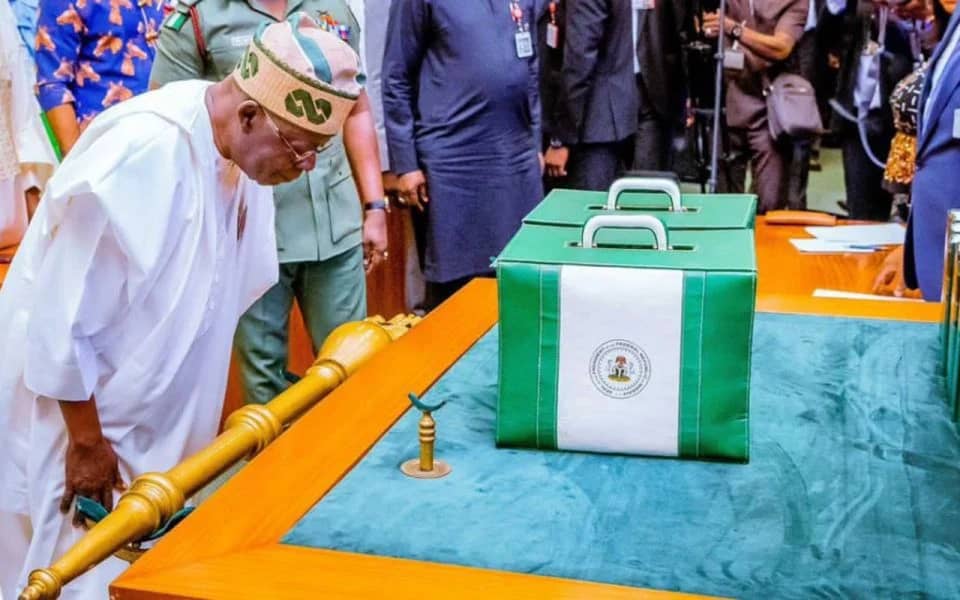
President Bola Ahmed Tinubu on Friday presented a ₦58.47 trillion 2026 Appropriation Bill to a joint session of the National Assembly, outlining a fiscal roadmap focused on consolidating economic reforms, strengthening national resilience and delivering broad-based prosperity.
Tagged “Budget of Consolidation, Renewed Resilience and Shared Prosperity,” the proposal reflects the administration’s intention to stabilise the economy, improve the investment climate, create jobs and deepen human capital development after more than two years of far-reaching reforms.
In his budget address, President Tinubu acknowledged the economic pressures Nigerians have faced since the start of the reform programme but assured citizens that the sacrifices were beginning to yield results, including moderating inflation, improving growth, rising oil output and stronger external reserves.
Key Budget Highlights
The President proposed a total expenditure of ₦58.47 trillion for 2026, with expected revenue of ₦34.33 trillion and a projected deficit of ₦23.85 trillion, representing about 4.28 per cent of GDP.
The 2026 budget is anchored on conservative economic assumptions, including a crude oil benchmark of US$64.85 per barrel, daily oil production of 1.84 million barrels, and an exchange rate of ₦1,400 to the US dollar.
Economic Outlook and Policy Direction
President Tinubu told lawmakers that Nigeria’s economy grew by 3.98 per cent in the third quarter of 2025, while inflation declined steadily to 14.45 per cent in November 2025 from over 24 per cent earlier in the year. He also disclosed that external reserves had risen to about US$47 billion, the highest level in seven years.
The President pledged stricter discipline in budget implementation in 2026, directing key economic officials to ensure that spending aligns strictly with approved allocations and timelines. He also announced expanded digitisation of government revenue collection to block leakages and enforce accountability across ministries, departments and agencies.
On security, Tinubu said the budget would support the modernisation of the armed forces, intelligence-driven policing and a revamped national counter-terrorism doctrine, declaring that all armed non-state actors operating outside the authority of the state would be treated as terrorists.
Reactions from Key Stakeholders
Reacting to the budget presentation, Senate President Godswill Akpabio described the proposal as “ambitious but necessary,” assuring that the National Assembly would give it thorough scrutiny in the interest of Nigerians. He noted that the focus on security and infrastructure aligned with current national priorities.
Speaker of the House of Representatives, Rt. Hon. Tajudeen Abbas, said the legislature would work with the executive to ensure that the budget translates into “measurable improvements in the daily lives of citizens,” stressing the importance of timely implementation.
The Minister of Finance and Coordinating Minister of the Economy, Wale Edun, said the 2026 budget was built on realism and fiscal prudence, adding that ongoing tax and oil-sector reforms would strengthen revenue performance and reduce deficit pressures over time.
From the private sector, Tony Elumelu, Chairman of Heirs Holdings, welcomed the emphasis on macroeconomic stability and infrastructure, noting that consistent policies and improved security were critical to attracting long-term investment and creating jobs.
Labour unions offered cautious reactions. Nigeria Labour Congress (NLC) President, Joe Ajaero, said while the budget showed commitment to growth and stability, the government must ensure that workers and vulnerable Nigerians feel the benefits through improved purchasing power, social protection and job creation.
Looking Ahead
President Tinubu concluded his address by calling for cooperation between the executive and the legislature, assuring Nigerians that the 2026 budget was not merely a statement of intent but a plan for delivery.
“The most important budget is not the one we announce, but the one we implement,” the President said, expressing confidence that the Renewed Hope Agenda would continue to guide Nigeria toward a more secure, competitive and inclusive future.