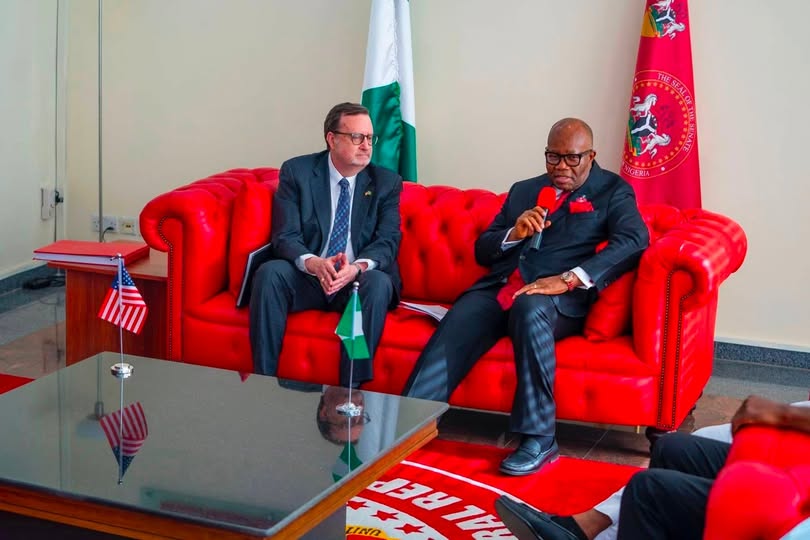
Senate President Godswill Akpabio, last ,Wednesday, received the United States Ambassador to Nigeria, Mr Richard Mills Jnr., at the National Assembly Complex, Abuja, where he called for strengthened diplomatic, democratic and developmental collaboration between Nigeria and the United States.
The meeting underscored a shared commitment by both countries to deepen bilateral relations, particularly in the areas of democracy, governance and mutual cooperation.
Akpabio noted that Nigeria and the United States share a common democratic heritage, stressing that Nigeria’s system of government was modelled after that of the United States, thereby underscoring the need to nurture and preserve democratic values in both nations.
“I thank you for receiving me during the 249th Independence Anniversary of your country. I congratulate you. That means you have practised democracy for 249 years. We cannot say we have done the same in Nigeria,” Akpabio said.
He added that the longstanding collaboration between the two countries remained significant, pointing out that the United States’ success and global influence were rooted in its strong democratic institutions and shared values.
“One thing I do know is that America has remained prosperous and has assisted many countries of the world because of the strong belief that, ‘In God we trust.’ In Nigeria, despite our religious and ethnic diversities, we also believe that God is supreme. So, we share something in common,” he stated, welcoming the envoy to the 10th Senate of the Federal Republic of Nigeria.
In his remarks, Ambassador Mills said the visit was aimed at reviewing the current state of U.S.–Nigeria relations and identifying areas for enhanced cooperation between the two countries.
He reaffirmed the commitment of the United States Mission to continued engagement with Nigeria in the pursuit of shared democratic ideals and development objectives.
According to him, the meeting also provided an opportunity to gain insight into the legislative agenda and priorities of the Nigerian Senate in the year ahead.
The visit comes amid recent diplomatic exchanges following the decision by the United States government to place Nigeria on its watch list of “Countries of Particular Concern,” over allegations of widespread persecution and killings of Christians.
Nigerian authorities have since rejected the designation, insisting that the country’s security challenges — including jihadist insurgency, banditry and communal violence — affect citizens across religious lines and should not be mischaracterised as religiously motivated persecution.
The Federal Government also dismissed suggestions of punitive measures or military intervention as unfounded and potentially destabilising, urging international partners to respect Nigeria’s sovereignty and collaborate constructively in addressing violent extremism and insecurity.